


.png?width=141&height=141&name=Transact%20(1).png)






.svg)

.svg)
.svg)
.svg)


%201.svg)

















Cisco Webex is one of the most widely used enterprise collaboration platforms, and most large organizations run at least some Cisco hardware or software alongside it. But no video platform is immune to call quality issues — so if Webex is your organization's collaboration backbone, you need the right data to troubleshoot video meeting quality, network performance, devices, and services before problems reach users.
Cisco Webex: one platform for enterprise collaboration
One suite, every channel your teams use to meet, message, and share.
In 2018, Cisco converged its Cisco Spark and Webex platforms into a single suite of collaboration services. The cloud-based UC ecosystem now covers every organization's core meeting and collaboration needs.
Webex supports collaboration from a desktop app, a mobile app, or the web version, including:
- Video conferencing
- Group messaging
- File sharing
- Whiteboarding
- Personal meeting rooms
- Guest access
The Webex platform
Calling, messaging, and meetings in a single app — not three separate tools.
Cisco's Webex suite brings calling, messaging, and meeting tools together in one platform, so IT teams manage collaboration and communications workloads from a single place.
Webex App
Webex App (previously known as Webex Teams) covers video meetings, messaging, file sharing, and whiteboarding, with a meeting room for in-office and remote teams to collaborate. It's primarily cloud-based but supports hybrid and on-premises devices and services. An open API lets developers build custom apps that extend Webex capabilities into daily workflows.
Webex Meetings
Cisco Webex Meetings enables global and virtual teams to collaborate on mobile devices and standard video systems in real time, with screen sharing, meeting recording, and customizable layouts. It integrates with Google Calendar, Outlook, Office 365, and Microsoft OneDrive, and supports large-scale events like webinars and virtual training.
Webex Calling
Webex Calling is a cloud-based phone system built for mid-sized businesses. It covers the essential business calling capabilities most teams need, without the expense and complexity of managing on-premises phone infrastructure. Webex Calling comes with standard cloud PBX functionality — call pickup, hunt groups, music on hold, call transfers, and voicemail — all controlled from the Webex Control Hub.

Webex devices
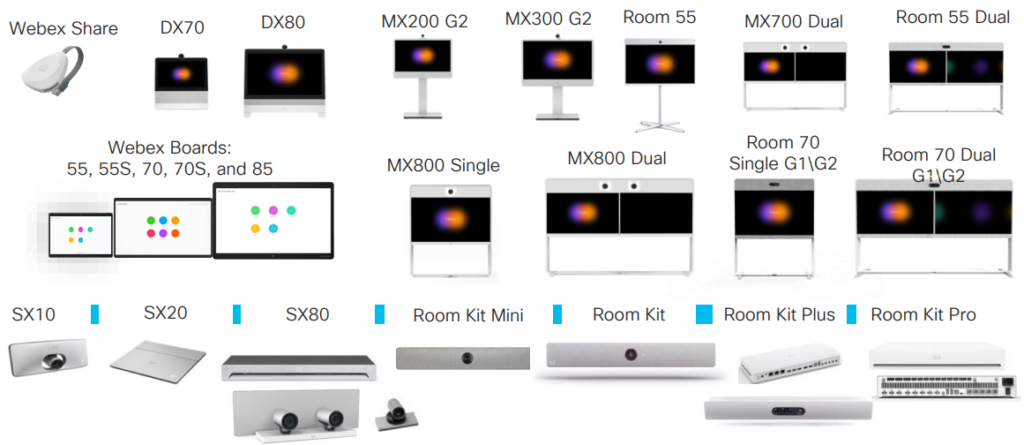
Cisco is known for its networking hardware — presentation equipment, cameras, speakers, microphones, and whiteboards — all managed from their associated virtual workspaces inside the Webex app.
The importance of Webex monitoring
Good call quality doesn't happen by accident — it's tracked, measured, and fixed before users notice.
Deploying and maintaining a quality video conferencing solution like Cisco Webex depends on monitoring system health. Gathering and analyzing performance data gives technology managers the visibility to act proactively, respond quickly, and make informed decisions about the environment.
Cisco Webex Monitoring Service
Cisco's own analytics show you what happened. They don't always show you why.
You can collect baseline data on your organization's network when using Webex services with the Cisco Webex Monitoring Service. Collected data can help you troubleshoot issues that affect user experience — for example, identifying whether a performance issue is caused by a network problem. This data is available from the Analytics tab in the Webex Control Hub.
Cisco Webex Control Hub lets IT administrators centrally view and manage calling, messaging, meetings, contact center, and team collaboration services and devices, along with analytics across all Webex services. It also allows configuration of security and compliance policies to keep data protected.
From the Webex Control Hub, you can also use the Webex Monitoring Service to monitor on-premises video devices for media quality metrics whenever they're used to join a Webex meeting.
Webex monitoring with third-party tools
Webex is rarely the only platform in your UC stack — your monitoring shouldn't be either.
Cisco's Webex Monitoring Service works well for Webex-only environments, but most enterprises run Webex alongside other UC platforms, devices, and vendors — and that's where third-party monitoring becomes essential.
Video conferencing ecosystems today span room systems, remote workers, and mobile devices across thousands of locations and multiple time zones. Performance data needs to be available immediately, so a single bad meeting can be diagnosed and resolved fast. Third-party monitoring gives you visibility and control across Cisco's on-premises and cloud platforms, plus every other video endpoint and vendor technology in your environment. Here's what third-party monitoring adds beyond Webex's own monitoring:
Live meeting and participant monitoring
Third-party tools reveal detailed quality-of-experience metrics for every meeting and individual participant, in real time.
Proactive performance management
Third-party tools provide real-time alerts, customizable dashboards, and ITSM integration to catch performance issues before users report them. They also extend UC visibility to remote work, with quality metrics on latency, jitter, and packet loss for every active meeting participant.
Historical quality analytics
Historical data helps identify and resolve issues affecting specific locations, departments, or groups of users over time.
Remote participant details
Monitoring wired and Wi-Fi connections, software clients, headsets, and peripherals helps diagnose the experience for remote users specifically.
Custom reporting
Third-party tools let you integrate geographic, departmental, or other custom data to get organization-wide usage insights.
Whether your network is small or spans thousands of users, across mostly Cisco devices or a mix of vendors and platforms, having monitoring tools in place is what lets you assess performance and gather the data that keeps your network running well.
That visibility gives your IT team full control not just over Cisco devices and network traffic, but over your organization's overall network health.
Hybrid and remote work mean network requirements keep shifting. Bandwidth usage keeps climbing, devices are no longer standard-issue, and endpoints — laptops, mobile phones, headsets — are spread across a wider, less predictable network. Availability and performance issues show up in places they didn't before.
A third-party network performance monitor that covers all of these variables gives your UCC network visibility a single-vendor tool can't.
Learn more about managing and optimizing your Cisco unified communications environment