




















A Wi-Fi strength test measures the connection quality between a device and a router or access point — usually expressed as RSSI in dBm or as a signal-bar percentage. It's a different measurement from an internet speed test, which checks how fast data actually moves once that connection is made. For hybrid and remote teams, a slow or dropped call can be caused by either one — so diagnosing it properly means checking both.
Key takeaways
- Signal strength and internet speed measure different things — and both need checking to properly diagnose a connection problem.
- RSSI is the reference metric for Wi-Fi signal quality; anything weaker than around -70 dBm typically causes noticeable disruption on calls.
- 100 Mbps down / 20 Mbps up is the FCC's current baseline for a connection to count as broadband — not "fast," just usable.
- Bandwidth competition, router placement, interference and network congestion are the most common causes of a weak signal.
- IT teams supporting remote employees need visibility into home network performance, not just the signal bars on a laptop.
What a Wi-Fi strength test actually measures
Signal strength tells you how well a device can hear the network — not how fast that network can move data.
Hybrid work put home Wi-Fi performance on the same footing as office network performance. If a team member's home connection is unreliable, meetings drop, screen shares freeze, and file transfers stall — all of which shows up as lost productivity, not just a personal inconvenience.
Internet connections have gotten faster almost everywhere, but availability is uneven. Many regions still can't support multiple connected devices and high-bandwidth applications running at once, which is why signal and speed both need to be part of any remote-work troubleshooting process.
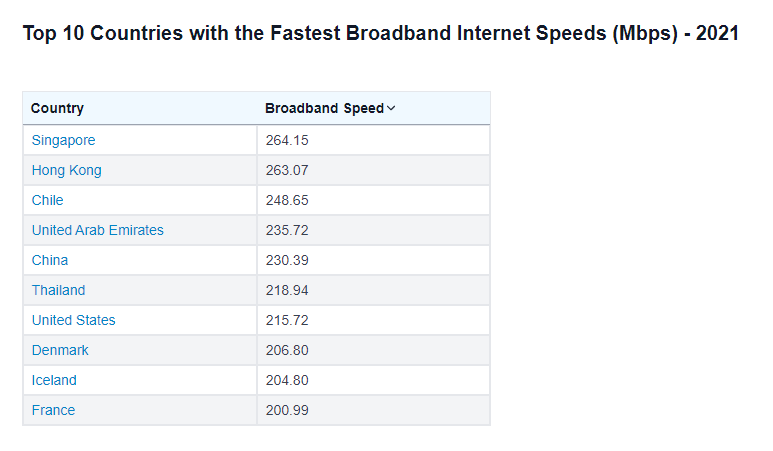
Image source: World Population Review
This is where a digital experience management solution earns its place — it can pinpoint exactly where a connection is underperforming, and why, rather than leaving IT to guess between a device issue, a home network issue, and an application issue.
Wi-Fi signal strength vs. internet speed
One is about connection quality. The other is about how much data that connection can carry.
Signal strength is a measure of how strong the wireless link is between a device and its access point. Internet speed measures throughput — how fast data uploads and downloads once that link is established. A device can show full signal bars and still run a slow connection, because the two are answering different questions.
| Signal strength | Internet speed |
|---|---|
| Answers: can my device hear the network reliably? | Answers: how fast can data move once I'm connected? |
| Measured as RSSI (dBm) or signal-bar percentage | Measured as Mbps, split into upload and download |
| Degrades from distance, walls, and interference | Degrades from bandwidth competition and network congestion |
A full signal indicator only confirms the device found the network — it says nothing about how fast that network can move data, in the same way a full fuel gauge says nothing about an engine's horsepower.
Weak signal strength on its own can cause packet loss, latency, jitter, and dropped connections — problems that look identical to a bandwidth issue from the user's side, but need a different fix.
Universal Wi-Fi indicator symbols

Why upload and download speed matter differently
Download speed decides how fast you receive; upload speed decides how you appear to everyone else.
Download speed determines how quickly information transfers to a device — it affects how long a large file takes to download. Upload speed determines how a user appears on a video call, since their video and audio feed has to leave their device before anyone else sees or hears it. Faster upload speeds matter most for video calls, screen sharing, and cloud file uploads — the exact activities that define a remote or hybrid workday.
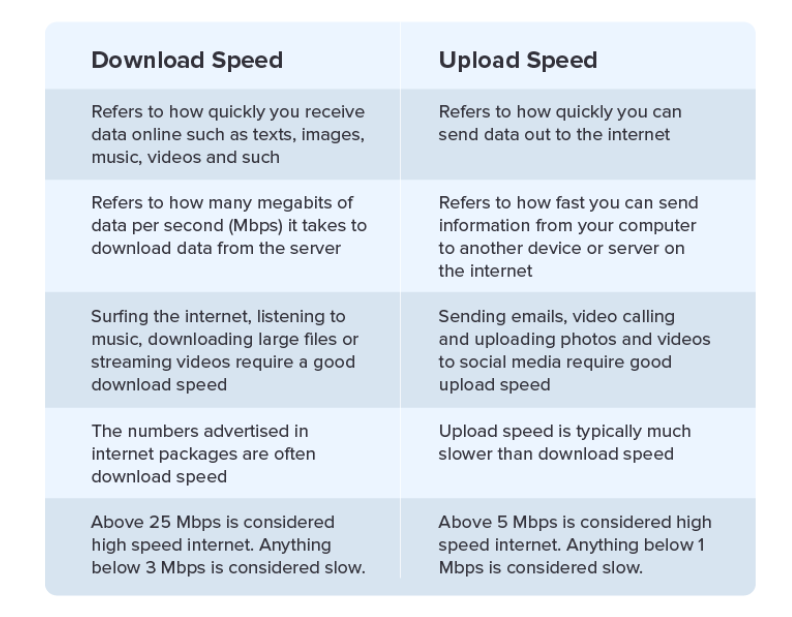
Image source: AllConnect
What is an internet speed test?
An internet speed test measures connection speed and quality in megabits per second (Mbps). Running consecutive tests across a period — rather than a single check — gives a much more reliable picture of whether a connection problem is constant or intermittent.
What is a Received Signal Strength Indicator (RSSI)?
RSSI measures how well a connected device can pick up a signal from an access point or router, typically expressed in negative dBm (closer to zero is stronger). It's the standard reference point for diagnosing whether a Wi-Fi problem is a signal issue rather than a bandwidth issue.
Reading RSSI: what counts as a good signal
Signal strength isn't pass/fail — it's a sliding scale, and the acceptable range depends on what the connection needs to support.
| RSSI (dBm) | What it typically means |
|---|---|
| -30 to -50 | Excellent signal, close to the access point |
| -50 to -60 | Good, reliable for most business applications |
| -60 to -67 | Reliable for video calls and streaming, but marginal |
| -67 to -70 | Weak — expect occasional drops and buffering |
| Below -80 | Effectively unusable for real-time applications |
These ranges are general guidance, not a fixed standard — the acceptable threshold shifts depending on the application. A real-time video call needs a stronger, steadier signal than a background file sync.
Network performance metrics worth monitoring
Two metrics separate an application problem from a transmission problem.
Network performance metrics are quantitative measurements used to evaluate and monitor the reliability of a network — and they're what separates an application-side issue from a data-transmission issue. A digital experience management solution typically tracks two in particular:
- Round-trip time (RTT): the time a data packet takes to reach its destination and be acknowledged as received.
- Server response time (SRT): the time required to complete a request and respond to it.
Tracking both makes it possible to tell whether a slow application is a network transmission problem or a server-side one — which changes who needs to fix it.
What counts as an acceptable internet speed for remote work
100/20 Mbps is the current baseline for broadband — not a target for a good remote work connection.
The Federal Communications Commission currently defines broadband as a connection delivering at least 100 Mbps download and 20 Mbps upload. That's the floor, not the target — it reflects general internet use, not the sustained real-time demands of video calls, screen sharing and cloud collaboration tools running simultaneously across a household.
Text and voice communication need relatively little bandwidth. Video streams are a constantly changing sequence of images that require continuous, real-time data transmission — which is why video is usually the first thing to visibly degrade when speed or signal strength drops. Insufficient speed shows up as buffering, loading failures, or stuttering playback — all of which interrupt a meeting well before anyone realizes it's a connectivity issue rather than a technical glitch on the call itself.
Read our guide to network troubleshooting for a deeper look at diagnosing these issues
How to test your Wi-Fi signal strength
Most operating systems already have what you need — you rarely need a separate tool to get a first read.
Wi-Fi strength and radio signal strength are directly linked: on the path between a wireless access point and a connected device, signal strength in each direction determines the data rate available on that link. Most operating systems, including Windows and macOS, have built-in monitoring for wireless connections, which is the fastest way to get an initial reading before escalating to a dedicated network test.
For a more complete picture — particularly for a remote employee whose home network sits entirely outside IT's visibility — running device, network, and wireless signal tests together, rather than checking signal bars in isolation, is what actually pinpoints where the problem sits.
How to fix weak Wi-Fi signal strength
Most weak-signal problems trace back to one of four causes: competing devices, router placement, interference, or an outdated frequency band.
Reduce the number of devices competing for bandwidth
Weak signal strength is often really a bandwidth competition problem — video calls, HD streaming, cloud applications, and file sharing can all draw on the same connection at once, making other devices appear to have poor signal when the real constraint is bandwidth. Quality of Service (QoS) settings let a router prioritize real-time traffic like calls over background downloads, reducing that competition.
See our guide to network congestion for more on fixing this at the network level
Reset the router regularly
Resetting a router clears a build-up of connected sessions and can resolve a degraded signal. Where a router supports it, scheduling a daily reset with third-party firmware can keep this from becoming a recurring manual task.
Check the frequency band
On a dual-band router, switching from the more common 2.4GHz band to 5GHz often improves throughput at close range, since 5GHz carries less interference from neighboring networks and household devices — though it typically has a shorter effective range.
Reposition the router and check for interference
Walls, floors, and large appliances all weaken a Wi-Fi signal, and placing a router in a closet or corner rather than a central, elevated position is one of the most common — and easiest to fix — causes of a weak connection at the far end of a home.
How IR Collaborate can help
The hardest part of a remote connectivity complaint usually isn't fixing it — it's finding where the problem actually sits.
RemoteInsight is a digital experience management solution available as part of the IR Collaborate suite. When a remote employee reports a Wi-Fi or internet speed issue, the real difficulty is rarely fixing the problem — it's identifying exactly where and why it's happening, since IT has no direct visibility into a home network.
RemoteInsight collects the information needed to remotely diagnose a problem on a user's home network — system tests, network tests, and wireless signal strength tests among them — then compiles the results so the relevant team can act on a clear diagnosis rather than a vague complaint.

For any enterprise supporting hybrid or remote employees, that visibility closes a gap that device-level troubleshooting alone can't reach — giving IT teams a consistent way to diagnose issues for every user, regardless of location.
Frequently asked questions
The questions IT teams and remote employees ask most when a connection feels off.
What is a Wi-Fi signal strength test?
A Wi-Fi signal strength test measures how well a device can receive a signal from its access point or router, usually expressed as RSSI in dBm or as a signal-bar percentage. It's a measure of connection quality, not connection speed.
What is a good Wi-Fi signal strength?
An RSSI between -30 and -60 dBm is generally considered good to excellent. Between -60 and -70 dBm, a connection may still work but is more prone to drops and buffering, particularly on video calls.
What's the difference between Wi-Fi signal strength and internet speed?
Signal strength measures how reliably a device connects to the network. Internet speed measures how much data that connection can move, in Mbps. A device can show full signal and still have a slow connection if the speed itself is limited.
What internet speed counts as broadband in 2026?
The FCC currently defines broadband as a connection delivering at least 100 Mbps download and 20 Mbps upload. That's a baseline for general use, not a guarantee of smooth performance across multiple simultaneous video calls or cloud applications.
Why does my Wi-Fi show full bars but still feel slow?
Full signal bars confirm the device can hear the network clearly — they say nothing about available bandwidth. A slow connection with strong signal usually points to bandwidth competition from other devices or applications, or a network congestion issue further upstream.
How do I test my home Wi-Fi signal strength?
Most operating systems have built-in wireless network monitoring that shows signal strength directly. For a fuller diagnosis, pair that with a separate internet speed test and, where available, a digital experience management tool that can test the network end-to-end.
Will switching to 5GHz fix weak Wi-Fi?
Often, at close range. The 5GHz band typically carries less interference than the more congested 2.4GHz band, though it has a shorter effective range — so it helps most when the device is reasonably close to the router.
How can IT teams monitor remote employees' home Wi-Fi without invading their privacy?
Digital experience management tools like RemoteInsight are designed to test network and device performance rather than monitor personal activity — they surface diagnostic data (signal strength, latency, packet loss) needed to fix a problem, not browsing history or personal usage.
Conclusion
A weak connection rarely announces itself clearly — full signal bars and a slow call can both point back to the same underlying issue, or two entirely different ones. Treating signal strength and internet speed as separate diagnostics, rather than one combined "Wi-Fi problem," is what actually shortens the path from complaint to fix — for IT teams and remote employees alike.
Want deeper visibility into how your remote and hybrid teams' networks are actually performing?