


.png?width=141&height=141&name=Transact%20(1).png)






.svg)

.svg)
.svg)
.svg)


%201.svg)

















The ability to capture network performance data is essential to maintain optimal performance throughout your network. AI network monitoring tools are becoming mission-critical to track network behavior and ensure network security.
The use of artificial intelligence and machine learning algorithms is fast eclipsing traditional network monitoring methods to:
-
Identify unusual network behaviors
-
Predict future network loads
-
Flag the location of bottlenecks and other security and network anomalies
-
Automate remediations
-
Prevent service disruption
AI network monitoring is revolutionizing how we manage and secure our digital infrastructures.
In this guide, we'll walk you through the benefits and challenges of AI network monitoring and how you can transform enterprise operations with intelligent automation. AI driven monitoring solutions are the natural evolution of IR's proven approach to managing complex enterprise environments.
Key takeaways:
-
AI network monitoring tools transform network complexity into clear, actionable insights - no more searching through multiple dashboards
-
AI monitoring systems provide a more adaptable and accurate alternative to traditional rule-based and legacy-based monitoring systems
-
Real-time anomaly detection goes beyond traditional monitoring to analyze vast amounts of data, predicting and preventing issues before they impact users
-
Enterprise-grade intelligence that learns your network patterns by analyzing real time and historical data to deliver deeper performance insights
-
Seamless integration with existing infrastructure - powerful AI network monitoring capabilities without the complexity
What is AI network monitoring and how does it work?
AI network monitoring leverages the power of machine learning, pattern recognition, and behavioral analysis to monitor network traffic. Integrating AI monitoring can identify suspicious behavior faster, optimize workloads, and learn from network traffic patterns to create a smarter, more secure network infrastructure.
By intuitively analyzing network data, AI monitoring can learn from experiences for greater accuracy over time, enabling faster detection, diagnosis, and resolution of network issues.
AI network management tools go beyond traditional monitoring systems, and we'll explain why later. They enable far more resilient, secure, and efficient network operations through:
-
Real-time performance optimization
-
Automated anomaly detection
-
Predictive analytics
-
Root cause analysis
-
Predictive maintenance
-
Automated threat detection
-
Smarter resource allocation.
How can AI improve network performance monitoring?
For large enterprises, near perfect network performance is non-negotiable. AI and ML take network monitoring to the next level, giving users a more reliable network experience with reduced outages and optimized connectivity. Here are five ways it does this:
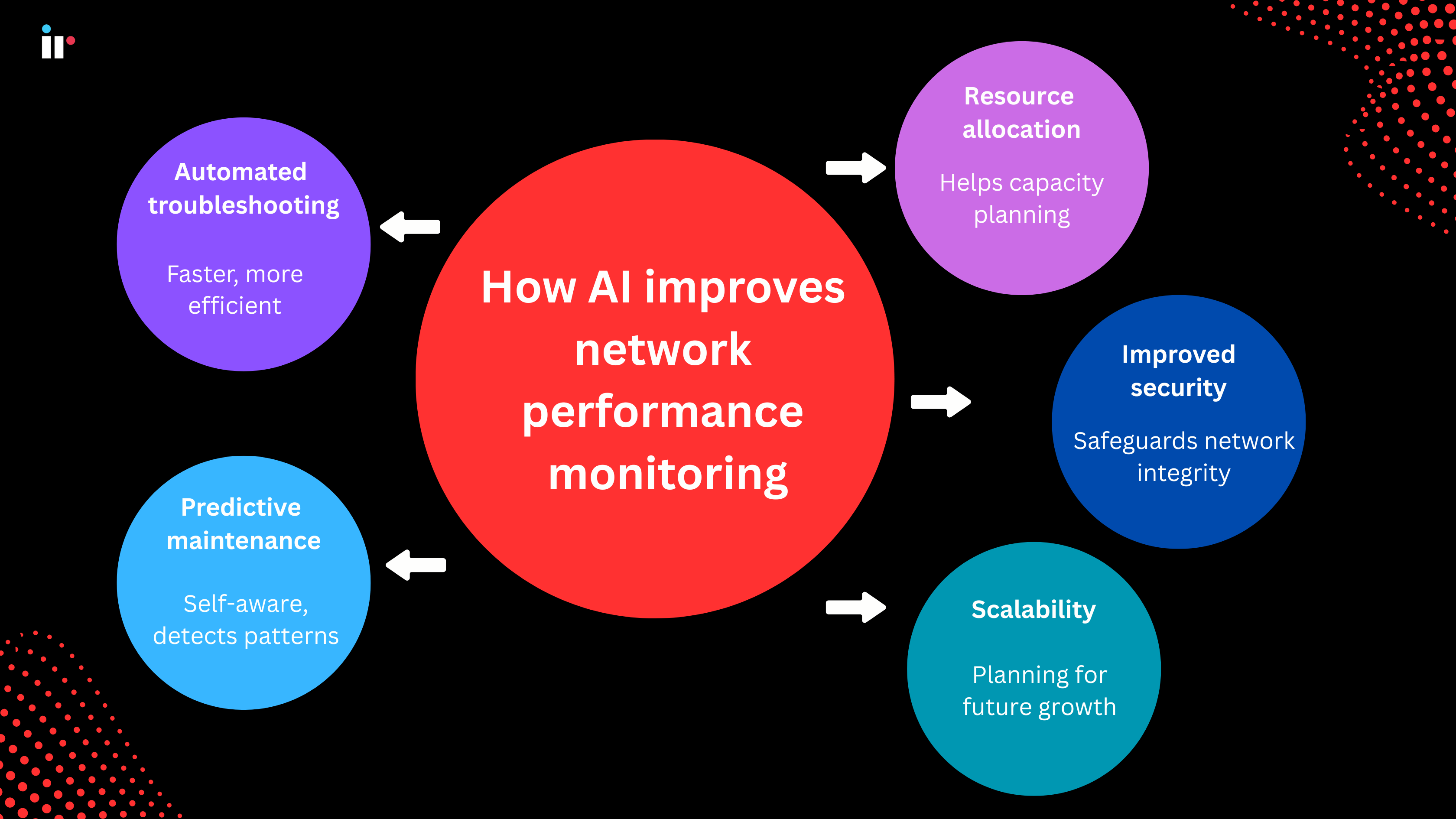
1. Automated troubleshooting
When network performance issues arise, the clock is ticking. AI and ML tools can help network operations teams troubleshoot issues much faster than traditional methods.
Artificial intelligence can analyze vast datasets, detect unusual patterns and anomalies, identify root causes, and execute remediation steps, significantly reducing Mean Time to Resolution (MTTR). AI monitoring systems learn what is "normal" system behavior looks like, and can detect deviations before they impact users
2. Predictive maintenance
One of the most substantial benefits of AI monitoring in network operations is its ability to detect deviations from normal network behavior.
Through machine learning and AI tools, network systems can become self-aware, analyzing network data in real-time to predict potential failures, like hardware malfunctions or service disruptions. By incorporating insights from historical data, AI can identify patterns that might not be obvious to the human eye.
3. Resource allocation for capacity planning
AI monitoring systems help optimize the allocation of network resources. From managing the allocation of IP addresses to balancing traffic loads across servers, to testing network configurations, AI models can ensure resources are used efficiently to reduce wasted time and money.
By automating these tasks, enterprise organizations can free up their network operations teams to focus on higher-level strategic initiatives.
4. Improved security solutions
AI-powered security monitoring tools can identify unusual activity, such as unlikely data flows or unauthorized access attempts.
Through machine learning algorithms, AI can help protect sensitive data, maintain privacy, and safeguard the integrity of network infrastructure without the need for constant human intervention.
5. Scalability in design and network planning
With its ability to analyze network data and predict future trends, AI can help design networks capable of meeting current demands while also being scalable for future growth.
For example, AI can help network engineers simulate different network configurations and predict systems will perform in different scenarios, allowing for better planning and more efficient design.
Find out how IR Collaborate can help increase network up-time
Traditional network monitoring vs. AI monitoring
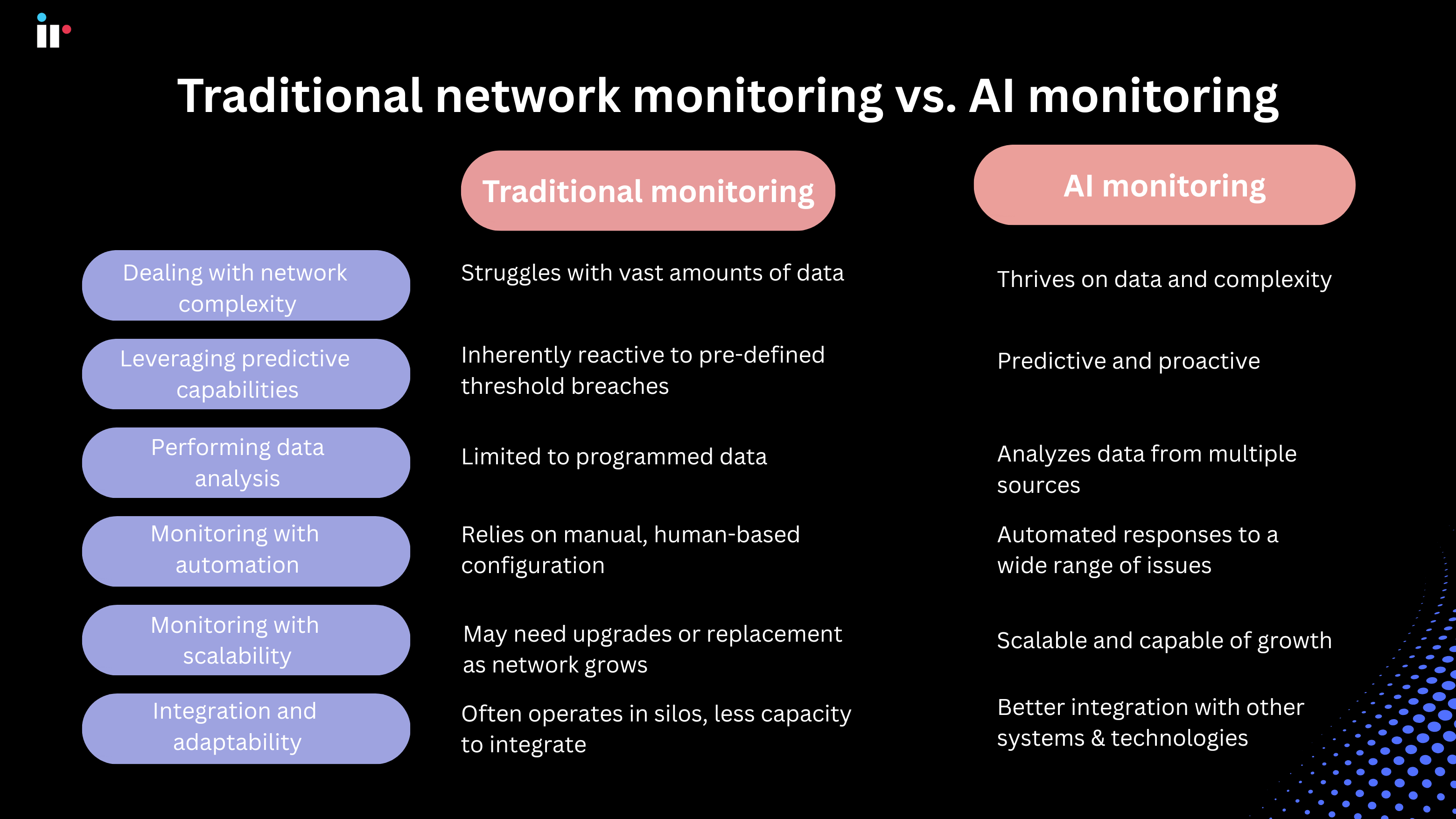
Traditional network management solutions rely on rule-based systems to detect predefined issues, while AI-based monitoring learns network behavior for proactive network management. Here are some of the differences between traditional and AI monitoring tools.

1. Dealing with network complexity
The growing complexity of modern networks presents challenges for traditional network monitoring systems.
AI-based monitoring solutions thrive on data and complexity, using sophisticated algorithms to manage diverse and intricate network environments.
2. Leveraging predictive capabilities
Traditional monitoring systems are inherently reactive, and will only create alerts after a pre-defined threshold is breached.
By analyzing historical data, AI network monitoring tools can predict issues before they impact the network, creating a more proactive approach to network management.
3. Carrying out data analysis
When it comes to analyzing data, traditional systems are limited to the data they are explicitly programmed to monitor.
AI systems can analyze massive quantities of data from multiple sources to identify issues, trends, and potential improvements.
4. Monitoring with automation
Traditional monitoring systems need manual configuration and are largely dependent on human decision-making.
AI driven systems can automate responses to a wide range of issues, reducing the need for human intervention and the potential for error.
5. Monitoring with scalability
As networks grow and the volume of data increases, traditional monitoring systems may need to be upgraded or even replaced.
AI platforms are scalable and capable of handling the growth in data volume and network complexity without the proportional increase in management resources.
6. Integration and adaptability
Traditional systems often operate in silos and may have difficulty integrating with new technologies.
AI-based solutions are generally better equipped to integrate with other systems and technologies, offering a more unified approach to IT network management.
The challenges of AI monitoring
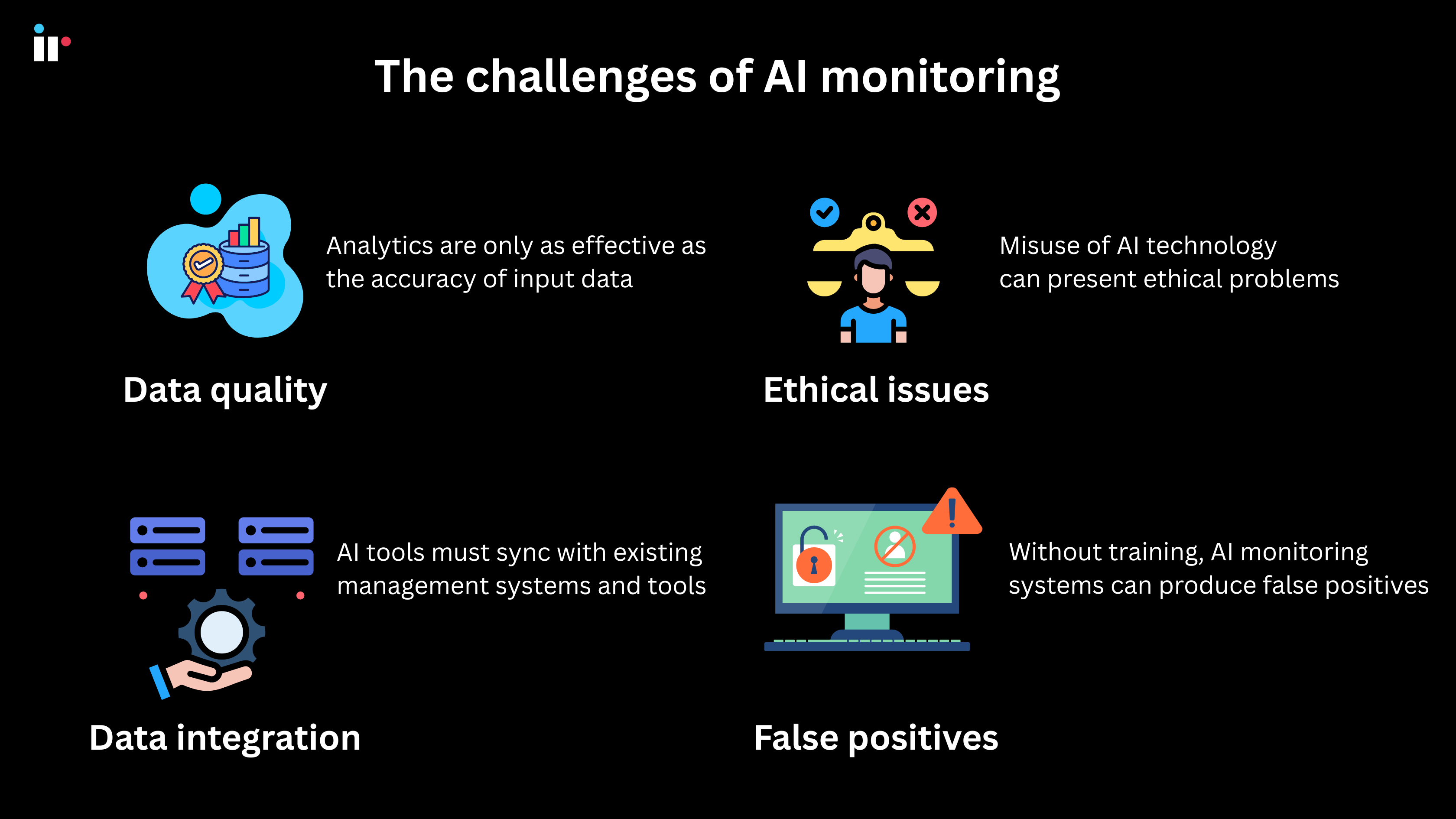
Despite the advantages of AI monitoring in a network environment, there are challenges and learning curves that have to be overcome for it to work effectively.
Data quality
Data analytics is only as effective as the integrity of the data being analyzed. Missing real-time data or data quality issues can lead to inaccurate results such as missing an issue or flagging a nonexistent problem.
Integration
Deploying any new technology into an existing network environment can be tricky if the AI monitoring tools don't sync with other management and security systems.
Ethical issues
Operational integrity and misuse of the technology can present ethical problems where AI technology is used to analyze vast amounts of data. Governments regulations on the way AI uses data are evolving and ongoing.
False positives
While AI has developed significantly in a short time, training AI monitoring systems can fail in areas such as security, producing false positives or overlooking serious threats. Trust takes time, training, and accurate input.
Implementing and evaluating AI monitoring solutions
Choosing the right AI monitoring solution for your organization can be overwhelming and confusing. However, the most effective AI and ML monitoring platforms consistently share certain key characteristics.
The ideal solution should:
-
Integrate seamlessly with your business process and workflows
-
Allow you to align custom performance metrics with your KPIs
-
Provide automatic, granular anomaly detection
-
Support feature and output tracking
-
Handle diverse data types from time series to categorical and tabular data
How IR Collaborate can help
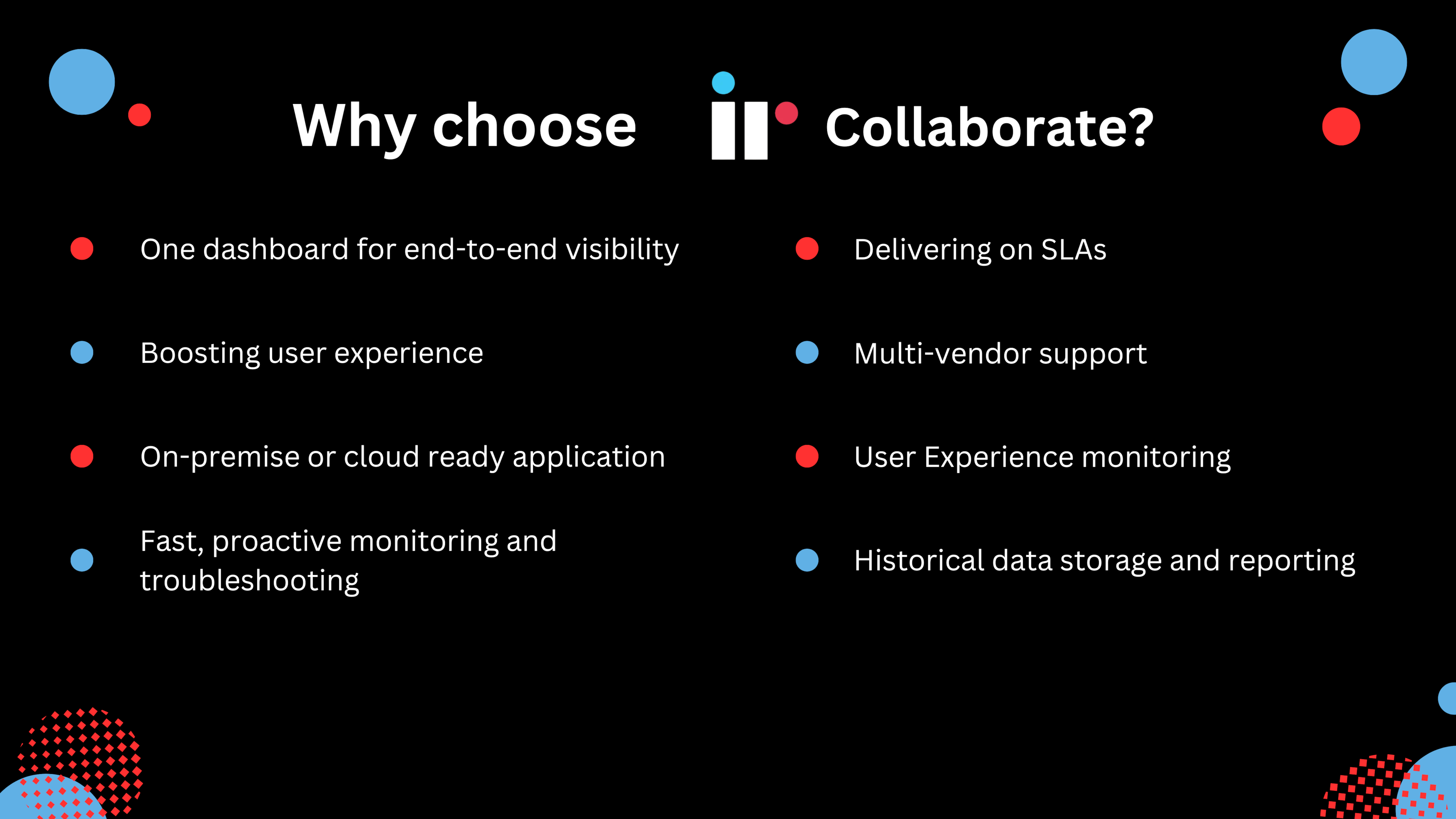
In a complex, multi-vendor unified communications ecosystem, real time network monitoring is essential to help you avoid, and quickly find and resolve performance issues across your on-premises, cloud or hybrid environments.
IR Collaborate's suite of performance management solutions are utilized by hundreds of the world's largest organizations to optimize their business-critical systems.
Find out how IR can help your organization thrive. Read our guide:
Network Monitoring 101: Tools, Metrics, and Best Practices
FREQUENTLY ASKED QUESTIONS
Q: How do I integrate AI monitoring into my existing infrastructure?
A:
-
Define clear objectives
-
Identify AI-ready processes
-
Make sure you have data governance
-
Choose the right AI tools
-
Pilot the monitoring solution
-
Train teams
Q: How can AI monitoring help resolve network performance issues?
A: By detecting anomalies and unusual patterns in real-time, AI can dynamically adjust:
-
Routing
-
Bandwidth allocation
-
Quality of service (QoS)
Q: What AI monitoring solutions should I avoid?
A: As AI monitoring is not a one-size-fits-all process, avoid "out-of-the-box" solutions. Expect to configure your own metrics, integrate with your business systems, and fine-tune anomaly detection to match your model’s needs.
Q: How does AI monitoring help stop cyber threats?
A: AI monitoring can:
-
Detect unusual login patterns
-
Reverse-engineer malware
-
Flag suspicious network activity
-
Predict potential vulnerabilities based on historical data. intrusion detection system