


.png?width=141&height=141&name=Transact%20(1).png)






.svg)

.svg)
.svg)
.svg)


%201.svg)

















Introduction
Unified communication channels are the arteries that lead to the heart of success for any organization. Even a few minutes of downtime in an enterprise unified communications environment can trigger a cascade of costly, brand-shattering consequences, from lost productivity and revenue, to erosion of customer trust.
"Cost of Hourly Downtime Exceeds $300,000 for 90% of Firms; 41% of Enterprises Say Hourly Downtime Costs $1 Million to Over $5 Million" - ITIC
For example, an AWS outage in October 2025 cost major U.S. companies millions of dollars per hour, and affected thousands of businesses worldwide. It halted or slowed key online services, from social media platforms and food delivery apps to streaming sites, online games, and even financial transactions.
The incident highlights how deeply daily life and business operations now depend on the stability of cloud providers and UCaaS solutions. It also emphasizes the crucial need to protect the integrity of your unified communications and collaboration platforms with robust monitoring and observability tools.
UCaaS migration: What it is and why it matters
UCaaS migration is the process of transitioning from legacy, on-premises communication systems to a cloud-based, as-a-service platform. This business model enables organizations to:
-
Support remote work with a better choice of collaboration and communication tools
-
Improve call quality
-
Gain the flexibility not available with on premises systems
-
Integrate new features and applications
-
Reduce costs
-
Maintain business continuity and performance visibility.
UCaaS cloud migration strategies include moving away from traditional, on-premises communication infrastructures (like PBX systems) to cloud-based platforms, integrating voice, video, messaging, and file sharing.
A UCaaS environment allows businesses to modernize operations, support remote workers, and achieve cost savings. Key steps include auditing existing systems, evaluating UCaaS providers, preparing network capabilities, considering security vulnerabilities, and managing the migration process across stakeholders.
To minimize disruption and ensure a seamless migration, it's vital for organizations to prioritize monitoring and performance management processes. This ensures not only that their UCaaS investment will yield ROI, but to guarantee service continuity and avoid user frustration. So advanced planning and key stakeholder buy-in is essential for long-term ROI.
Find out more about UCaaS monitoring and why it's critical for optimal performance
Read our article for expert tips
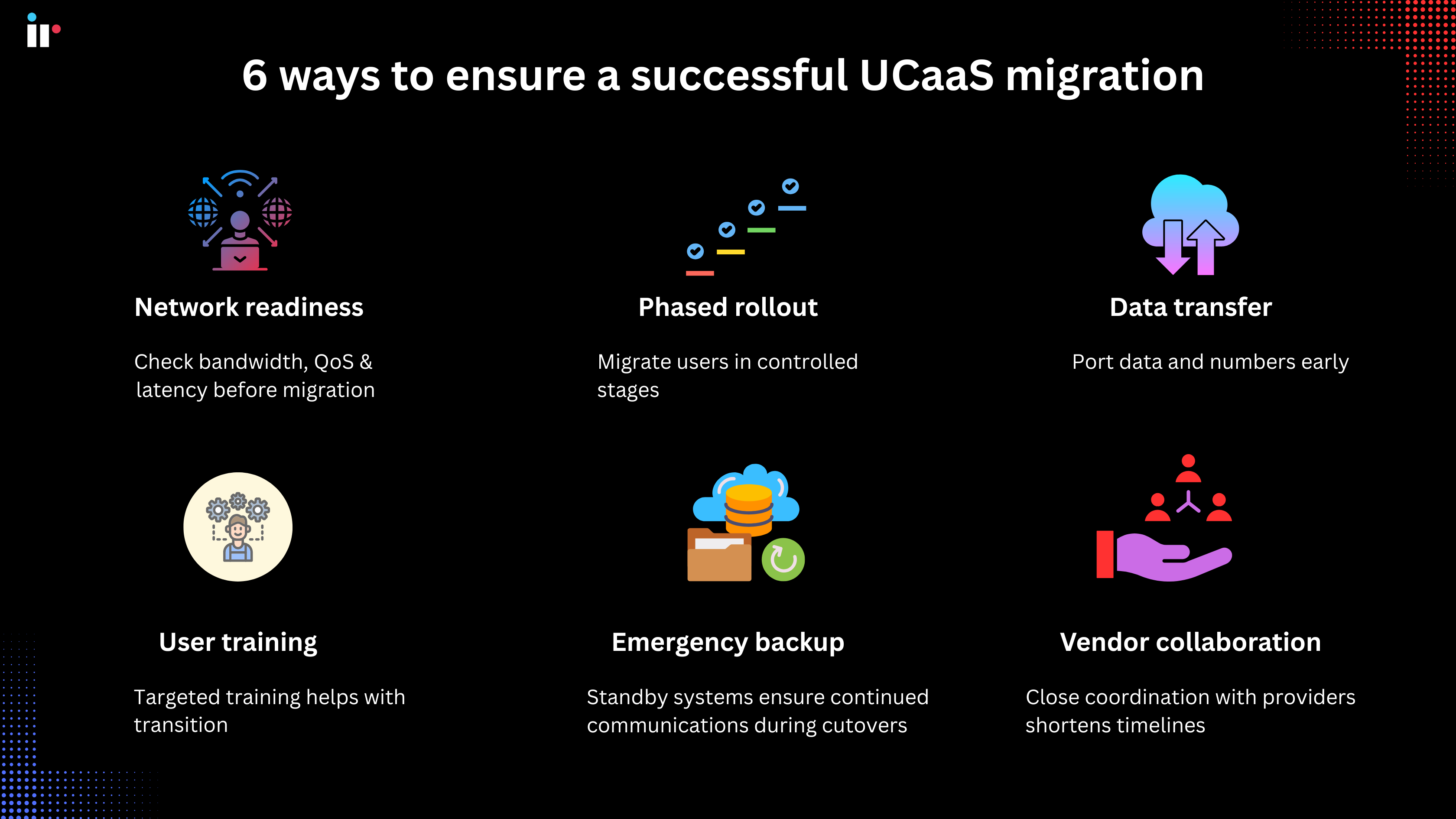
6 fast facts to ensure a successful UCaaS migration
-
Network readiness is non-negotiable. Bandwidth, QoS, and latency checks are essential before migration, to avoid call degradation and outages.
-
A phased rollout reduces risk. Migrating users in controlled stages prevents organization-wide disruption and simplifies troubleshooting.
-
Data and number porting requires precision. Early verification of carrier details prevents delays, failed ports, and service interruptions.
-
User adoption drives ROI. Targeted training ensures employees embrace new UCaaS tools instead of reverting to old workflows and reliance on legacy systems.
-
Redundancy and failover safeguards uptime. Being able to switch back to a standby system ensures communications remain available during cutovers or unexpected issues.
-
Vendor collaboration accelerates success. Close coordination with your UCaaS provider shortens timelines and helps anticipate hidden challenges.
UCaaS migration: A step-by-step process to ensure success
The process of UCaaS migration can create complex environments. Success depends on meticulous planning, precise execution, and continuous monitoring at every stage. Leveraging robust monitoring and observability tools, like IR’s Collaborate and Elevate allows IT teams to detect issues early, maintain service quality, and ensure a smooth, disruption-free and successful UCaaS migration.
1. Assess your current environment
Start with a full audit of your existing unified communications voice, network and collaboration systems. Review call volumes, device types, bandwidth capacity and existing pain points. This baseline is critical, for cloud migration, and with observability tools, you gain real-time insight into performance gaps before they become migration blockers.
2. Validate network readiness
Run QoS, jitter, packet-loss and latency tests across all sites. UCaaS platforms are only as strong as the network beneath them. Continuous testing and monitoring ensures you detect bottlenecks early and verify that your network can continue to support high-quality voice and video traffic.
3. Build a phased migration plan
Avoid a “big bang” cutover by organizing users into waves based on complexity, location, or department. A controlled rollout reduces risk and makes troubleshooting manageable. Observability platforms allow performance tracking throughout each phase, ensuring that issues won't overflow into the next group.
4. Execute detailed number and data porting
Port numbers, routing rules, call flows and voicemail data with precision. Misconfigured ports can cause disruptive downtime. End-to-end visibility helps validate that every port and call route behaves exactly as expected before going live.
5. Train and prepare users
Success depends on adoption. Provide hands-on training, quick-reference guides and clear communication about new workflows. Monitoring tools can highlight patterns of user behavior, such as repeated failures or dropped calls, allowing IT teams to intervene proactively.
6. Perform staged testing before full cutover
Run call simulations, failover tests, call-flow validation, emergency routing checks and load tests. IR’s proactive monitoring tools can surface anomalies long before customers or employees experience them.
7. Go live with real-time observability
During cutover, watch every metric: call quality, service availability, device registration and network stability. Observability tools provide the deepest insights, ensuring that you can identify issues instantly and resolve them before they affect business operations.
8. Optimise post-migration
Once live, continuously review performance trends. With IR’s analytics, you can fine-tune QoS policies, optimise routing, reduce support tickets and ensure long-term reliability.
9. Ensure security and compliance
Implement strong access controls, encryption, and policy enforcement during and after migration. UCaaS security is vital to prevent breaches and protect sensitive communications, as well as maintaining compliance with industry regulations. Rigid monitoring processes detect suspicious activity or misconfigurations before they can compromise operations.
Choosing the right UCaaS provider for your business
Selecting the right service provider is critical to unified communications and cloud migration. Every decision impacts productivity, reliability, and long-term ROI. A provider isn’t just a vendor, they become a partner in ensuring seamless communication, secure operations, and ongoing innovation.
Not all providers can supply the features you need. Careful evaluation helps you avoid service gaps, costly downtime, and unexpected limitations as your business evolves.
Critical features and evaluation framework
Assess must-have capabilities like voice, video, messaging, analytics, and observability. Look beyond basic voice and video to include messaging, collaboration, analytics, and integrated monitoring capabilities. A structured evaluation framework will help you compare providers objectively, ensuring the solution meets operational needs, supports growth, and enables proactive issue detection.
Integration with existing tools & hybrid systems
Ensure they provide a platform that will work seamlessly with your CRM, collaboration apps, and legacy systems. Poor integration can lead to inefficiencies, duplicate workflows, or missed communications.
A service provider that supports robust APIs and unified management dashboards gives IT teams the power to monitor performance across all systems, ensuring both user adoption and operational continuity without compromising quality or security.
Security, compliance, and data privacy
Security is a top priority, and non-negotiable for every enterprise in modern communications. Evaluate service providers for encryption, multi-factor authentication, and compliance with industry standards like HIPAA, GDPR, or SOC 2.
Your provider needs to ensure that the platform comes with built-in protection against suspicious activity, policy violations, or misconfigurations. Choosing a provider that prioritizes security in real time, reduces risk, protects sensitive data, and reinforces trust with employees, partners, and customers.
Scalability and flexibility
As your business grows and evolves, your UCaaS platform must keep pace. Evaluate whether the service provider can scale users, locations, and features without downtime or major system changes. Flexibility also includes supporting hybrid teams, seasonal spikes, and rapid onboarding.
Real-time monitoring and analytics allow IT teams to anticipate capacity constraints and optimize resource allocation before performance issues arise, ensuring smooth communication as your organization expands.
Reliability, SLAs, and support
Even a short UCaaS outage can disrupt productivity and damage reputation. Review service-level agreements (SLAs) for uptime guarantees, redundancy, failover, and disaster recovery procedures. Also, consider the quality and availability of technical support.
Integrated observability tools allow IT teams to monitor system health continuously, verify SLA compliance, and respond proactively, minimizing the impact of unexpected disruptions and ensuring consistent business operations.
Cost transparency and total cost of ownership & additional features
UCaaS pricing can be complex. Hidden fees for add-ons, support, or number porting can escalate the cost of a UCaaS system. Evaluate the total cost of ownership, including software, devices, network upgrades, and ongoing support.
A provider that offers transparent pricing and predictive analytics helps forecast future expenses and ROI. Observability tools can also reduce operational costs by identifying inefficiencies, optimizing network performance, and minimizing downtime, delivering tangible value beyond the subscription fee.
Collaboration tools & remote work scalability
Modern UCaaS platforms are more than just voice and video - they provide integrated collaboration tools that enable teams to work effectively from anywhere. Businesses must ensure that the ability to share files, message on different platforms, and seamless video conferencing is easy, secure, and scalable, while also supporting remote work policies and mobile device management.
Choosing a platform that combines collaboration with robust monitoring ensures consistent performance and productivity across all locations and devices.
File sharing, instant messaging, and video conferencing
A strong communications-as-a-service solution integrates file sharing, instant messaging, and video conferencing in a unified interface. This reduces workflow friction, improves response times, and eliminates the need for multiple, disjointed apps.
Observability tools are vital to provide end to end visibility and insights into call quality, latency, and system health, ensuring teams can collaborate without interruptions. Reliable collaboration features are essential for maintaining productivity, whether employees are in the office or working remotely.
Remote work enablement
Supporting remote work depends on secure access, reliable connectivity, and user-friendly interfaces across home networks and personal devices. UCaaS platforms that provide end-to-end monitoring allow IT teams to track performance, troubleshoot issues remotely, and maintain high-quality communications for offsite employees.
Scalability is crucial, enabling organizations to quickly add new users or locations without compromising service quality or security.
Mobile device management and remote teams
The ability to be mobile is a lifeline for remote and hybrid teams, but they introduce security and performance challenges. A service provider with strong mobile support and integrated observability ensures that devices register properly, and flag poor call quality.
Effective device management protects sensitive data while enabling employees to stay connected and productive from anywhere.
Matching UCaaS to business goals
Selecting a UC cloud migration platform is not just a technology decision, it’s a strategic business move that aligns with your organization’s operational priorities, growth plans, and user experience expectations.
Integrated observability and monitoring are critical to ensure the platform supports real-time collaboration, seamless performance and always-on UC continuity.
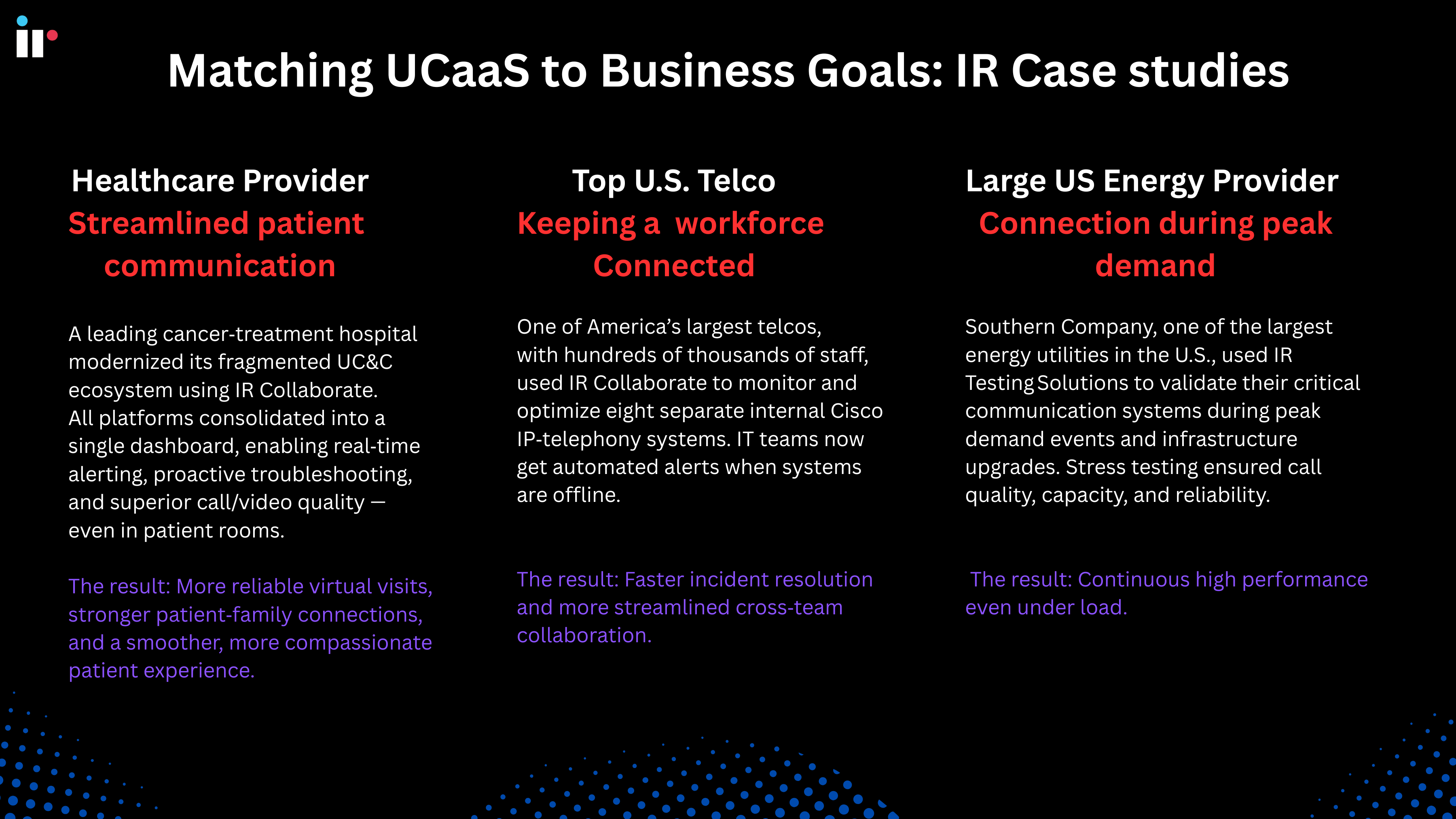
For decades, IR has successfully delivered unified communications monitoring solutions for global banks and financial services providers, healthcare organizations, telecommunications companies, and energy firms, demonstrating how tailored UCaaS deployments can meet complex industry requirements.
Book a Performance Readiness Audit with IR Today
Ensure your UCaaS migration is seamless, secure, and disruption‑free. IR’s Performance Readiness Audit provides real‑time insights, proactive monitoring, and actionable recommendations tailored to your environment.
From call quality and system reliability to network optimization and compliance, IR helps you identify risks before they impact your business. Discover how leading banks, healthcare providers, telcos, and energy companies rely on IR to deliver flawless communications. Take the first step toward a migration you can trust.

Frequently Asked Questions
Q: What is UCaaS cloud migration and why is it important?
A: UCaaS migration moves your communication systems to the cloud, improving reliability, scalability, and productivity while reducing reliance on legacy infrastructure. Proper migration ensures business continuity and better collaboration across teams.
Q: What are the key phases of a UCaaS migration process?
A: Key phases include assessing current systems, validating network readiness, phased cutovers, number/data porting, user training, testing, and post-migration optimization, all monitored to minimize downtime and ensure smooth operations.
Q: How do I evaluate my current legacy systems for migration?
A: Audit devices, call volumes, network performance, workflows, and security policies. Observability tools help identify bottlenecks, risks, and optimization opportunities before migration.
Q: How can I ensure a smooth UCaaS migration with minimal disruption?
A: Migrate in phases, test configurations, implement failover, train users, and leverage real-time monitoring to detect and resolve issues instantly.
Q: What should I look for in a UCaaS provider?
A: Look for reliability, scalability, integration with existing tools, mobile support, security, strong SLAs, and built-in observability for proactive monitoring and performance optimization.
Q: How do UCaaS cloud platforms support remote workers and mobile equipment?
A: UCaaS enables secure messaging, voice, video, and file sharing from anywhere. Mobile device management and monitoring tools ensure connectivity, performance, and security for remote teams.
Q: What security issues should I consider when migrating?
Focus on encryption, access control, compliance (HIPAA, GDPR, SOC 2), and monitoring to detect suspicious activity and misconfigurations in real time.
A: How do I measure success and ROI after migration?
Track uptime, call quality, user adoption, efficiency gains, and reduced support incidents. Analytics tools provide real-time insights to demonstrate ROI and guide ongoing optimization.