


















Money doesn't move the way it used to. Cards, wallets, real-time rails and embedded finance now sit side by side in a single transaction — and according to Worldpay's 2026 Global Payments Report, digital wallets now account for 56% of global e-commerce value and 33% of in-store spend. The lines between banking, payments and commerce haven't just blurred — for most organisations, they've disappeared.
Card and debit payments at the point of sale no longer dominate the way they once did. New rails, new players and new customer expectations are reshaping the payments ecosystem in real time, and the organisations that keep up are the ones that stay in control of their revenue.
What's driving the change?
New payment methods, ubiquitous high-speed connectivity, a wave of mergers and acquisitions, and rapidly advancing technology have thrown the payments industry wide open. Add a consumer appetite for convenience that shows no sign of slowing, and the global payments ecosystem keeps getting more complex for payment providers, merchants, merchant acquirers and financial institutions alike.
In this piece, we look at how the payments ecosystem is changing, what's coming next, and how transaction monitoring helps organisations stay ahead of the disruption.
The chart below is Worldpay's original 2022 forecast for global e-commerce and POS payment methods through 2025. It called the shift toward digital wallets early — and the market has since moved even faster than predicted.
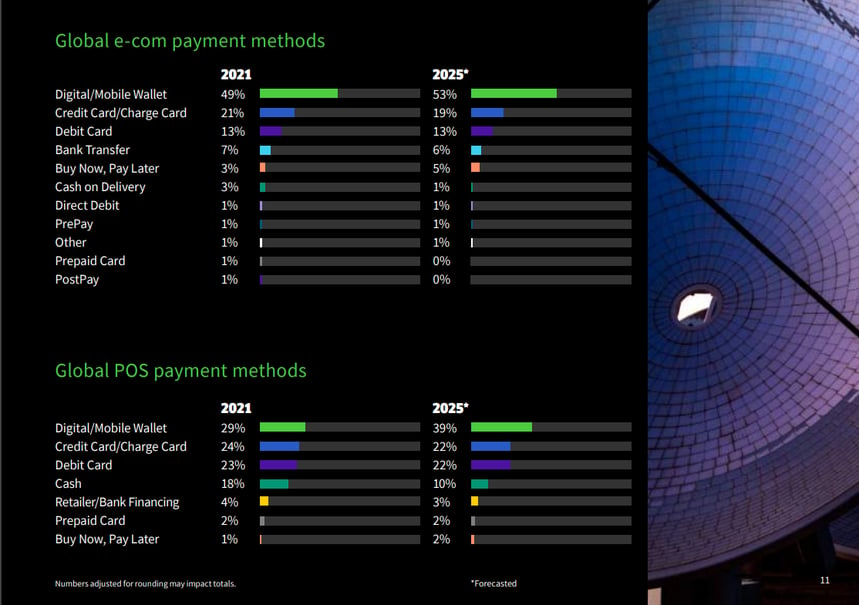 2022 forecast. Image source: Worldpay Global
By 2025, digital wallets had already reached 77% of online spend and 63% of in-person spend across Asia-Pacific — the highest share of any region — while payment apps globally are now growing 135% faster than overall point-of-sale payments, and are forecast to make up 46% of global POS value by 2030.
It pays to keep up
Technology no longer just facilitates electronic payments — it defines how organisations accept them. Fintechs and traditional financial institutions are converging fast to keep up with merchant and consumer expectations.
It used to be enough to accept a credit card. Payment processing meant facilitating in-store payments, contactless, or a funds transfer, and that was the job done.
Today's payment providers compete on experience. Business owners have more control over how they run their operations, more room to grow, and more choice in how they build out their payment stack. Organisations that don't keep pace with the speed of change stand to lose ground to those that do.
Banks and financial institutions are under particular pressure. The regulatory load from the 2008 financial crisis reshaped traditional banking compliance — and now the same institutions have to apply comparable rigour to digital channels, or risk falling foul of it.
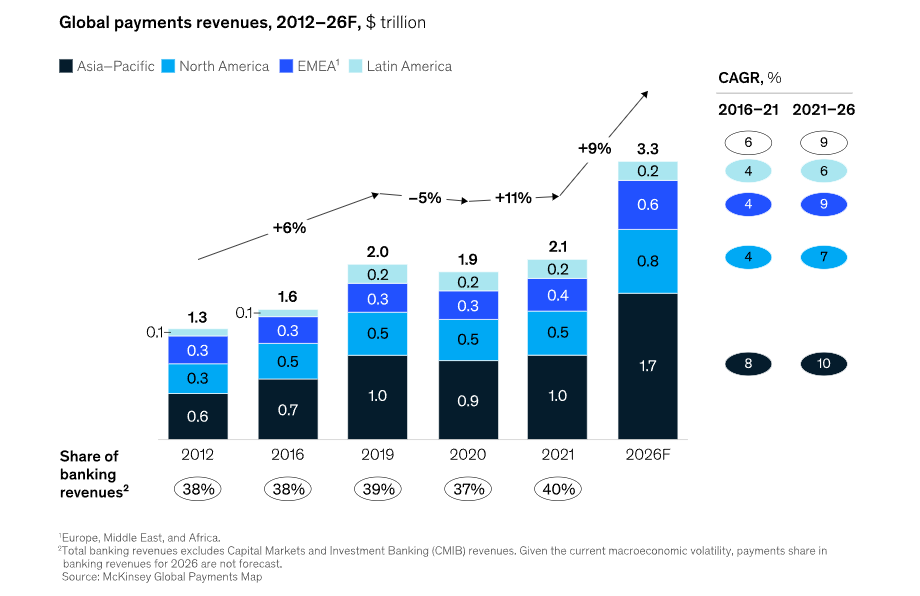 Image source: McKinsey
Key players in the changing payments ecosystem
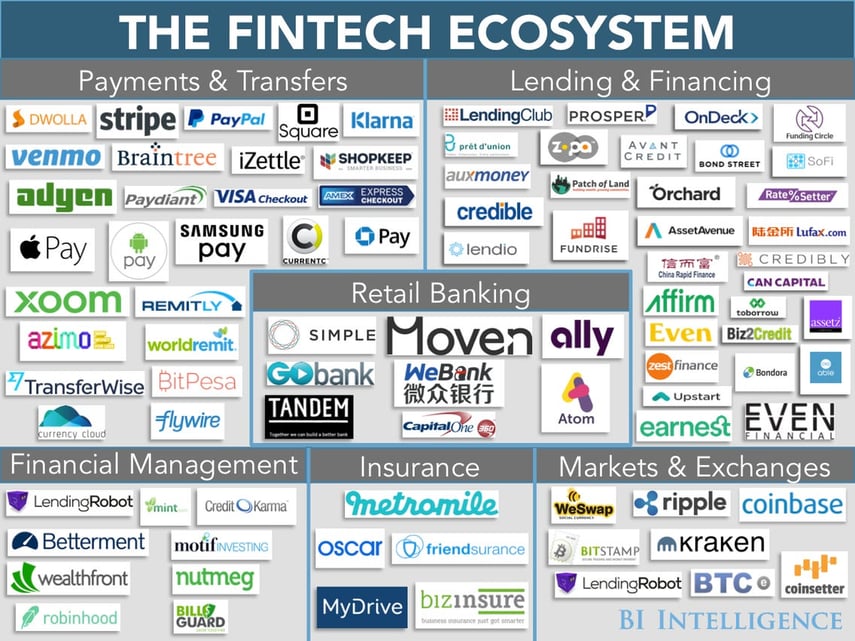
Financial technology is reshaping the world of finance for banks, financial institutions and consumers alike. Here's who's driving that change.
Fintechs
COVID accelerated the influence of fintechs, but the shift was already under way, driven by consumer demand rather than crisis.
-
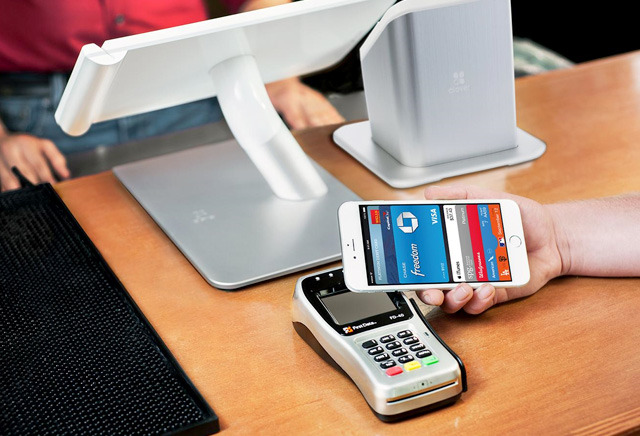
You can open a bank account entirely online, no branch visit required. Link it to your phone, and it becomes a digital wallet — tap-to-pay through Apple Pay or Samsung Pay is as fast as pointing your device at a terminal.
-
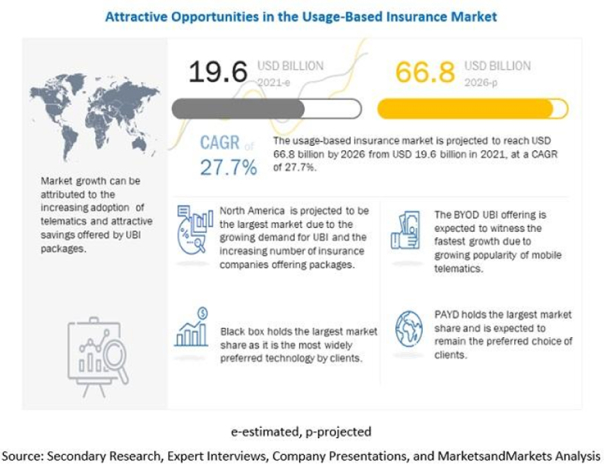
Insurance has changed just as much. Most motor insurers now offer telematics-based cover, using data from a smartphone or an in-vehicle black box to price a policy — and some sell it on a pay-as-you-go basis.
-
Investing has moved the same way — execution-only, entirely online, no face-to-face required.
-
At the point of sale, the shift to contactless during COVID opened the door to Buy Now, Pay Later, proximity payments like Apple Pay, and click-and-collect.
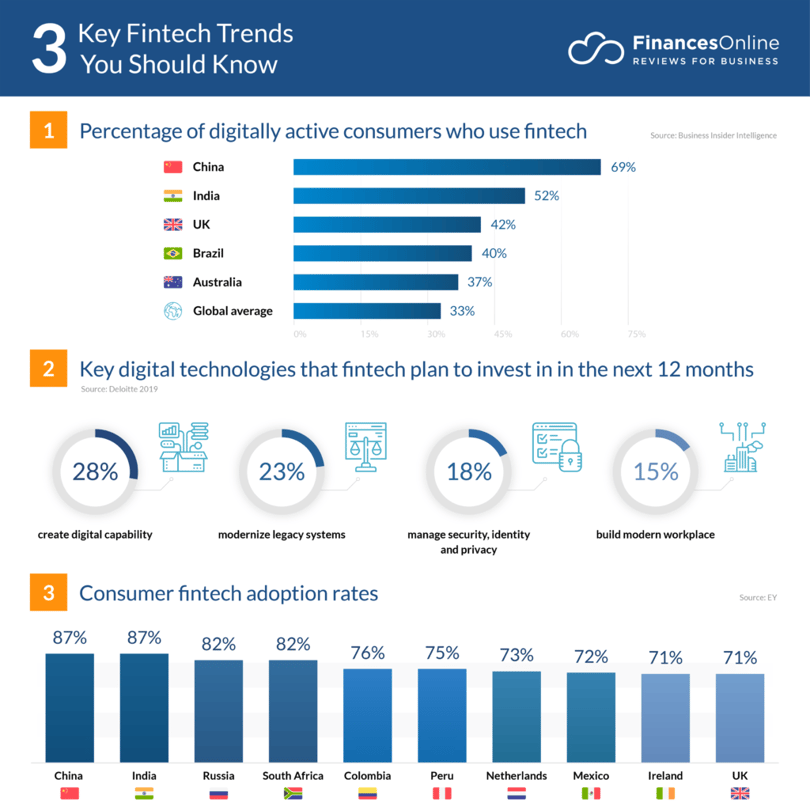
Image source: Finances Online
Payment service providers (PSPs)
Payment service providers are third-party organisations that act as payment facilitators, letting merchants accept any payment method — including card payments.
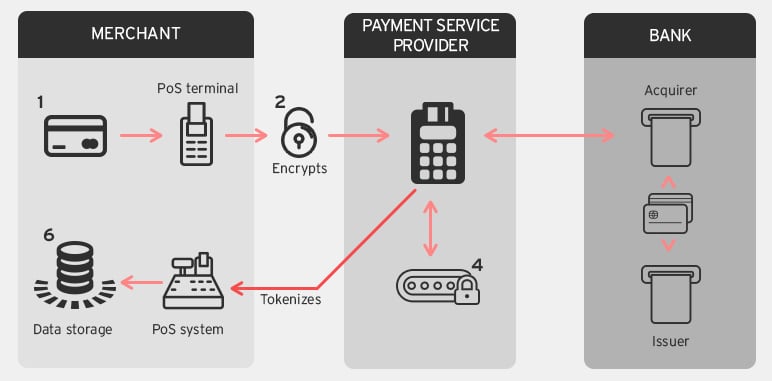 Image source: Magestore
PSPs provide the gateway to a merchant's bank account, making sure payments get collected and managed cleanly. Broadly, they fall into three categories: gateway providers, acquirers and processors, and networks.
Together, gateway providers, acquirers and processors are described as payment service providers. Add networks to that mix, and you get payment providers more broadly.
These aren't fixed roles. A PSP might be a pure gateway provider that never touches the funds, or it might also process, transfer and collect payments — acting as acquirer and processor at once.
Mobile wallets like Apple Pay, Alipay and PayPal can also act as the network for a transaction, letting merchants connect directly to the wallet provider instead of going through a processor. In that case, the wallet performs the gateway and acquirer/processor roles too.
Independent sales organisations (ISOs)
An ISO is a third-party company that sells credit card processing services independently of a bank, and can approve a business to accept card payments. It isn't part of a bank itself, but it accepts cards on a merchant's behalf through the alliances it's built with banks.
Explaining the payments ecosystem
As a merchant, understanding the payment processing cycle helps you choose the right solutions for your business. The whole process takes seconds, but it's a complex journey from the point of sale to the consumer's bank account and back to the merchant's acquiring bank.
The payment processing cycle
Here's what happens in a typical credit card payment.
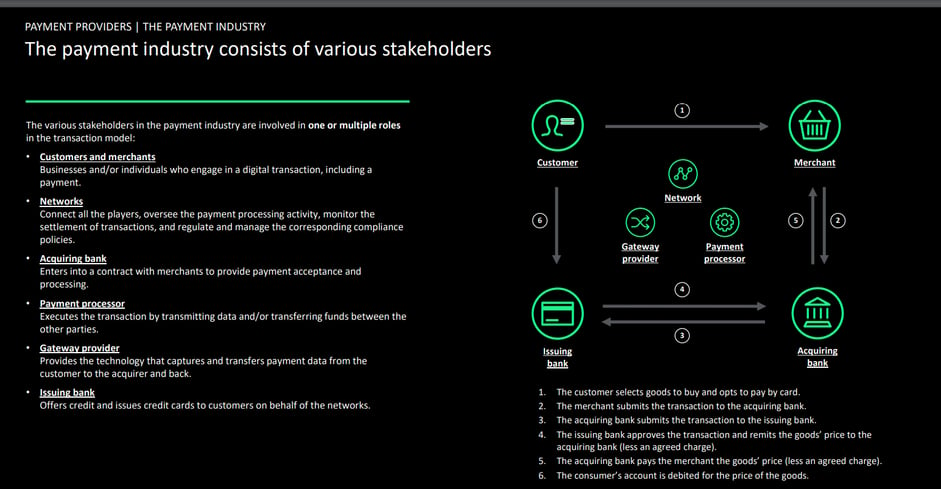 Image source: Deloitte
-
Customers and merchants. A customer chooses a card as their payment method. The merchant submits the transaction to the acquiring bank.
-
Networks make the connection, oversee processing activity, monitor settlement, and manage the compliance policies that hold it all together.
-
The acquiring bank has a contract with the merchant to provide payment acceptance and processing, submits the transaction to the issuing bank, and pays the merchant once it's cleared.
-
The payment processor executes the transaction, transmitting data and transferring funds between the other parties.
-
The gateway provider handles the technology that captures the payment method and moves payment data between customer and acquirer.
-
The issuing bank issues the credit card, approves the transaction, and remits the total (less fees) to the acquiring bank.
-
The consumer's bank account is debited for the purchase.
Looking to the future: the forces reshaping the global payment ecosystem
PwC and Strategy& once forecast global cashless payment volumes climbing from around 1 trillion transactions in 2020 to almost 1.9 trillion by 2025, and nearly tripling by 2030.
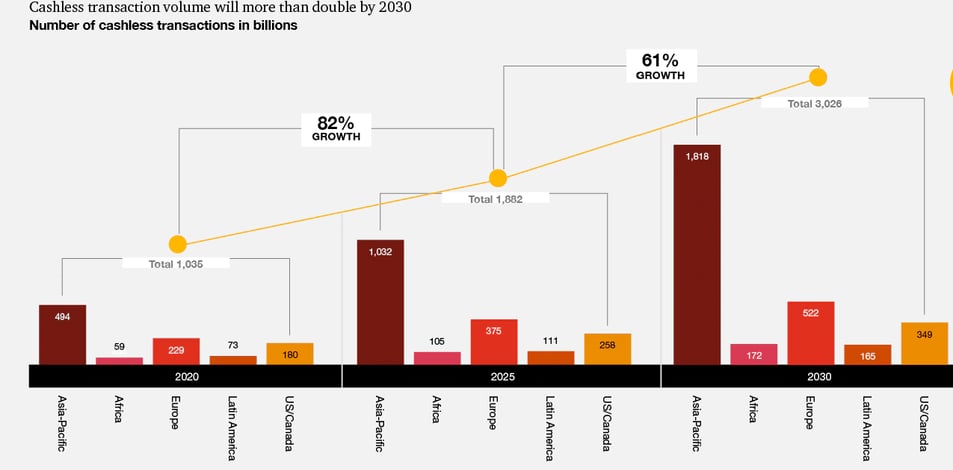 2020 forecast. Image source: PwC
The market has kept pace with — and in places outrun — that forecast. Global cashless transaction volumes have grown at more than 16% a year since 2023 and have now passed 2 trillion, and tokenised payment transactions are on track to exceed 1 trillion globally this year, up from 680 billion in 2022.
Financial institutions are still carrying the regulatory burden, risk management obligations, capital constraints and cost pressures that come with running a payments business, and that makes it harder to keep pace with the sheer volume of choice now available. Businesses increasingly bypass their banks altogether, working directly with fintechs to remove friction from the payments process — a trend that's sharpening competition between financial institutions and fintechs, while also opening the door to more collaboration between them.
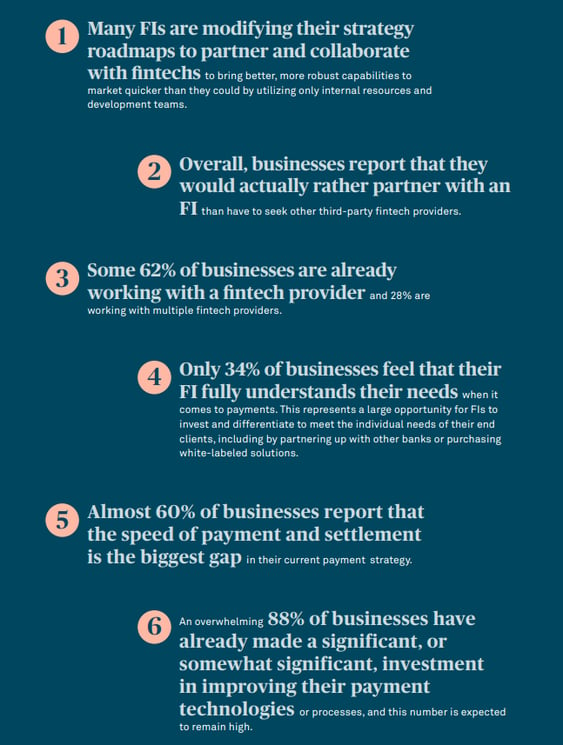 Image source: BNY Mellon
Downtime equals financial mayhem
Whether it's acquiring banks, merchant services, card networks or payment facilitators, full visibility across your payments ecosystem isn't optional. Transaction monitoring and POS monitoring are what stand between you and a costly service disruption.
From business to consumer, a single payment passes through a point of sale, a mobile or online channel, a card network, a merchant bank, data centres, multiple switch servers and several backend databases before it's done. To manage that journey — and guarantee critical transactions complete — operations teams need full visibility of every stage of traffic coming through.
The cost of getting this wrong is real. We've modelled what a single outage can cost a financial institution processing 100 transactions a second — and the number runs into the millions, before reputational damage and lost customers are even factored in.
The importance of transaction monitoring and performance management
Full visibility of your payments ecosystem in real time means you can see exactly where payments are processing successfully — and where they're being declined.
Request and response timings, transaction values, error codes and network address data all need to be visible enough to pinpoint where and when a problem occurred, so you can work out why it happened and how to resolve it.
As your payments infrastructure grows, so does its complexity — which is exactly why transaction analytics matters more every year, not less.
How IR Transact can help
With IR Transact, you get visibility into your entire payments ecosystem, no matter how complex it gets. Monitoring is broken down by card or merchant acquirer, so you can drill into individual locations and get geographic insight into card usage and uptake.
A lot can go wrong across a payments ecosystem, and even the smallest transaction issue can ripple out to affect a large number of customers before you know there's a problem. IR Transact gives you the clarity to see that coming — today, our platform monitors 600 million transactions a day for customers around the world.
How does it work?
-
Transact is built to be proactive, not reactive. Rapid troubleshooting and comprehensive analytics mean issues get solved faster — which means a better customer experience, and more revenue protected.
-
It keeps your systems and infrastructure ready for whatever new technology comes next.
-
Beyond hardware, Transact monitors the application layer too, so every system is confirmed to be talking to the others as it should — and transactions keep flowing. That gives acquirers and processors insight into their top merchants' transactions, with instant notification the moment something looks abnormal.
Prognosis, the platform IR Transact is powered by, now also includes Iris — an AI layer built to surface insights and accelerate root cause analysis, helping teams cut resolution time without replacing the expertise of the people running the show.
Watch our webinar: Payments Analytics and Improving the Merchant Experience
Need to know about real-time payments?
Find out how real-time payments are revolutionizing global commerce
IR Transact doesn't just simplify the complexity of monitoring and managing a modern payments system — it turns that data into intelligence that sharpens business decisions and grows revenue. Payment analytics gives you the agility and adaptability to move with a payments landscape that isn't slowing down.
See IR Transact in action — request a demo, or download our guide to managing your changing payments business.