


.png?width=141&height=141&name=Transact%20(1).png)






.svg)

.svg)
.svg)
.svg)


%201.svg)















High value payments (HVP) in banking are a commodity item, and these payment types represent the largest part of the world’s payments infrastructure. While considered niche, these types of payments are crucial to the global economy.
Each country has different references for interbank and corporate payment schemes – such as Institutional payments, High Value Clearing Systems (HVCSs in Australia), Large-Value Payments Systems (LVPSs in the US), Clearing House Automated Payment Systems (CHAPS in the UK).
HVPs provide economic stability, and trust within the banking sector.
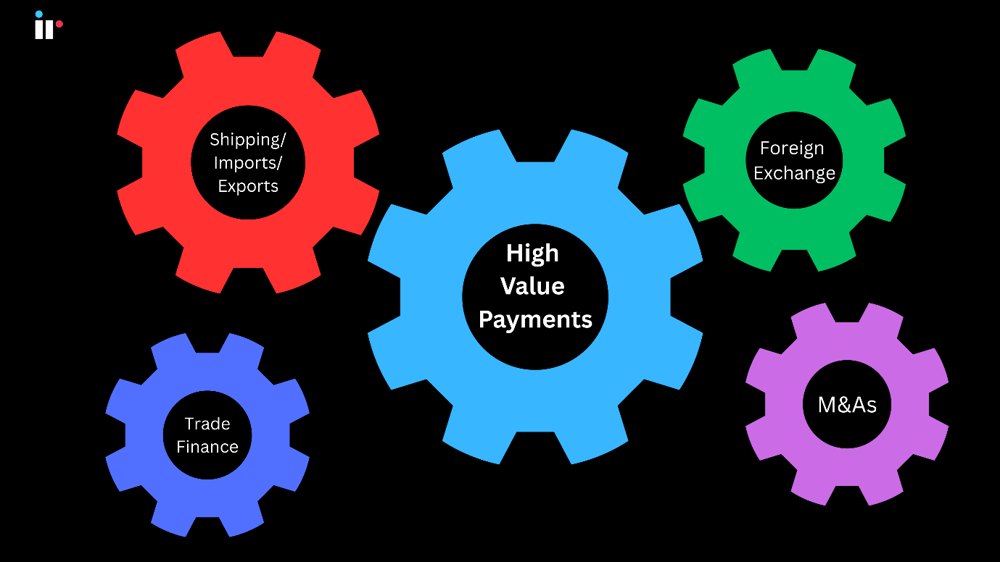
HVPs are an integral part of the economic machinery that is global finance. Shipping companies, trade finance, foreign exchange, imports and exports, mergers and acquisitions – all large corporate transactions hinge on the seamless efficiency of these transactions.
Find out more about key technology priorities for wholesale banking in 2026 and beyond.
Read the whitepaper.
The importance of monitoring HVPs
Banks are under constant scrutiny when high-value payment systems fail. Every delay, failed settlement, or operational hiccup can have far-reaching consequences for corporate clients, counterparties, and the broader financial ecosystem.
High value transactions underpin critical business operations, from liquidity management to international trade - and even a brief disruption can trigger financial losses, reputational damage, and regulatory scrutiny.
In this environment, real-time monitoring and end-to-end visibility are no longer optional; in fact advanced monitoring systems are essential for maintaining trust, efficiency, and operational resilience.
To protect clients and safeguard their own operations, banks need to take a proactive approach to monitoring high value payments.
Six key reasons why banks need to monitor HVPs
Banks operate in a high-stakes environment where every payment counts, and for high value payments in particular, the most advanced monitoring systems are essential for both operational and strategic reasons.
Effective monitoring goes beyond simply tracking transactions; it provides real-time visibility across the entire payment lifecycle, identifies anomalies before they escalate, and ensures that settlement deadlines and service-level agreements are consistently met.
The benefits are multi-faceted, and impact everything from operational efficiency to regulatory compliance and client trust. Below are six key reasons why banks can’t afford to overlook monitoring in the wholesale payments space:
1. Operational resilience
High-value payments often have strict cut-offs and settlement deadlines, so the smallest delays can disrupt client operations and trigger penalties. Monitoring enables banks to detect and resolve issues quickly, maintaining smooth and reliable payment flows.
2. Risk management and liquidity optimization
A robust monitoring system allows banks to anticipate congestion, manage intraday liquidity efficiently, and prevent overdrafts or settlement failures.
3. Regulatory compliance and audit readiness
Comprehensive monitoring produces detailed records of every transaction, simplifying reporting requirements and providing evidence for internal and external audits.
4. Customer trust and predictability
Corporate clients rely on the timely and accurate settlement of large-value payments, and consistent frictionless performance reinforces confidence in the bank’s reliability.
5. Early detection of systemic or cross-rail issues
Wholesale payments traverse multiple internal systems, correspondent banks, and settlement networks. Any disruption in even one link of the process can cascade through the ecosystem. Advanced monitoring allows banks to spot these issues early, preventing small glitches from becoming large-scale failures.
6. Fraud and financial crime prevention
Monitoring is crucial to help detect unusual transaction patterns and ensure compliance with anti-money-laundering and counter-terrorism financing regulations.
Smarter, Faster, Safer: AI’s potential to power high value payments
The infiltration of artificial intelligence into the payments industry is reshaping the landscape of high-value payments by enhancing both speed and security.
AI-driven analytics can monitor transactions in real-time, identifying anomalies and potential fraud far faster than traditional methods.
Predictive algorithms allow institutions to anticipate liquidity needs and optimize fund transfers, reducing settlement times and operational risk.
AI also facilitates smarter compliance checks, ensuring that high-value payments meet regulatory requirements without slowing down processing times.
As a result, financial institutions can deliver more reliable, efficient, and secure payment experiences, strengthening trust in an increasingly complex payments ecosystem.
IR Transact: The best solution for monitoring HVPs
To measure up to the tough demands of the HVP environment, banks need more than basic monitoring tools.
They require an advanced, payment-native solution that delivers end-to-end visibility, real-time analytics, and actionable insights.
IR Transacts high-value payments monitoring platform, provides precisely that. By combining deep telemetry with contextualized analytics, it allows banks to detect anomalies, predict queue congestion, and resolve issues before they impact clients or counterparties.
IR Transact proactively enhances operational efficiency, supports compliance with regulatory standards, and strengthens customer trust by ensuring payments are timely, accurate, and transparent.
In a financial ecosystem where milliseconds matter and trust is everything, deploying a sophisticated monitoring solution like IR Transact is no longer optional – it’s a critical strategic investment.
Ready to take control of your high value payments?
Book a demo and discover how IR Transact can help you.

.png?width=767&height=450&name=high-value-payments-monitoring-tile%20(1).png)
.png?width=767&height=450&name=rtgs-high-value-payments-settlement-tile%20(1).png)