























Quick answer: Transaction monitoring software analyzes payment and transaction data — in real time, in batches, or both — to flag suspicious activity, support anti-money laundering (AML) compliance, and give payments teams visibility into how their environment is actually performing.
Key takeaways
The short version, before you read the rest.
- Market growth:
The transaction monitoring software market is on track to more than double by 2034, driven by AML regulation and faster payment rails. - Real-time vs. batch:
These solve different problems — most payments environments need both, not one or the other. - False positives:
They're the biggest hidden cost of poor monitoring, and AI/machine learning is the most effective way to reduce them. - What to look for:
Risk scoring, sandbox testing, real-time alerts, and rule management your team can update without a developer. - Where IR fits:
IR Transact gives payments teams end-to-end visibility across vendors, rails, and regions from a single tool.
Businesses, financial institutions (FIs), merchant acquirers, and Managed Service Providers (MSPs) are all operating in a payments landscape that's moving faster than most risk and compliance teams can comfortably keep up with.
Consumers expect faster, more seamless processing. Regulators keep tightening anti-money laundering (AML) requirements. And fraud tactics evolve as quickly as the payment rails built to stop them. Against that backdrop, transaction monitoring has never mattered more.
For every player in the payments chain, a properly configured transaction monitoring system does three things at once: strengthens AML compliance, catches fraud before it settles, and gives teams a clearer, more streamlined view of how transactions are actually performing.
Simplify your payments by using one tool to monitor and manage transactions across multiple vendor solutions.
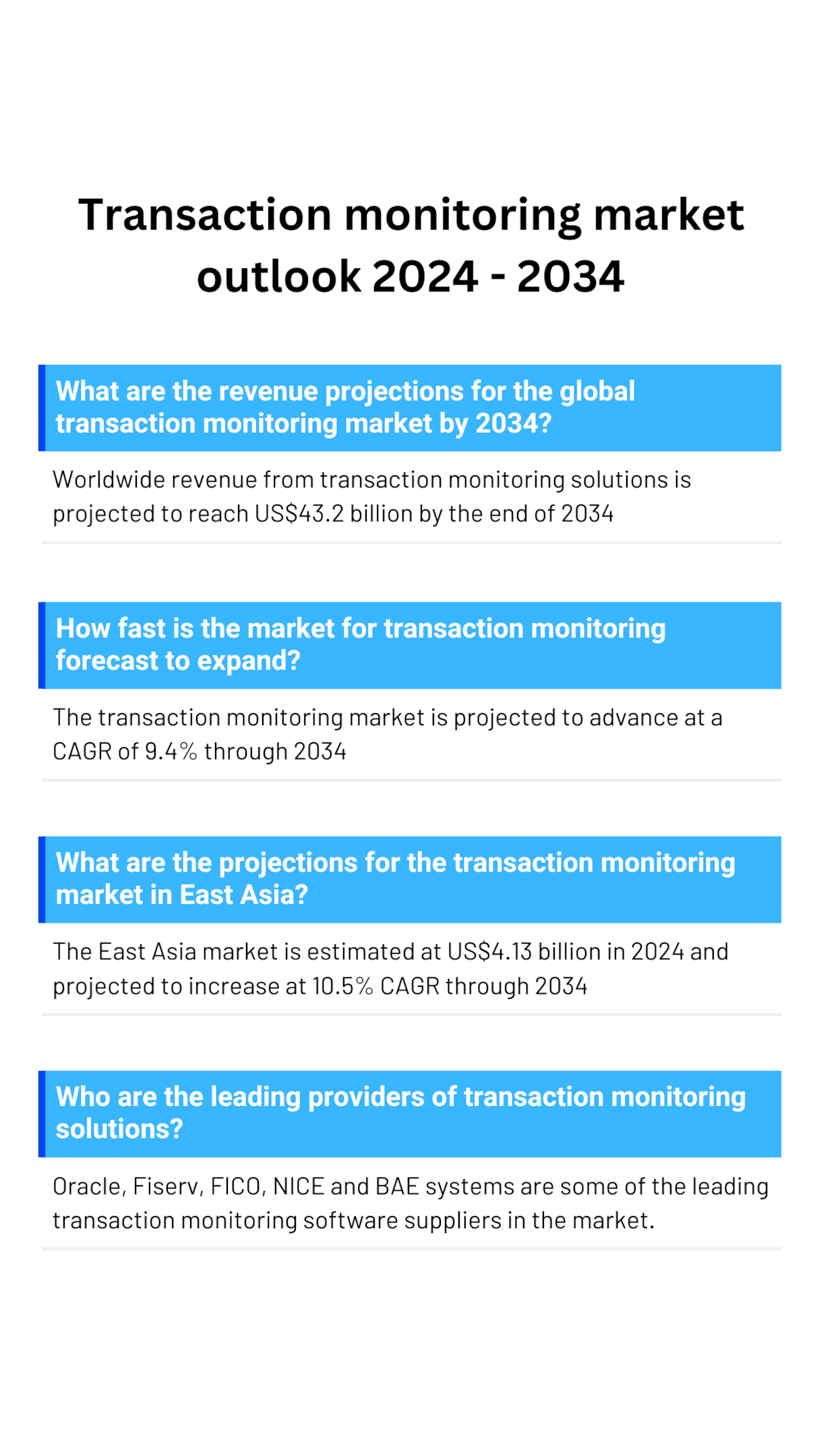
The transaction monitoring software market: growth 2025–2034
The case for investing in monitoring keeps getting stronger.
The global transaction monitoring software market is valued at USD 20.4 billion in 2025 and is projected to reach USD 52.8 billion by 2034 — a compound annual growth rate (CAGR) of 10.83% (IMARC Group, 2025). Forecasts vary by research firm; treat the CAGR trend, not the exact figure, as the takeaway.
What is transaction monitoring software?
It's less about watching transactions and more about understanding them.
Transaction monitoring software analyzes transaction patterns to protect financial systems — mitigating risk and helping organizations avoid costly penalties and reputational damage.
What does a transaction monitoring solution do?
The strongest transaction monitoring tools analyze customer transactions to detect suspicious activity, surfacing the anomalies and patterns that point to fraud or other illegal activity.
An advanced platform like IR Transact uses analytics to collect transaction data and bring visibility to your entire payments environment — in near real-time, not after the fact. That visibility also gives organizations a way to see customer transactions in context, analyzing historical data alongside current activity to spot what's changed.
Real-time vs. batch monitoring
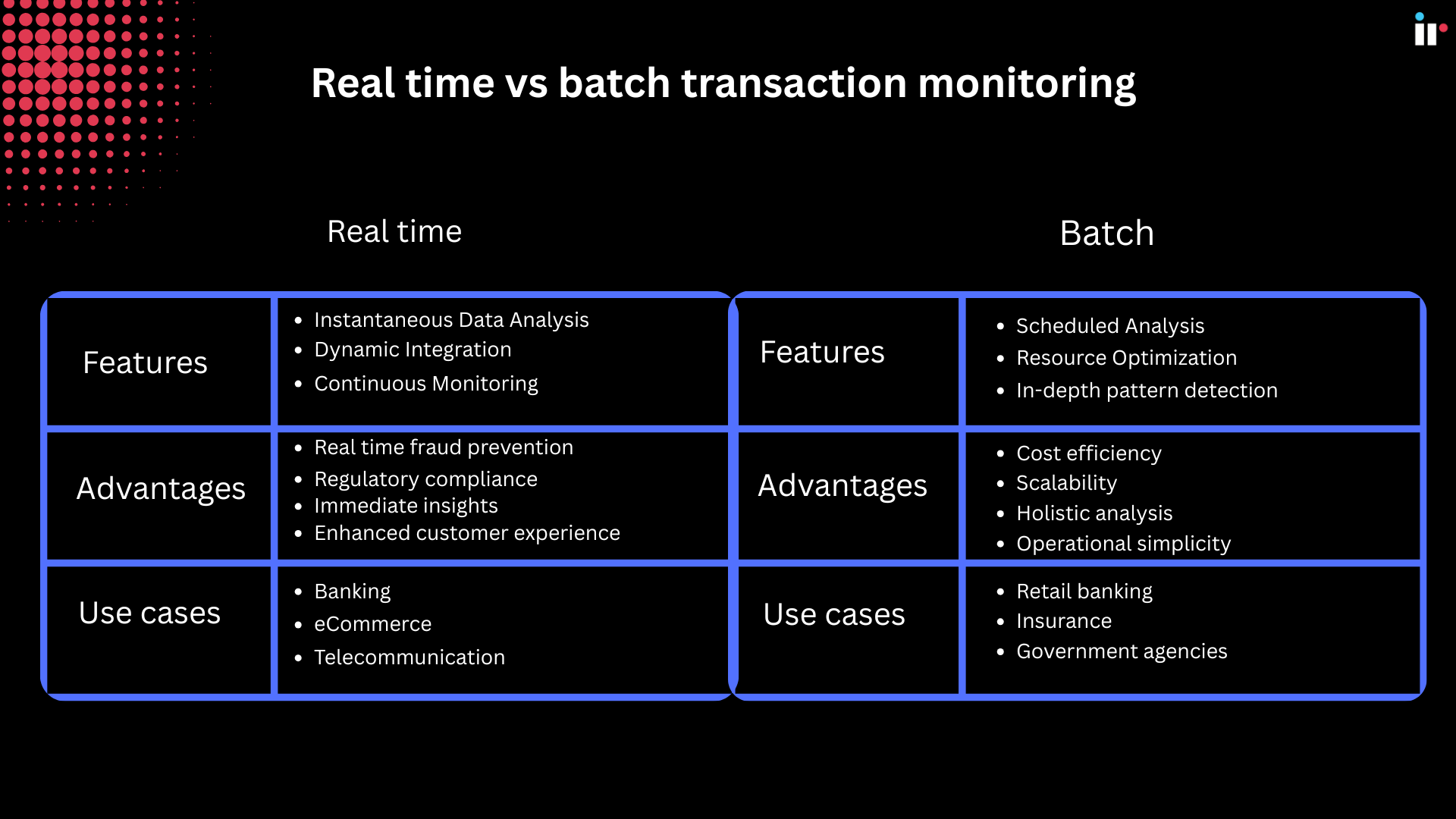
Real-time and batch transaction monitoring solve different problems. Most mature payments environments run both, rather than choosing one over the other.
| Real-time monitoring | Batch monitoring |
|---|---|
| Analyzes transactions as they happen, enabling immediate, proactive intervention on suspicious activity. | Processes transactions in sets — typically daily or weekly — enabling deeper analysis of long-term trends. |
Both approaches contribute the same underlying capability: identifying abnormal behavior, spotting suspicious transactions, and blocking high-risk activity before it damages the customer experience.
Industry use cases for transaction monitoring
- Banking:
Real-time monitoring detects unauthorized account activity — unusual withdrawals or transfers — as it happens. - E-commerce:
Real-time monitoring identifies and blocks fraudulent payment attempts, particularly during high-volume sales events. - Telecommunications:
Real-time monitoring flags unusual call routing behavior or suspicious prepaid account activity. - Retail banking:
Batch monitoring of daily account activity helps identify potential money laundering or fraud patterns. - Insurance:
Batch monitoring audits claims transactions to flag inconsistencies or suspicious patterns. - Government agencies:
Cross-institutional batch analysis helps identify large-scale money laundering operations.
How does transaction monitoring software work?
A workflow built to catch financial crime without stalling legitimate transactions.
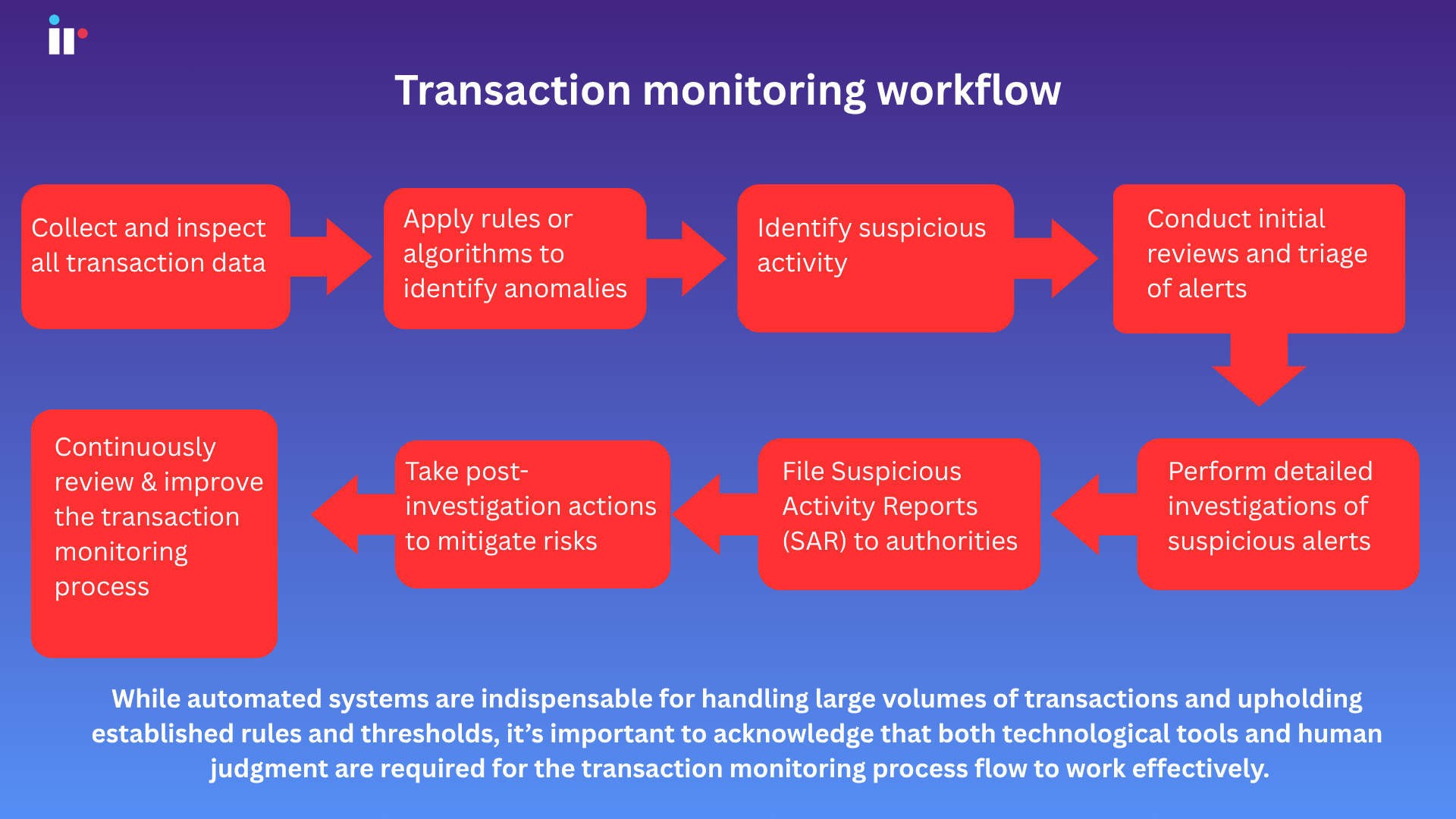
AML transaction monitoring exists to prevent financial crime — money laundering, terrorist financing — while protecting the reputation of the bank or financial organization behind it. Tools like IR Transact follow a common workflow:
- Collect and inspect all transaction data.
- Apply rules and algorithms to identify anomalies.
- Flag suspicious activity for review.
- Triage alerts through an initial review.
- Investigate flagged alerts in detail.
- File Suspicious Activity Reports (SARs) with regulators where required.
- Take post-investigation action to mitigate risk.
- Continuously review and refine the monitoring process.
False positives: the hidden cost of poor transaction monitoring
Not every alert is a threat — but every false alarm has a cost.
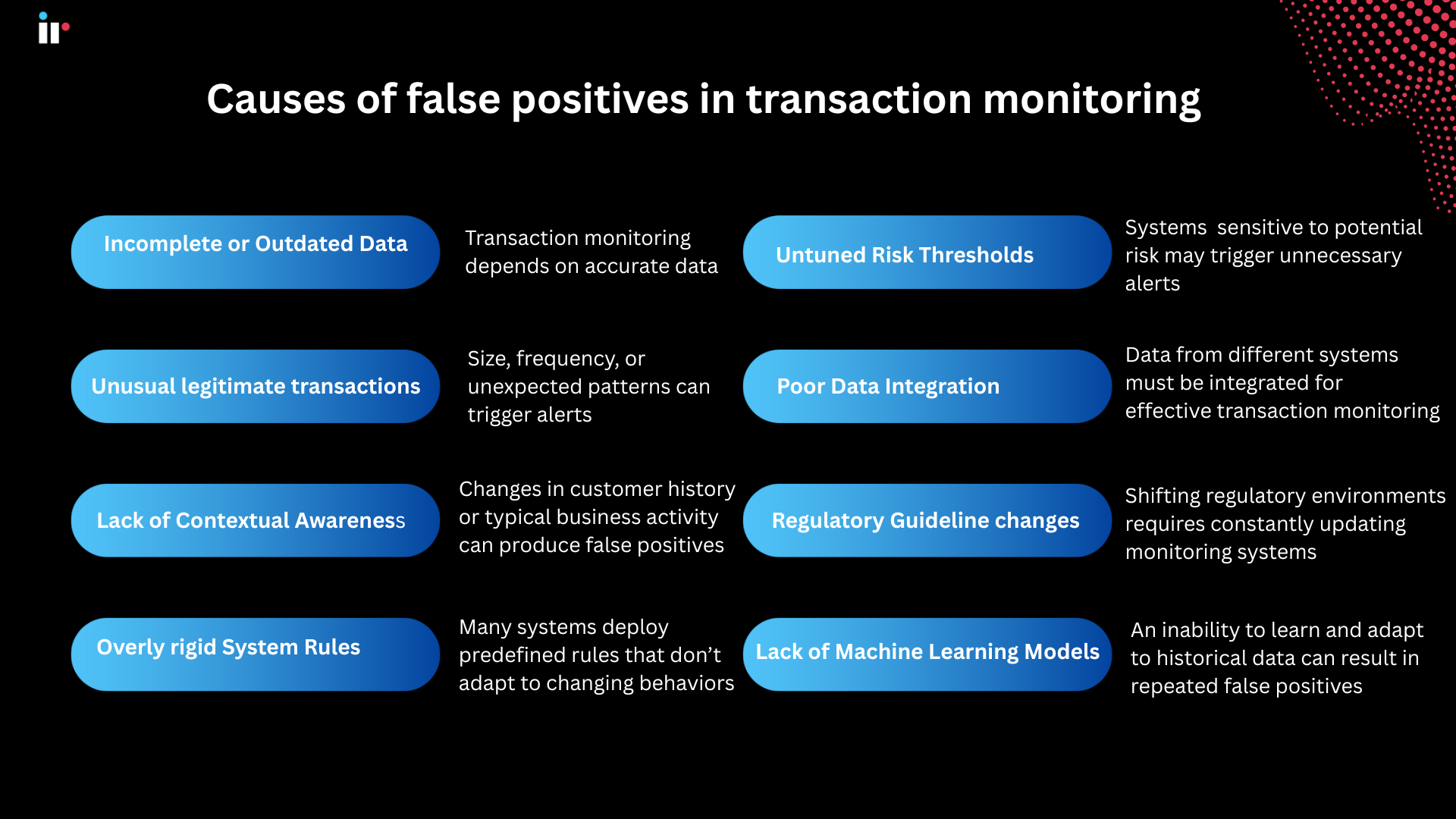
A monitoring tool flags unusual activity, but not every alert indicates real risk. False positives are typically caused by overly sensitive rules or incomplete, inaccurate data — and they're expensive to manage at scale.
The impact of false positives
- Higher compliance costs:
Compliance teams spend time and resources investigating transactions that were never suspicious. - Reduced operational efficiency:
Unnecessary investigations slow down operational processes across the board. - A worse customer experience:
Legitimate customers get wrongly flagged, creating friction at the worst possible moment. - Wasted analyst time:
Time spent ruling out false positives is time not spent on transactions that are genuinely suspicious.
How AI and machine learning cut false positive rates
The fix isn't stricter rules — it's smarter ones.
Machine learning and AI have extended transaction monitoring well past static, rule-based thresholds — automating tasks, reducing noise, and improving fraud detection accuracy in the process.
- Pattern recognition:
AI learns from historical transaction data to distinguish legitimate activity from suspicious activity — instead of flagging anything that crosses a fixed threshold. - Contextual intelligence:
AI-driven monitoring weighs customer history, transaction location, and business relationships to judge whether a flagged transaction is genuinely suspicious or simply unusual. - Workflow automation:
Automating routine tasks — generating SARs, prioritizing alerts — speeds up compliance workflows and improves detection accuracy at the same time. - Continuous adaptation:
Unlike static rule sets that need periodic manual updates, ML models adjust continuously as behavioral patterns change, helping teams review suspected fraud faster.
Why transaction monitoring is critical for financial institutions
Every organization in the payments chain needs the same thing: a clear view of what's actually happening.
To recognize fraud and other criminal activity, every financial organization, merchant acquirer, and payments processor needs comprehensive, real-time insight into transactions moving through their systems.
Want to go deeper on real-time monitoring specifically? Read our comprehensive guide
Key features to look for in a transaction monitoring system
Powerful enough to meet compliance requirements, flexible enough to keep up with them.
1. Risk scoring
Rule management sits at the core of every monitoring tool — triggering alerts based on your specific risk strategy, and assigning a risk score that decides whether a transaction is accepted, declined, or sent for manual review.
2. Sandbox environment
Risk rules need testing against both live and historical data before they go live, so the ability to test in sandbox mode is what keeps false positive and false negative rates in check.
3. Real-time alerts
AML transaction monitoring has to detect suspicious activity and surface it almost instantly — supporting compliance while keeping friction away from legitimate customers.
4. Custom rule management
Compliance requirements change constantly, so your team needs to create, edit, and update rules without waiting on developer time.
How IR Transact can help
From reactive problem-solving to proactive resilience.
IR Transact gives payments teams real-time visibility across their entire environment — and turns that visibility into decisions, not just alerts.
- Customizable dashboards:
See the information most relevant to your specific payments environment, not a generic view built for someone else's. - Data made usable:
Complex data sets are translated into information your team can act on, not just read. - Your own rules:
Add and adjust alert rules yourselves to reduce false positives, without depending on IR or your internal dev team. - End-to-end observability:
Track performance across your entire payments ecosystem — from infrastructure to individual transaction flows — so issues surface before they escalate.
Transaction monitoring software matters for risk management and compliance, but it also improves operational efficiency — analyzing large volumes of data quickly enough that teams spend less time chasing noise and more time on the transactions that actually need attention.

Frequently asked questions
Q: What is transaction monitoring software?
A: Transaction monitoring software continuously tracks and analyzes customer transactions to identify unusual or potentially suspicious activity. It's a core part of anti-money laundering (AML) compliance programs, and it also helps detect fraud and other illicit activity.
Q: Why is transaction monitoring software important?
A: It helps organizations comply with AML regulations, catch fraud earlier, protect against reputational damage, and improve the overall customer experience by reducing friction on legitimate transactions.
Q: What key features should transaction monitoring software have?
A: Seamless integration with existing banking and financial systems; real-time monitoring; automated anomaly detection; risk scoring; customizable rules; and AI/ML capabilities that improve alert accuracy over time.
Q: What are the key challenges in implementing transaction monitoring software?
A: Managing high transaction volumes, controlling false positive and false negative rates, keeping pace with evolving fraud techniques, achieving true real-time processing, maintaining data quality across legacy systems and silos, and navigating regulatory complexity.
Q: How can organizations overcome these challenges?
A: Choose software that's fully customizable and integrates with existing systems; improve data quality through APIs and middleware; adopt a risk-based approach built on customer behavior and transaction profiles; use AI to automate alert triage and reduce false positives; and regularly review monitoring rules against current regulatory requirements.
Conclusion
The tools have changed. The stakes haven't.
AML transaction monitoring used to mean rules, thresholds, and a growing backlog of alerts to clear. AI and machine learning have changed what "keeping up" looks like — but the goal is unchanged: catch what's genuinely suspicious, clear what isn't, and keep the payments experience moving for everyone else. The organizations getting this right are the ones treating monitoring as a source of business insight, not just a compliance checkbox.