


.png?width=141&height=141&name=Transact%20(1).png)






.svg)

.svg)
.svg)
.svg)


%201.svg)

















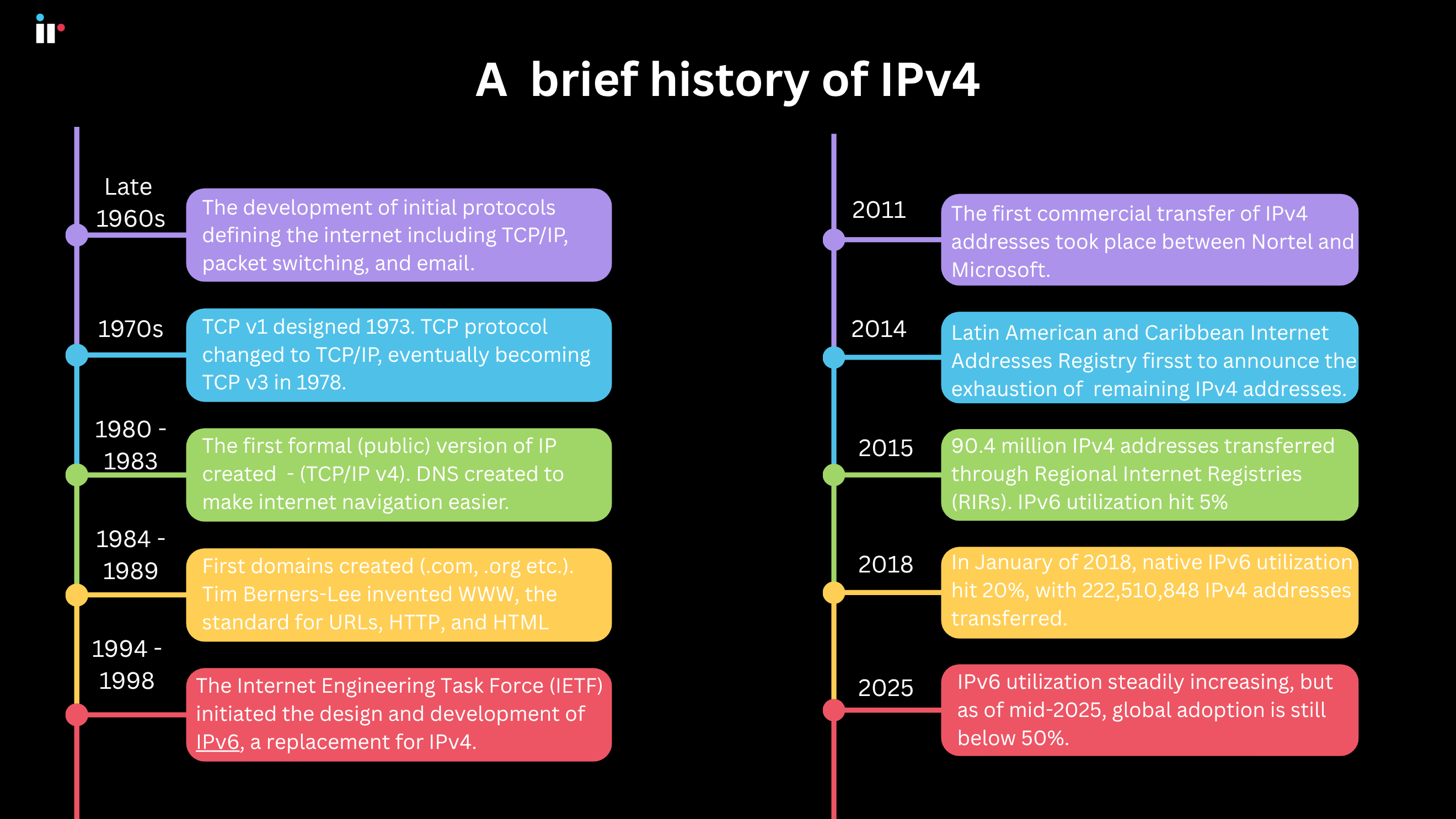
When the internet first came to be, every internet-connected computer was assigned a unique public IP address. At the time, there seemed to be an ample supply of addresses, with nearly 4.3 billion values, but by the late 1980s, IPv4 exhaustion became a problem for carriers and subscribers.
The industry needed a long-term solution, beginning with creating a new protocol for the rapidly growing number of internet connected devices.
What is IPv4 - IPv6 Migration?
Seamless communication across the globe depends on IP addresses, specifically IPv4 and IPv6. These two protocols play a critical role in ensuring that digital interactions across all network devices happen flawlessly, but the rapid exhaustion of IPv4 addresses has called for IPv6 transition sooner rather than later.
The current hybrid environment encompasses both IPv4 and IPv6, but the gradual transition to IPv6 has led to the introduction of transition mechanisms to ease transition and extend the life of existing IPv4 infrastructures.
Transition technologies are crucial for conserving the limited number of public IPv4 addresses and provide a degree of security by hiding the structure of the private network.
Enterprises can achieve seamless IPv6 migration by supporting both IPv4 preservation and translation and tunneling between IPv4 and IPv6 networks.
-
Network Address Translation (NAT) solutions allow a single IPv4 address to be shared throughout the existing network infrastructure, across multiple connected devices or sites. This means that organizations can leverage their existing investment in IPv4 and avoid purchasing additional and costly IPv4 addresses.
-
NAT Protocol Translation (NAT-PT) is a service that converts IPv4 addresses into IPv6, and vice versa.
Understanding the IPv4 Address Exhaustion Crisis
The rapid growth of traffic on the internet, fueled by the increasing number of users, devices (including mobile phones and IoT devices), and always-on connectivity, has dramatically increased the demand for IP addresses.
The exhaustion problem is largely due to the initial design of IPv4, which was not originally intended for the scale of today's internet. Constantly advancing technologies, and the proliferation of devices like computers, smartphones, IoT devices, etc. have far outstripped the available IPv4 addresses.
IPv4 to IPv6 Benefits for Enterprise Networks
IPv6 transition will offer several key benefits for enterprise organizations, primarily focusing on enhanced security, improved scalability, and greater efficiency.
1. Expanded Address Space
-
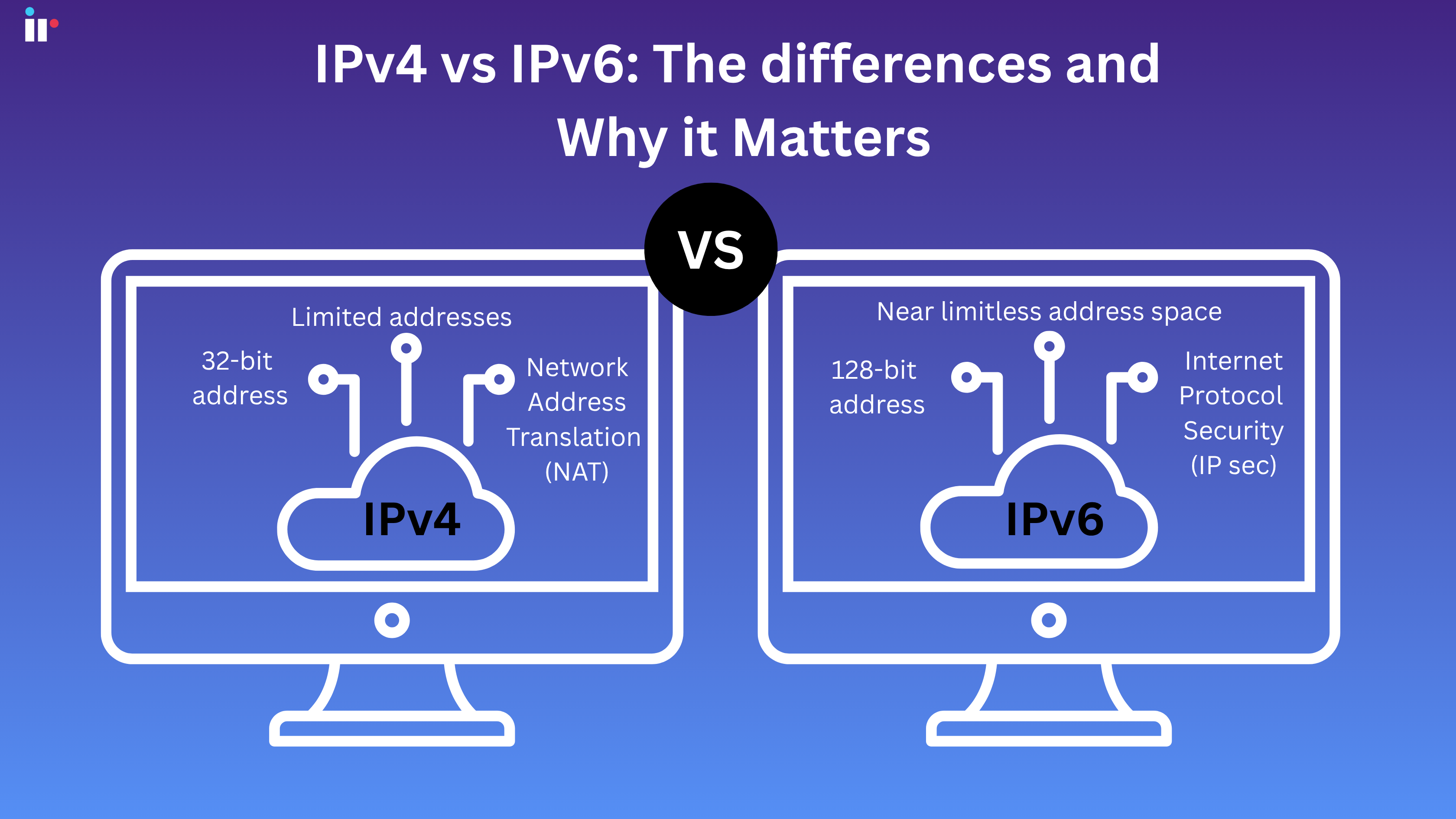
The main benefit of IPv6 is that it provides a significantly larger address space (128 bits) compared to IPv4 (32 bits), effectively eliminating address exhaustion concerns for growing networks.
-
IPv6 allows for unique, publicly routable IP addresses for every device on the network without the need for NAT.
-
Built-in security features
-
More detail in a streamlined header structure
2. Enhanced Security
-
IPv6 includes built-in encryption and authentication for data packets, strengthening network security by protecting data confidentiality and integrity.
-
IPv6 also includes secure neighbor discovery, which helps prevent attacks like neighbor spoofing
3. Improved Routing Efficiency
-
IPv6 offers more efficient routing compared to IPv4. This can mean faster data transmission and reduced latency, resulting in quicker website loading times and smoother user experiences. The simplified header structure and absence of NAT reduces processing overheads on network devices, and enhances network performance even further.
4. Better Support for Emerging Technologies
-
IPv6 transition will provide better support for emerging technologies like virtualization, cloud computing, and the Internet of Things (IoT).
Why Enterprises Must Migrate from IPv4 to IPv6 Now
It's important that enterprise organizations migrate from IPv4 to IPv6 as soon as possible.
The exhaustion of available IPv4 addresses, the need for improved security, and the demand for increased network efficiency means that IPv4 will no longer be able to support future growth and new technologies.
IPv4 Address Scarcity and Rising Costs
While IPv4 to IPv6 migration involves initial costs, the long-term benefits of improved efficiency, security, and future-proofing far outweighs this. Additionally, the cost of IPv4 addresses is increasing as they become more scarce.
Government Mandates and Compliance Requirements
The U.S. Federal Government has mandated a deadline for the IPv4 and IPv6 transition, of September 30, 2025. This entails organizations having at least 80% of their IP-enabled internet assets running on IPv6.
IPv4 vs IPv6 Address Assignment: Technical Comparison for Decision Makers
-
Address Length: IPv4 addresses are 32 bits long, while IPv6 addresses are 128 bits long.
-
Address Space: IPv4 supports approximately 4.3 billion addresses. IPv6 Supports 340 undecillion addresses. This is over 79 octillion times more than IPv4.
-
Address Representation: IPv4 addresses are typically written in dotted-decimal notation (e.g., 192.168.1.1), while IPv6 addresses use hexadecimal notation with colons separating the eight 16-bit groups, for example: 2001:0db8:85a3:0000:0000:8a2e:0370:7334
-
Routing and Addressing: IPv6 simplifies routing with features like stateless address autoconfiguration (SLAAC) and better routing header structures. It also includes built-in security features with IPSec.
IPv6 Migration Strategies: Choosing the Right Approach
While IPv4 and IPv6 are still being used concurrently, IPv6 migration strategies depend on specific network environment and resources.
Different methods and most common strategies include:
Dual-Stack Network Implementation (Recommended for Most Enterprises)
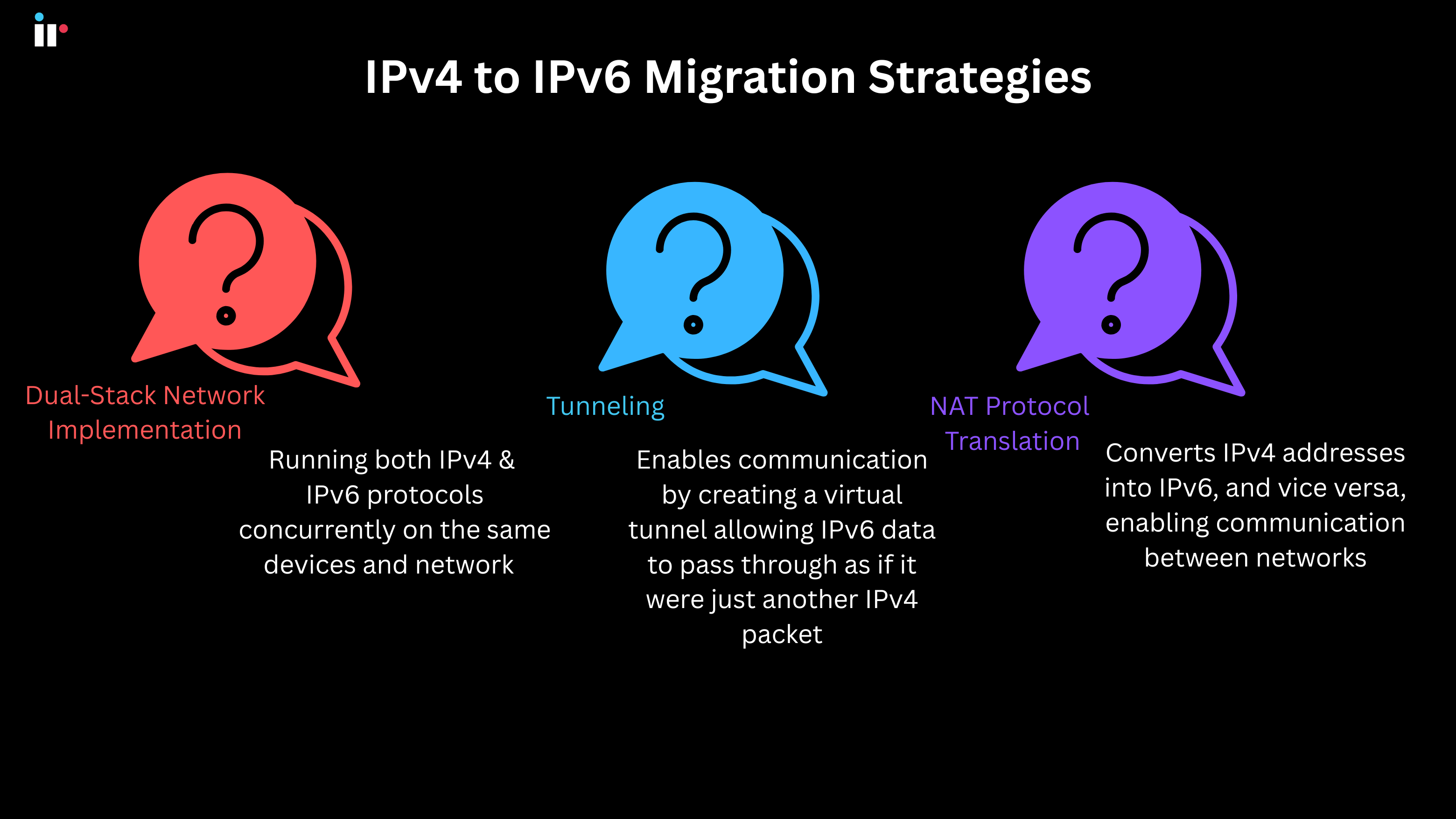
This approach involves running both IPv4 and IPv6 protocols on the same devices and network infrastructure. A server tha has been configured with both IPv4 and IPv6 addresses can communicate with all hosts of IPv4 and IPv6 via dual-stack router (DSR).
The dual stack router (DSR) creates the path for all the hosts to communicate with the server without changing their IP addresses.
-
Pros: Dual stack mode is the simplest to implement and provides a straightforward path for transitioning.
-
Cons: A dual stack router requires all network devices and endpoints to be IPv6-compatible, which may call for upgrades or replacements.
Tunneling
While a dual-stack router allows both IPv4 and IPv6 networks to run concurrently, tunneling is a technique that enables communication by essentially creating a virtual tunnel through the IPv4 network, allowing IPv6 data to pass through as if it were just another IPv4 packet.
-
Pros: Tunneling is useful for connecting IPv6 islands or when gradual migration is needed, especially when dealing with legacy IPv4 equipment.
-
Cons: Adds complexity to network management and can introduce latency
NAT Protocol Translation
NAT Protocol Translation (NAT-PT) is a service that converts IPv4 addresses into IPv6, and vice versa, enabling communication between IPv4 and IPv6 networks. NAT protocol translation mechanisms work by converting packets from one format to the other, allowing devices on either network to communicate with devices on the other, even if they don't natively support the other protocol.
-
Pros: Enables a phased migration from IPv4 to IPv6, rather than a complete changeover, which can be disruptive.
-
Cons: Can introduce performance overhead and may not be suitable for all applications.
Creating an IPv6 Network from Scratch
Some organizations will want to start fresh with an IPv6 network. Waiting for the next network hardware refresh cycle can provide opportunities to build a new network without using dual stacks or tunnels. This can eliminate reliance on translation methodologies, and greatly simplify the transition process.
Step-by-Step IPv4 to IPv6 Migration Process
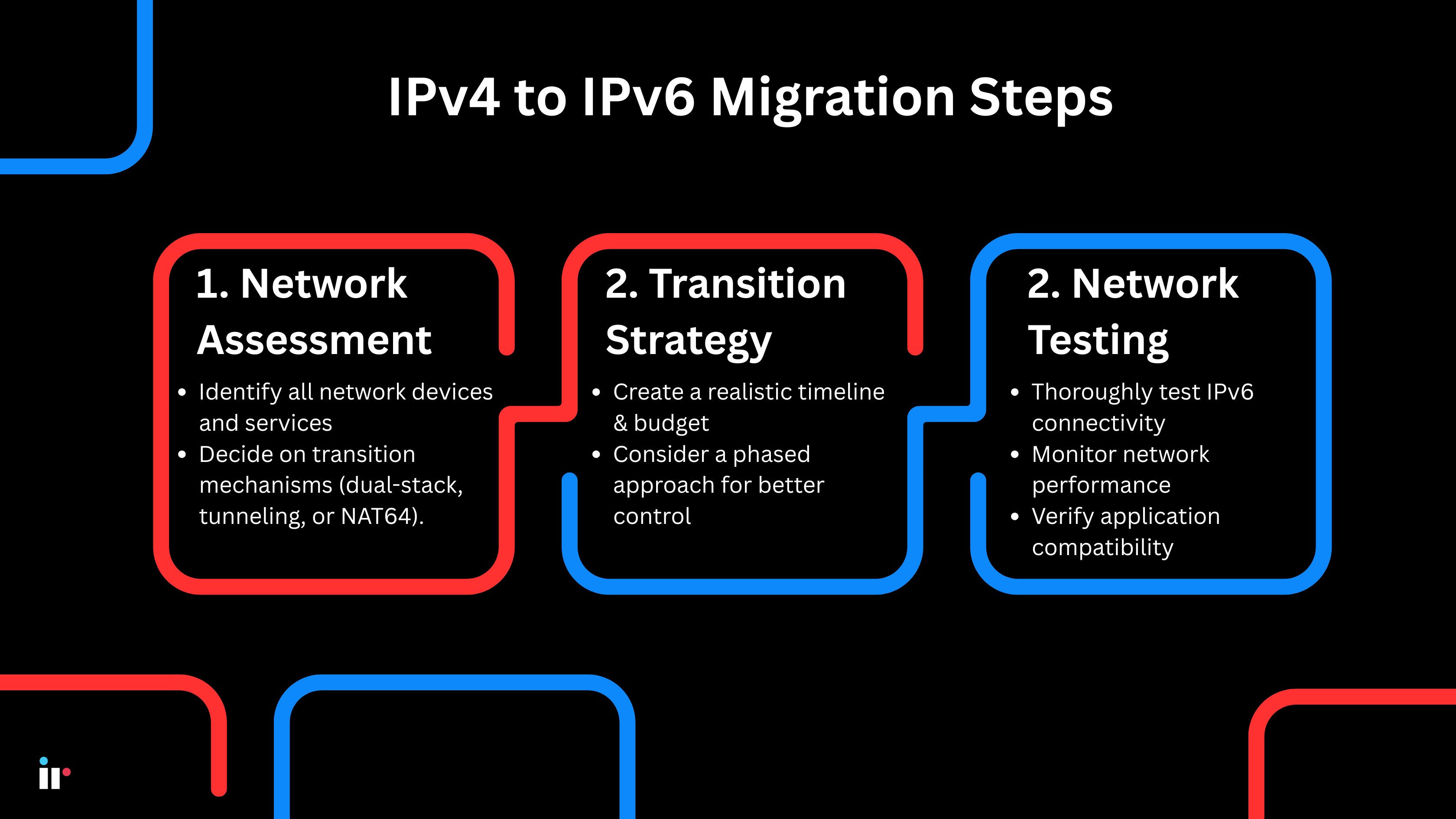
The IPv4 to IPv6 migration involves assessing your current network, planning the transition, deploying IPv6, testing, and finally migrating your network to IPv6.
1. Assess Your Network
-
Identify all devices and services on your network
-
Decide which transition mechanisms (dual-stack, tunneling, or NAT64) will be used based on your network's needs
2. Develop a Transition Strategy
-
Create a realistic timeline and budget for the migration, considering the complexity of your network and the resources available.
-
Consider a phased approach, starting with external-facing services like websites and email before migrating internal systems.
3. Test Your Network
-
Thoroughly test IPv6 connectivity and monitor network performance to ensure everything is working as expected.
-
Verify that your applications are compatible and work correctly with IPv6.
-
Ensure that IPv6 security mechanisms are properly configured.
IPv6 Network Monitoring and Management
By leveraging monitoring and management tools like IR Collaborate, and understanding the different transition mechanisms, network administrators can effectively manage the transition from IPv4 to IPv6 and ensure a seamless experience for users.
How IR Collaborate Streamlines IPv6 Migration Projects
-
IR Collaborate can provide enhanced visibility and control, enabling dual stack management, and a unified view of both IPv4 and IPv6 networks. This allows administrators to monitor and manage devices and services running on either protocol.
-
Our software can efficiently track and manage IPv4 and IPv6 address allocation, preventing conflicts and optimizing resource utilization.
-
Organizations can track key performance indicators (KPIs) for both IPv4 and IPv6 traffic, identifying bottlenecks and performance degradation during the transition.
-
Our tools collect logs and data from various network devices, allowing for centralized analysis and faster troubleshooting of issues related to dual-stack configurations or protocol transitions.
-
Our solutions offer built-in diagnostic tools for IPv6, such as ping6 and traceroute6, to verify connectivity and identify routing issues.
FAQS
General questions
Q: Why is IPv6 replacing IPv4?
A: IPv6 is the latest IP version, designed to replace IPv4, due to the exhaustion of IPv4 addresses. IPv6 offers a significantly larger address space and improved features.
Q: What are the advantages of IPv6?
A: IPv6 offers a larger address space, built-in security features like IPsec, simplified routing, and improved network efficiency.
Q: Can IPv4 and IPv6 be used simultaneously?
A: Yes, dual-stack networks allow both protocols to coexist, which is common during the transition
Transitioning to IPv6
Q: How difficult is it to transition to IPv6?
A: Transitioning to IPv6 can be a challenge for enterprise organizations, due to a variety of factors, including the need for new hardware and software, complex DNS configurations, and the cost of implementation.
Q: Is new hardware necessary to support IPv6?
A: Many modern devices and routers are already IPv6 compatible. Older hardware may require updates or replacement.
Q: What is the process of transitioning to IPv6?
A: Transitioning involves options including dual-stack implementation (running both IPv4 and IPv6), IPv6 tunneling, or using NAT protocol translation.
Q: When will the global transition to IPv6 be complete?
A: There is no definitive timeline for a complete transition, but experts predict it may not be complete for at least two more decades.
Security
Q: How does security compare between IPv6 and IPv4?
A: IPv4 does not include encryption or authentication as core features. IPv6 has built-in security features like IPsec, which can improve network security. However, proper configuration is important to avoid vulnerabilities.