


.png?width=141&height=141&name=Transact%20(1).png)






.svg)

.svg)
.svg)
.svg)


%201.svg)
















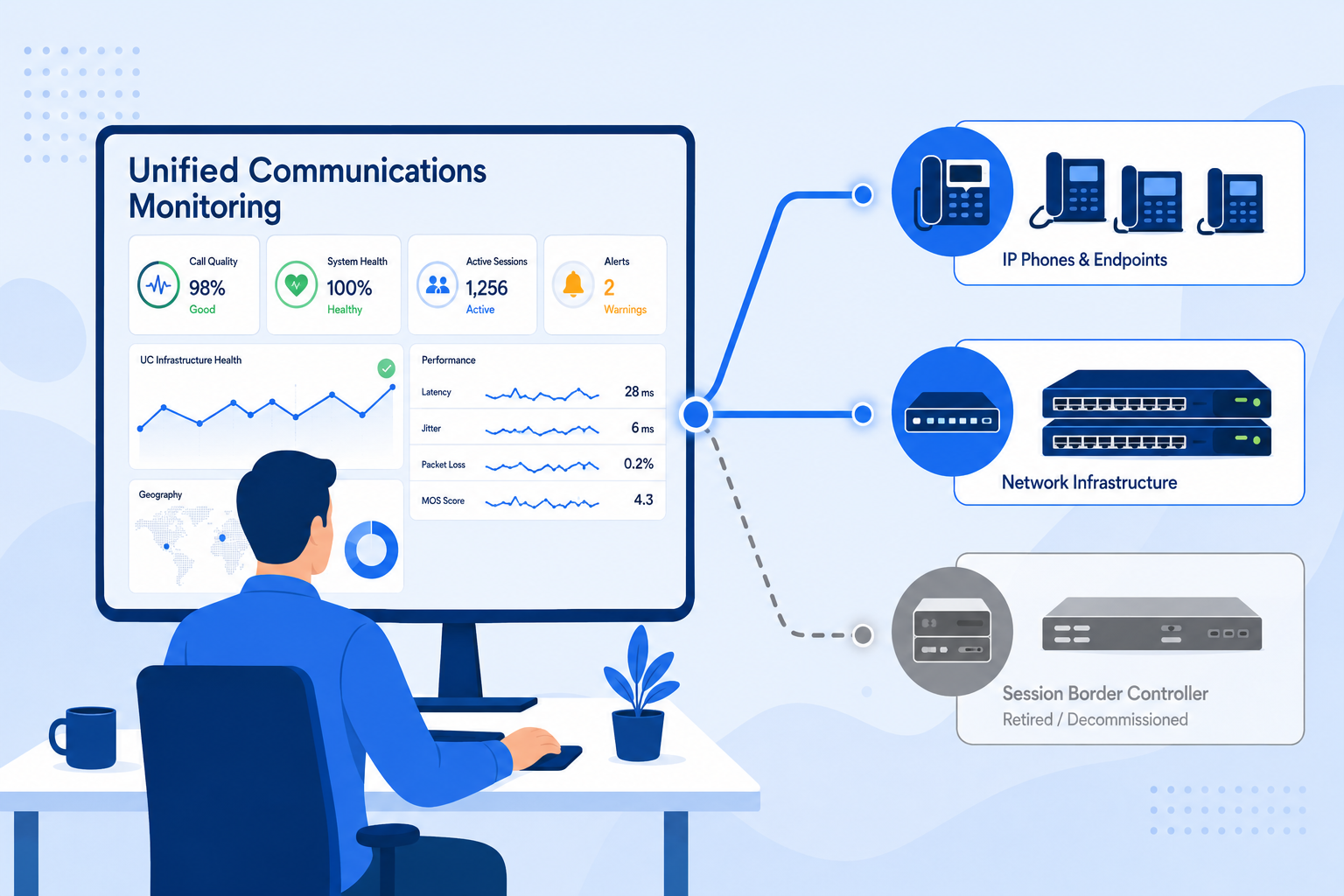
One of the most common problems Cisco users mention to us is the simple inability to place or receive calls. It’s rarely a one-cause problem, and teams that grew used to checking Cisco Prime first don’t always have the full picture they need for a fast fix – especially now that Cisco has retired the tool.
If the issue is inside Cisco Unified Communications Manager, Cisco’s own tooling may still surface it. If it’s happening outside the Cisco environment – on a non-Cisco device, a misconfigured session border controller, a flaky WAN link – Cisco was never built to see it, and Cisco Prime isn’t there to check anymore either way. That’s where a unified communications troubleshooting system like IR Collaborate takes over. It doesn’t just identify the issue inside Cisco – it can troubleshoot beyond Cisco’s software, hardware, and network entirely, across voice, video, and contact center traffic alike.
Troubleshooting Cisco Unified Communications: Disrupted Service and Failed Calls
Start by confirming whether the fault sits inside Cisco or beyond it.
When a Cisco user can’t place or receive calls, the first job is narrowing down where the fault actually lives. IR Collaborate alerts an administrator to exactly which user or group of users is affected, then lets you drill from that alert down to individual users and the specific call legs involved – rather than working through the whole cluster one ticket at a time.
Take a typical example: a user reports dropped calls at random points during the day, with no obvious pattern from the help desk logs alone. Rather than guessing, IR Collaborate lets you trace the call path end to end and surface the cause – in this case a configuration issue on a non-Cisco session border controller interacting with Cisco Unified Communications Manager. Because IR Collaborate isn’t a single-vendor tool, it crosses that boundary automatically instead of stopping at Cisco’s edge, so your team can resolve the issue before customers or employees ever notice a disruption.
Now That Cisco Prime Is Retired, Who Diagnoses the First Failure?
Cisco’s own monitoring and diagnostics tool for CUCM no longer exists.
For years, Cisco Prime Collaboration Assurance and Analytics (PCA) was the default first stop for Cisco UC teams triaging a failed call. Cisco announced end-of-sale for PCA in October 2021, and end-of-support followed on October 31, 2024. Past that date, the product is fully obsolete, with no replacement on Cisco’s own roadmap.
That leaves a real operational gap, not just a licensing one – and it doesn’t only affect Cisco-only environments. Most enterprise UC estates already blend Cisco with other vendors, which means the multi-vendor visibility IR Collaborate provides was always the more complete answer. Now it’s also the only actively supported one for that first line of diagnosis. If your team leaned on Cisco Prime to confirm whether a problem was even a Cisco problem in the first place, that step needs a new home before the next outage, not after it.
Practically, that means auditing where Cisco Prime still shows up in your team’s troubleshooting workflow today – whether that’s a documented runbook step or just institutional habit – and confirming a replacement is in place before the next major incident, not mid-incident.
Tracking Down the Cause of a Problem in Cisco Unified Communications
The path from alert to root cause takes minutes, not a war room.
IR Collaborate’s welcome screen lets administrators drill straight down to the Communications Manager cluster where a service interruption has been flagged. From there, view cluster-level performance, drill into the specific alerts IR Collaborate has raised for that cluster, or search historical calls for a particular user.
If the disruption is tied to one person, drill down to their extension and review recent calls for the tell-tale signs: zero-duration calls, an abnormal release code, or a pattern that only shows up at certain times of day or from certain locations. Cross-reference that against call quality indicators like jitter and packet loss, and you can usually tell within minutes whether you’re looking at a device issue, a network issue, or a Cisco configuration issue. IR Collaborate organizes that information across every system in your UC ecosystem, so your team can go straight to the point of failure instead of working backward through logs one system at a time.
How IR Collaborate Can Help
One dashboard, every vendor, inside and outside Cisco.
IR Collaborate makes Cisco troubleshooting fast through a single, purpose-built dashboard: visualize the issue, drill into the affected area of the network, and see the likely cause without switching tools. And because Cisco Prime’s monitoring stopped at the Cisco boundary even before its retirement, IR Collaborate’s reach was always broader – covering Cisco voice, video conferencing, and contact center environments alongside every other vendor in the stack, plus the testing needed to catch problems before users report them.
- Cross-vendor visibility:
See Cisco Unified Communications Manager alongside every non-Cisco device, SBC, and application in the same call path. - User- and cluster-level drill-down:
Move from a cluster-wide alert to the specific user, call, or extension in a few clicks. - Root-cause detail:
Surface release codes, call duration anomalies, and configuration issues – not just an alert that something is wrong. - End-to-end coverage:
Extend the same visibility across voice, video conferencing, and contact center traffic, not just desk phone calls.
Explore what IR Collaborate can do for your Cisco environment, or get a demo to see it against your own UC ecosystem.
Read more related articles on Cisco UC: