


.png?width=141&height=141&name=Transact%20(1).png)






.svg)

.svg)
.svg)
.svg)


%201.svg)
















With Unified Communication & Collaboration (UC&C) markets continuing to expand globally, many organizations assume that on-premises UC is ‘legacy’, and should be phased out.
UC&C market size and outlook
The global UC&C market was estimated at ~ USD 136.2 billion in 2023, with forecasts toward USD 595.1 billion by 2032.
In the Asia Pacific region specifically, the UC&C market is projected to reach ~ USD 31.4 billion in 2025, and is anticipated to grow at a CAGR of 17.4% - attaining USD 96.1 billion by 2032.
The global Unified Communication as a Service (UCaaS) market size was valued at USD 70.50 billion in 2024, calculated at USD 84.9 billion in 2025 and is expected to reach around USD 433.29 billion by 2034. This represents a CAGR of 18% from 2025 to 2034.

Why on-prem is a control strategy, not a relic
In the APAC region, however, it’s far from outdated. On-prem UC remains prevalent, particularly among large enterprises, in regulated and latency-sensitive industries like banking and government, who need strict control over compliance and sensitive data.
That said, with UCaaS adoption accelerating across the region, there’s a strong and growing trend towards cloud-based and hybrid solutions - driven by the need for flexibility, and support for hybrid work models.
In these industries, the control of on-premises UC systems, combined with the agility and scalability of the cloud, can balance the benefits of cost optimization and enhanced operational flexibility.
Regulation & data residency
Some APAC markets, for example Singapore, Australia, India, etc., have strict rules about where voice or call metadata can reside. Pure cloud infrastructure can sometimes fail compliance.
Predictability & governance
On-prem UC components can provide a tighter control over upgrades, customizations, quality tuning, and fault isolation.
Latency / performance / deterministic quality
For certain voice paths (especially inter-site or PSTN breakouts), on‐prem UC can have lower jitter issues, better QoS, and fewer cloud network glitches.
Hybrid as risk mitigation
Hybrid allows you to partition sensitive workloads to your own infrastructure while leveraging the benefits of cloud communication for burst or collaboration.
Why hybrid is a realistic default
As organizations across APAC modernize their communications environments, few are making the leap to cloud-only architectures.
Instead, hybrid UC has become the pragmatic default - not out of reluctance, but necessity.
From uneven backbone infrastructure and latency between regional sites - to strict regulatory frameworks governing data flow and sovereignty, the region’s complexity demands flexibility.
Hybrid allows enterprises to optimize for reliability, compliance, and performance, keeping what must stay local, while taking advantage of the agility and innovation of the cloud.
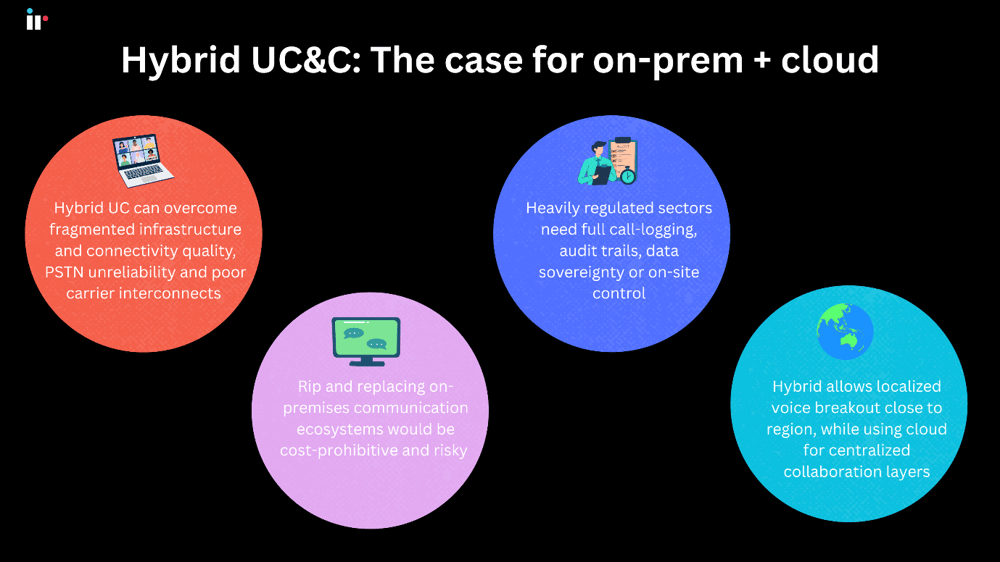
- Some APAC regions still have fragmented infrastructure and connectivity quality, PSTN unreliability and poor carrier interconnects. Hybrid UC can overcome this.
- Heavily regulated sectors like finance, healthcare and government often demand full call-logging, audit trails, data sovereignty or on-site control.
- Many enterprises have vendor specific on-prem communications ecosystems such as from Cisco or Avaya, so ripping and replacing would be cost-prohibitive and risky.
- With geographic spread, hybrid allows voice breakout to be localized close to region, while using cloud for centralized collaboration layers.
Employee Experience (EX), Customer Experience (CX)
In the world of employee and customer experience, reliability and voice quality is non-negotiable.
For frontline teams in healthcare, banking, logistics, and customer service, a dropped call can mean lost trust or lost revenue, so many organizations are keeping the critical voice layer close to home.
Maintaining on-prem SBCs, dial plans, and QoS controls ensures consistent call quality, even in regions with variable connectivity.
At the same time, layering cloud-based video, messaging, and collaboration tools delivers flexibility and innovation where it matters most. Hybrid UC gives enterprises the best of both worlds: dependable voice for the frontlines, and modern, cloud-powered experiences for everyone else.
Addressing common pain points
While hybrid UC offers clear advantages, it also introduces new layers of complexity.
Enterprises across APAC and globally, are balancing legacy infrastructure, regulatory mandates, and the unpredictable realities of regional connectivity.
From compliance and data sovereignty to voice quality and upgrade cycles, each challenge has the potential to undermine reliability if not properly managed.
The table below highlights some of the most common pain points - and how a thoughtful hybrid strategy can help address them.
| Pain Point | Mitigation |
| Compliance / data residency | Hybrid allows localized call detail / logs / sensitive metadata on-prem, while using cloud for non-sensitive workloads. |
| PSTN reliability / carrier access | Use local breakouts with redundant on-prem SBCs, multi-carrier routing, fallback paths, and active monitoring. |
| Site-to-site jitter, packet loss | On-prem voice routing for internal calls, reducing dependency on inter-site WAN to carry real-time media across cloud segments. Use MPLS or controlled circuits for critical voice paths. |
| Upgrade debt / CUCM entanglement | Migrate in phases. Use hybrid UC as a bridge. Don’t force rip & replace; gradually retire or consolidate under observation. |
| Operational complexity | Hybrid may be more complex, but this is exactly why you need monitoring, for visibility, diagnostics, and orchestration tools. |
How IR Collaborate can help
With remote and hybrid working, and the fast implementation of cloud collaboration platforms, organizations all over the globe are tasked with managing increasingly complex unified communications environments to ensure the lines of communication are always open.
IR Collaborate’s advanced monitoring and performance management features help you avoid, and quickly find and resolve performance issues in real-time – across your on-premises, cloud or hybrid environments.
- Multi-vendor visibility & orchestration: We support Cisco, Avaya, Teams Direct Routing, etc., in a unified monitoring plane.
- MOS / jitter / packet loss: Not just real time, but historical trend baselines, alerts on drift, and correlation with events.
- SIP ladder diagnostics & trunk health monitoring: Allowing you to easily highlight SIP trunk anomalies, routing problems, error rates, call failure causes.
- Capacity forecasting & usage planning: Project trunk growth, bandwidth needs, oversubscription margins, seasonal trends.
- Alarm correlation & root-cause insights: Correlate network-layer events, routing changes, carrier failures, regional issues.
- End-to-end UX monitoring: You can detect when agents or remote users are experiencing degraded UX, call quality issues, jitter, packet loss, etc.
Conclusion
In 2026 and beyond, we’ll see the “on-prem vs cloud” dichotomy becoming outdated.
The real issues for enterprise organizations are control, performance, compliance, and operational visibility. Hybrid UC, when well-planned and administered, is becoming the default posture for enterprises in APAC, and globally.
If organizations want reliable calling, future-proof growth, and risk-managed evolution, they won’t abandon on-prem; they’ll master it with hybrid orchestration.
Find out how IR Collaborate can give you end-to-end visibility, diagnostics, and forecasting in a hybrid UC environment to fit your architecture.