

The transition from monitoring to observability represents one of the most significant shifts in how enterprises will manage complex systems moving forward.
Traditional monitoring tools that served organizations well for decades now struggle with distributed systems, microservices architectures, and the massive telemetry data volumes generated by modern applications.
A payment processor managing millions of daily transactions can't afford to discover system degradation only after customers report failed authorizations. A unified communications platform serving global enterprises needs to understand why video quality degrades before users experience dropped calls. These scenarios demand more than traditional monitoring practices.
This guide provides a complete roadmap for enterprises navigating this critical transition from monitoring to observability.
What does transitioning from monitoring to observability mean?
Basically, it means evolving from reactive system health checks based on predefined metrics to proactive, comprehensive understanding of complex system behaviors through unified analysis of metrics, logs, and traces.
Traditional monitoring focuses on known failure modes, setting thresholds for CPU usage, memory consumption, or response times, then alerting when those thresholds are breached. It answers the question "Is this specific thing broken?"
Observability enables you to explore system behavior dynamically, ask questions you didn't anticipate, understand relationships between distributed components, and identify root causes of issues in complex IT environments. It answers "Why is this happening, what else is affected, and how do we prevent it?"
The key differences:
- Monitoring tells you when something breaks; observability reveals why it broke
- Monitoring works with predefined metrics; observability lets you query arbitrary system data
- Monitoring focuses on individual components; observability understands distributed systems holistically
- Monitoring is reactive; observability enables proactive problem prevention
For enterprises managing distributed architectures, multi-vendor environments, or business-critical systems where downtime has an immediate impact on revenue, this transition is no longer optional...it's essential for maintaining system reliability at scale.
Key takeaways on transitioning to observability
Why transition matters: Traditional monitoring tools can't handle the complexity of modern distributed systems, cloud-native applications, and microservices architectures. Observability provides the deep visibility required for enterprise system performance in 2026.
Core differences:
- Monitoring focuses on system health through predefined metrics and basic monitoring of known issues.
- Observability enables understanding of complex system behaviors through data correlation, distributed tracing, and the ability to ask arbitrary questions about system data.
Key benefits of observability:
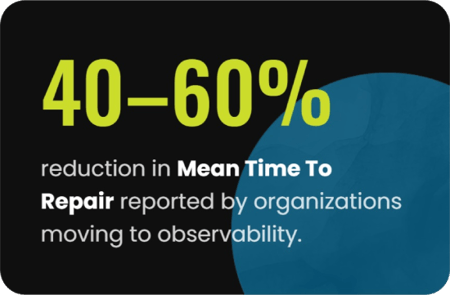
- Faster root cause identification (reducing MTTR by 40-60%)
- Proactive issue detection before user impact
- Understanding of distributed system interactions
- Correlation between system performance and business outcomes.
What's required:
- Unified observability platforms that collect telemetry data (metrics, logs, traces) across all systems
- AI-powered analytics for pattern detection
- Integration with existing monitoring tools
- Organizational readiness to leverage actionable insights.
Implementation approach:
- Start with critical services and establish baseline metrics
- Implement comprehensive data collection across distributed systems
- Enable intelligent analytics
- Gradually expand observability coverage while retiring redundant traditional monitoring tools.
Expected outcomes: Organizations completing the transition report significant improvements - from 50-70% reduction in mean time to repair, proactive prevention of 60%+ of potential incidents, and better resource utilization through data-driven capacity planning.
Monitoring vs Observability: Understanding the key differences
The distinction between monitoring and observability extends beyond semantics. It represents fundamentally different approaches to understanding system health and performance.
Traditional monitoring: The legacy approach
Traditional monitoring emerged when systems were relatively simple, when applications were running on predictable infrastructure with well-understood failure modes. The traditional monitoring approach relies on:
Predefined metrics and thresholds: Monitoring solutions track specific metrics (CPU usage, memory consumption, disk space, network throughput) and trigger monitoring alerts when values exceed static thresholds. "Alert when CPU exceeds 80%" or "notify if response time surpasses 500ms."
Known failure modes: Traditional monitoring focuses on anticipated problems. Teams define what might go wrong, configure alerts for those scenarios, and wait for threshold breaches to indicate issues.
Component-level visibility: Traditional monitoring solutions examine individual components in isolation. A server, database, or a specific network segment. Understanding how components interact requires manual correlation across multiple tools.
Reactive problem-solving: Monitoring tells teams when something broke, but diagnosing why it broke requires manual investigation including checking logs, correlating events across systems, and piecing together the failure sequence.
Monitoring data limitations: Traditional monitoring focuses primarily on metrics, with limited integration of log data or distributed tracing. This creates blind spots in understanding complex system behaviors.
Modern observability: A new paradigm
Observability approaches system understanding differently, acknowledging that modern distributed systems are too complex for predefined monitoring alone:
Arbitrary data exploration: Rather than relying solely on predefined metrics, observability platforms enable teams to ask questions they didn't anticipate. "Show me all transactions from this customer segment that experienced latency spikes in the last hour" or "What changed in system behavior before this cascade failure?"
Unknown failure discovery: Observability solutions excel at detecting issues teams didn't predict. Machine learning algorithms identify anomalous patterns in system data even when individual metrics remain within "acceptable" ranges.
Distributed system understanding: Observability platforms automatically map dependencies between services, track requests across distributed architectures, and reveal how component failures cascade through complex systems.
Proactive intelligence: Beyond reactive alerting, observability enables predictive analytics—forecasting capacity constraints, identifying degradation trends before they impact users, and preventing failures through early intervention.
Comprehensive telemetry data: Observability integrates metrics, logs, and distributed tracing into unified platforms, providing complete context for understanding complex system behaviors across distributed systems.
|
Aspect |
Traditional Monitoring |
Modern Observability |
|---|---|---|
|
Primary Focus |
Known issues and predefined metrics |
Unknown issues and exploratory analysis |
|
Data Sources |
Primarily metrics, some logs |
Metrics + logs + traces (unified telemetry data) |
|
Question Scope |
"Is X broken?" |
"Why is this happening and what's affected?" |
|
System Understanding |
Component-level, siloed |
Distributed, holistic view of system interactions |
|
Problem Detection |
Threshold breaches on specific metrics |
Pattern recognition across correlated system data |
|
Response Model |
Reactive (after threshold breach) |
Proactive (predictive analytics and early detection) |
|
Complexity Handling |
Struggles with distributed architectures |
Designed for complex IT environments |
|
Root Cause Analysis |
Manual correlation across tools |
Automated analysis with AI-powered insights |
The monitoring to observability maturity model
Organizations don't transition from monitoring to observability overnight. The journey typically follows a maturity progression as teams build capabilities, adopt observability tools, and develop practices that leverage comprehensive telemetry data.
|
Stage |
Characteristics |
Capabilities |
Limitations |
|---|---|---|---|
|
Stage 1: Basic Monitoring |
Simple threshold-based alerts on individual systems. Siloed monitoring tools for different infrastructure components. |
Server health checks, basic monitoring of CPU/memory, reactive alerting when thresholds breach. |
No visibility into distributed systems, high false positive rates, manual root cause analysis required. |
|
Stage 2: Enhanced Monitoring |
Multiple monitoring tools covering applications, infrastructure, and networks. Some log aggregation. |
Application performance monitoring, centralized logging, basic dashboards showing system metrics. |
Still reactive, limited data correlation across tools, struggles with complex system behaviors. |
|
Stage 3: Early Observability |
Introduction of distributed tracing, unified observability platforms beginning deployment. |
Basic distributed tracing, some correlation between metrics and logs, initial machine learning for anomaly detection. |
Incomplete coverage of distributed systems, observability practices not yet standard, teams still rely heavily on traditional monitoring. |
|
Stage 4: Advanced Observability |
Comprehensive telemetry data collection across all services, AI-powered analytics, proactive alerting. |
Full distributed tracing, automated root cause analysis, predictive analytics, natural language querying of observability data. |
Some legacy systems still using traditional monitoring tools, organizational learning ongoing. |
|
Stage 5: Observability-Driven |
Observability integrated into all development and operations processes, self-healing capabilities deployed. |
Autonomous issue detection and remediation, complete system observable behavior mapping, business metrics correlated with system performance. |
Requires ongoing refinement, cultural shift to leverage observability fully. |
Most enterprises currently operate between Stage 2 and Stage 4, with financial services, healthcare, and telecommunications sectors generally more advanced due to strict system reliability requirements and zero tolerance for downtime.
Why transition to observability? Key benefits
The transition to modern observability delivers measurable benefits that directly impact both operational efficiency and business outcomes.
1. Understand complex system behaviors in distributed architectures
Modern applications built on microservices, containers, and cloud-native platforms create complexity that traditional monitoring solutions simply cannot handle effectively.
The challenge: A single user transaction might touch dozens of services across multiple clouds, each generating telemetry data. When response times degrade, traditional monitoring alerts you that "Service X is slow" but can't explain why or reveal which upstream dependencies are causing the issue.
How observability solves it: Distributed tracing maps the entire request path through your system, showing exactly where latency occurs, which service dependencies are affected, and how failures cascade. Data correlation across metrics, logs, and traces provides complete context for understanding complex system behaviors.
Measurable impact: Organizations report 60-80% faster root cause identification for issues in distributed systems compared to traditional monitoring approaches.
2. Detect issues proactively before user impact
Traditional monitoring reacts to threshold breaches. By the time alerts fire, users often already experience degraded performance. Observability enables proactive detection through pattern recognition and predictive analytics.
How it works: Machine learning algorithms analyze historical data to establish baselines for normal system behavior across different contexts (time of day, traffic patterns, seasonal variations). When subtle deviations appear, even within "acceptable" ranges, observability platforms flag emerging issues hours or days before they escalate.
Real-world example: For payment processing systems, observability might detect gradual increases in transaction processing latency that signal approaching capacity limits. This enables proactive scaling before authorization failures occur, preventing the revenue loss and customer frustration that reactive monitoring would miss.
Measurable impact: Enterprises implementing observability report 50-70% reduction in user-impacting incidents through early detection and prevention.
3. Accelerate root cause analysis and reduce MTTR
When incidents occur, every minute counts. Observability dramatically accelerates troubleshooting by automating the correlation and analysis that traditional monitoring requires manual effort to perform.
Traditional approach: Engineers check multiple monitoring tools, search through logs, correlate timestamps across systems, examine recent deployments, and manually piece together the failure sequence. For complex IT environments, this process could take anywhere from 2-4 hours.
Observability approach: Automated root cause analysis correlates events across all telemetry data sources, identifies temporal relationships, maps system dependencies, and presents ranked probable causes with supporting evidence - all within minutes.
Measurable impact: Research shows observability platforms reduce mean time to repair (MTTR) by 40-60%, with some organizations achieving even greater improvements for issues in distributed systems.
4. Eliminate tool sprawl and reduce operational costs
Many enterprises operate 10+ separate monitoring tools for different system components such as infrastructure monitoring, application performance monitoring, network monitoring, log management, and specialized tools for payments or communications systems. This creates significant challenges:
The cost of multiple tools:
- License costs for numerous vendors
- Integration complexity maintaining data flows between tools
- Training overhead as teams learn multiple platforms
- Operational inefficiency switching between dashboards during incidents
Observability solution: Unified observability platforms consolidate telemetry data from all sources into single platforms, providing one interface for metrics, logs, and traces across your entire environment. For specialized systems like payment infrastructure or unified communications, purpose-built observability tools like IR Transact or IR Collaborate provide deep domain-specific insights while integrating with broader observability monitoring.
Measurable impact: Organizations report 30-50% reduction in monitoring tool costs and 40% improvement in operational efficiency by consolidating traditional monitoring tools into unified observability platforms.
5. Correlate system performance with business outcomes
Perhaps the most strategic benefit: observability connects technical system metrics with business metrics, enabling data-driven decisions about technology investments.
Traditional monitoring limitation: Technical teams know system health but struggle to articulate business impact. "Database queries are slow" doesn't resonate with executives the way "slow queries reduce transaction success by 15%, costing $2M annually" does.
Observability capability: Modern observability platforms correlate system data with key performance indicators, revealing direct relationships between technical performance and business outcomes—conversion rates, transaction volumes, customer satisfaction, revenue impact.
Real-world application: Financial institutions use observability data to demonstrate that reducing payment processing latency by 200 milliseconds increases authorization success rates by 8%, directly correlating infrastructure investment with revenue improvement.
Observability tools and platforms: What's required for transition
Successfully transitioning to observability requires both technology platforms and organizational readiness. Let's examine the key capabilities needed.
Essential observability platform capabilities
1. Comprehensive data collection
- Agents or integrations that capture telemetry data from applications, infrastructure, cloud services, databases, and network components
- Support for metrics, logs, and distributed tracing across the entire technology stack
- Ability to collect data from both modern cloud-native systems and legacy infrastructure
2. Unified data storage and analysis
- Centralized storage for high-volume observability data with efficient querying
- Retention policies balancing machine learning requirements (algorithms need historical data) with storage costs
- Fast search and retrieval across billions of events
3. Intelligent analytics and correlation
- Machine learning for anomaly detection and pattern recognition
- Automated data correlation across metrics, logs, and traces
- Root cause analysis that identifies probable causes automatically
- Predictive analytics forecasting capacity constraints and emerging issues
4. Visualization and exploration
- Dashboards showing system health across distributed architectures
- Natural language querying enabling teams to ask arbitrary questions
- Topology mapping revealing service dependencies and system interactions
- Customizable views for different roles (engineers, managers, executives)
5. Integration capabilities
- APIs connecting observability platforms with incident management, collaboration tools, and IT service management
- Bidirectional integration with existing monitoring tools during transition
- Support for OpenTelemetry and industry-standard protocols
Specialized vs. General-Purpose Observability Solutions
Organizations face a choice between general-purpose observability platforms and specialized solutions designed for specific environments:
General-purpose platforms (Datadog, Splunk, Dynatrace, New Relic):
- Broad coverage across infrastructure, applications, and cloud services
- Extensive integration ecosystems
- Scalable for large, complex IT environments
- May lack depth for specialized systems like payment processing or unified communications
Specialized Observability Solutions (IR Transact for payments, IR Collaborate for UC):
- Deep domain expertise in specific technology areas
- Understanding of industry-specific compliance requirements
- Purpose-built analytics for domain-specific patterns
- Often integrate with general-purpose platforms for complete coverage
Decision framework: Planning your transition to observability
Successful transition requires strategic planning aligned with your organization's maturity, complexity, and business priorities.
Step 1: Assess your current state
Evaluate existing monitoring tools and coverage:
- How many separate monitoring tools are you currently using?
- What blind spots exist in your current visibility into distributed systems?
- Where do manual correlation and troubleshooting consume the most time?
- Which business-critical systems lack adequate observability?
Understand your complexity:
- Do you operate microservices, containers, or cloud-native architectures?
- How distributed are your systems across regions, clouds, or vendors?
- What compliance requirements govern your telemetry data collection and retention?
Step 2: Define success criteria
Establish measurable goals for your observability transition:
- Target reduction in MTTR (typical: 40-60% improvement)
- Percentage of incidents detected proactively before user impact
- Reduction in false positive monitoring alerts
- Consolidation of multiple tools into unified observability platforms
- Specific business outcomes (improved transaction success, better system performance)
Step 3: Prioritize systems for transition
Don't attempt to transition everything simultaneously. Prioritize based on:
|
Priority Level |
System Characteristics |
Transition Approach |
|---|---|---|
|
Highest Priority |
Business-critical systems with distributed architectures, high complexity, or revenue impact (payment systems, customer-facing applications) |
Deploy comprehensive observability solution immediately, maintain traditional monitoring in parallel initially |
|
Medium Priority |
Important but less complex systems, or those with adequate traditional monitoring |
Transition after validating approach on high-priority systems |
|
Lower Priority |
Stable legacy systems with simple architectures and low change frequency |
May retain basic monitoring, transition only if business value justifies investment |
Step 4: Choose the right observability solution
For payment and financial transaction systems: Consider specialized observability platforms like IR Transact that understand payment-specific patterns, compliance requirements, and the nuances of transaction processing across multiple payment rails.
For unified communications environments: Purpose-built solutions like IR Collaborate provide deep visibility into multi-vendor UC systems, understanding collaboration-specific performance metrics and user experience factors.
Integration requirements: Ensure chosen observability tools integrate with your existing technology stack, incident management systems, and can coexist with traditional monitoring during transition.
Step 5: Execute phased implementation
Phase 1 - Foundation (Months 1-3):
- Deploy observability solution on highest-priority systems
- Establish baseline metrics and normal behavior patterns
- Run observability platforms in parallel with existing monitoring tools
- Train teams on new capabilities
Phase 2 - Expansion (Months 4-6):
- Expand coverage to medium-priority systems
- Begin retiring redundant traditional monitoring tools
- Implement automated anomaly detection and alerting
- Validate MTTR improvements and proactive detection capabilities
Phase 3 - Optimization (Months 7-12):
- Achieve comprehensive observability coverage across critical systems
- Enable advanced capabilities (predictive analytics, automated remediation)
- Fully retire traditional monitoring tools where observability provides superior visibility
- Measure and report on business outcomes achieved
Frequently Asked Questions
Q: What is the main difference between monitoring and observability?
A: Monitoring focuses on tracking predefined metrics and alerting when thresholds are breached. It tells you when something is broken. Observability provides the ability to understand why something broke, through unified analysis of metrics, logs, and distributed tracing.
Q: How long does transitioning from monitoring to observability take?
A: The timeline varies based on system complexity and organizational readiness, but most enterprises complete initial transition in 6-12 months. High-priority business-critical systems can typically achieve observability within 3-4 months.
Q: Can monitoring and observability coexist during transition?
A: Yes. Running observability platforms alongside existing monitoring tools during transition is recommended best practice. This parallel operation allows teams to validate that observability provides equal or better visibility before retiring traditional monitoring.
Q: What are the costs associated with observability platforms?
A: Observability solution costs vary significantly based on data volumes, retention requirements, and feature sets. While observability platforms may have higher licensing costs than basic monitoring tools, organizations typically achieve net cost savings and ROI through observability benefits.
Q: Do we need to replace all monitoring tools with observability solutions?
A: Not necessarily. Many organizations adopt a hybrid approach, deploying observability for complex distributed systems and business-critical applications while maintaining simpler traditional monitoring for stable legacy infrastructure.
Q: What skills do teams need for observability?
A: Transitioning to observability requires both technical and analytical skills:
- Understanding of distributed systems and microservices architectures
- Ability to interpret telemetry data across metrics, logs, and traces
- Familiarity with the specific observability platform's capabilities and query languages
- Analytical thinking to leverage actionable insights for proactive problem prevention.
Q: How does observability improve business outcomes?
A: Integrating observability solutions enables correlation between system performance and business metrics, revealing direct relationships between technical improvements and revenue impact. Our observability platforms provide the real-time insights, automated analytics, and actionable intelligence that transform reactive monitoring into proactive system management.
How IR can help your monitoring to observability transition
IR delivers specialized observability solutions designed for the environments where system performance has immediate business impact:
IR Transact provides comprehensive observability for complex, high-volume payment systems, ensuring transaction reliability, regulatory compliance, and optimal performance across card payments, real-time payments, and settlement infrastructure. With deep expertise in payment-specific patterns and compliance requirements, IR Transact delivers the specialized visibility financial institutions need.
IR Collaborate offers experience management and unified observability for multi-vendor unified communications environments, enabling proactive issue prevention, faster root cause analysis, and improved collaboration quality across Microsoft Teams, Zoom, Cisco platforms, and contact center systems.
Meet Iris - Your all-in-one solution to AI-powered observability