


.png?width=141&height=141&name=Transact%20(1).png)






.svg)

.svg)
.svg)
.svg)


%201.svg)















Indonesia’s real-time payments market didn’t just hit its 2026 target — it blew past it years early. When BI-Fast went live in December 2021, Bank Indonesia and the country’s banks treated ISO 20022 adoption as a compliance deadline: get connected, meet the new service level agreement (SLA), move on. That framing hasn’t aged well.
Indonesia processed almost 1.9 billion real-time transactions in 2023 alone — 267% growth year-over-year — and now ranks #8 among the world’s fastest-growing real-time payment markets, and #3 in Asia-Pacific for real-time payments volume, share, and growth. ACI Worldwide projects a 44.6% compound annual growth rate through 2028, reaching an estimated 12.2 billion transactions a year. The industry’s original forecast of 1.6 billion transactions by 2026 wasn’t wrong so much as it undersold what was coming.
For banks and payment providers, that growth curve changes the nature of the problem. What started as a project to meet a new SLA is now a permanent operating condition: real-time volumes that keep compounding, running on infrastructure that was never built to carry them — which is exactly the pressure IR Transact’s Real-Time Payments solution is built to take off your team.
What’s driving the surge
Indonesia skipped the legacy queue and went straight to ISO 20022 — and the volumes are compounding faster than anyone modeled.
Three things are compounding at once. First, Indonesia built BI-Fast without the older messaging formats that many real-time schemes elsewhere had to migrate away from — it went straight to ISO 20022, the global standard that carries richer, structured payment data end to end. That head start is a real advantage, but it also means the infrastructure has no slack built in from years of incremental upgrades.
Second, the ecosystem keeps getting more crowded. BI-Fast now connects 135 banks, plus multi-tenant aggregators such as Rintis Sejahtera, Artajasa, and Alto Network, which bring non-bank participants and merchants onto the same rails. Every new participant is a new path a payment can take — and a new place it can stall.
Third, financial inclusion is still the underlying mandate. Indonesia has 270 million people, and an estimated 100 million of them remain unbanked, so BI-Fast’s growth isn’t just existing transactions moving faster — it’s new transactions, from new users, on channels that barely existed a few years ago.
Where legacy monitoring breaks down
More participants means more handoff points. Each one is a place a payment can go quiet.
Reconciliation confirms a payment settled correctly after the fact. Real-time monitoring tells you it’s about to fail while there’s still time to do something about it. That distinction mattered less when real-time volumes were small enough to check manually. At close to 2 billion transactions a year and rising, it’s the difference between a bank that holds its SLA and one that’s explaining a breach to its regulator.
It’s also a cost problem beyond Indonesia — failed payments cost the industry an estimated USD 118.5 billion globally, and every added participant in a scheme like BI-Fast is another point where a transaction can go missing between systems, orchestration steps, and the sanctions and anti-money laundering (AML) checks layered on top.
How IR Transact can help
Visibility that scales with the ecosystem, not just with your own systems.
IR Transact, powered by the Prognosis platform, turns that sprawl into a single dashboard. Instead of tracing a stalled payment across BI-Fast, your core banking system, and every aggregator in between by hand, your team gets one view of the full multi-leg journey — which is what a modernization program needs to hold its SLA as the network keeps growing.
Detailed tracking of payment flows
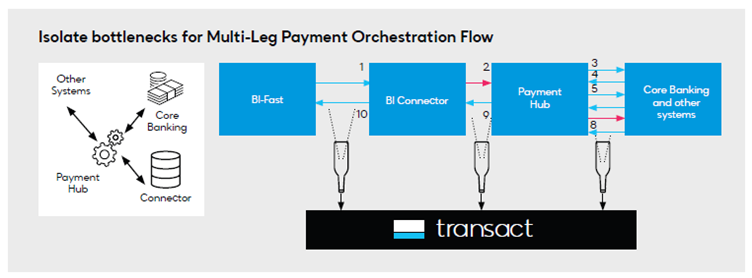
With IR Transact, you can identify and troubleshoot slowdowns that may cause SLA breaches by:
- Cross-system bottleneck detection
See exactly where a transaction slows down — including orchestration flow across sanctions and AML checks — instead of guessing which system is responsible. - BI-Fast vs. internal system isolation
When connected through IR’s BI-Fast connector, quickly separate delays caused by the central infrastructure from delays inside your own environment.
Reduce the need to trace with hung transactions
Customers expect their real-time payments to complete in seconds. When they don’t, you need to know immediately — not after a complaint comes in. With IR Transact you can:
- Uncover hung transactions
before they turn into support tickets. - Detect repeated failures
as a pattern, not as isolated one-off incidents. - Troubleshoot transaction flow
without falling back on manual trace.
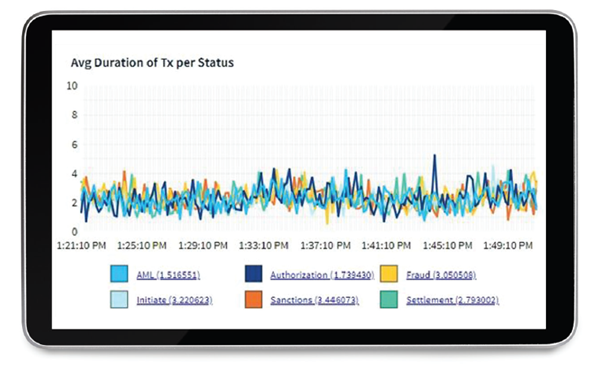
Other key benefits of IR Transact’s Real-Time Payments solution include:
- Spot trends before they become problems
Surface patterns in payments data early enough to act on them, not just report on them after the fact. - Automate SLA reporting
Cut the manual work out of regulatory reporting and get a continuous view of SLA performance instead of a point-in-time snapshot. - Resolve issues faster
Shorten the path from “something’s wrong” to “here’s the fix,” which is what customers actually experience as reliability.
BI-Fast didn’t just meet its target — it reset what “real time, at scale” means for every bank connected to it. The SLA that used to be a launch milestone is now a daily operating condition, and the banks that treat it that way are the ones staying ahead of the growth curve instead of explaining why they fell behind it.
Find out more about what IR Transact can do for your business. Book a demo today.

.png?width=767&height=450&name=high-value-payments-monitoring-tile%20(1).png)
.png?width=767&height=450&name=rtgs-high-value-payments-settlement-tile%20(1).png)