
















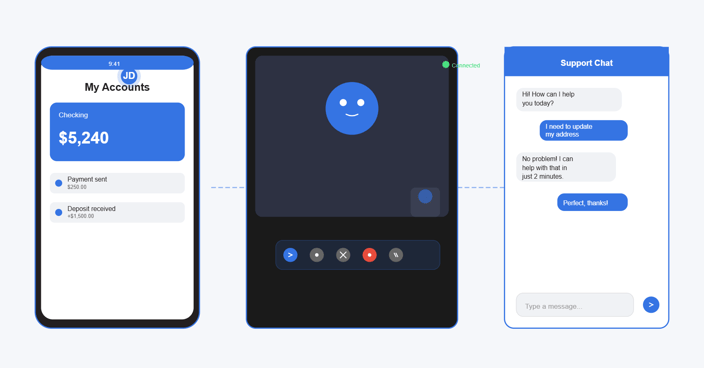

In banking, trust is built in ordinary moments: a call that connects cleanly, a video consultation that doesn't freeze, a chat that hands off to a human agent without losing context. For financial institutions across Asia-Pacific, those moments increasingly run on unified communications and collaboration (UC&C) systems — and when those systems falter, so does the customer's confidence in the institution behind them.
The region's banks, insurers, and financial services firms are under pressure to modernize customer experience while working across hybrid infrastructure, multiple vendors, and tightening data regulation. This article looks at how UC&C is reshaping customer service assurance in the APAC BFSI sector — with India as a leading example — and why monitoring, not just deployment, is what turns UC&C investment into a reliable customer experience.
Deploying UC&C and monitoring it are not the same thing. A bank can roll out cloud calling, video banking, and unified messaging, and still lose a customer to a dropped call nobody caught in time. The technology only delivers on its promise when performance is watched closely enough to catch problems before customers do — which is why monitoring, not deployment, is the real measure of UC&C maturity in banking.
Digital transformation is redefining what "reliable" means in APAC banking
Policy is pushing digital banking forward. The communications layer has to keep pace.
Many APAC markets are embracing digital transformation, and in banking and financial services the effect is significant. Driven by government initiatives and competitive pressure, Singapore, Hong Kong, Australia, India, and Japan have all implemented policies encouraging digital banking and innovation in financial services. UC&C solutions let banks modernize their communication infrastructure to keep up with the push to improve customer experience.
Hybrid infrastructure is now the norm, not a phase
Banks and financial institutions across APAC are migrating at least part of their systems to the cloud to reduce operational costs and improve flexibility. UCaaS brings voice, video, messaging, and collaboration tools into a single platform. But privacy is a real concern for financial institutions, so adoption is slower than in other sectors, and on-premises systems remain in place for a reason.
As a result, IT and communications teams now manage cloud and on-premises systems side by side — keeping the two consistent while meeting strict security and compliance requirements.
Customer experience is now a board-level priority
The financial services industry has recognized the value of integrating business applications — Customer Relationship Management (CRM), Enterprise Resource Planning (ERP) — with video collaboration, via APIs or communications platform as a service (CPaaS). That trend is only growing as organizations treat these integrations as a core requirement.
Customer experience transformation has become a critical focus of digital transformation in banking and financial services across APAC, driven by changing customer expectations, digital disruption, and competitive pressure from fintech challengers.
Omnichannel banking is the default expectation
Omnichannel banking lets customers move across mobile apps, social media, phone, and email without losing continuity. UC&C brings all of these channels into a single platform, which means faster response times, more personalized service, and a more consistent customer experience.
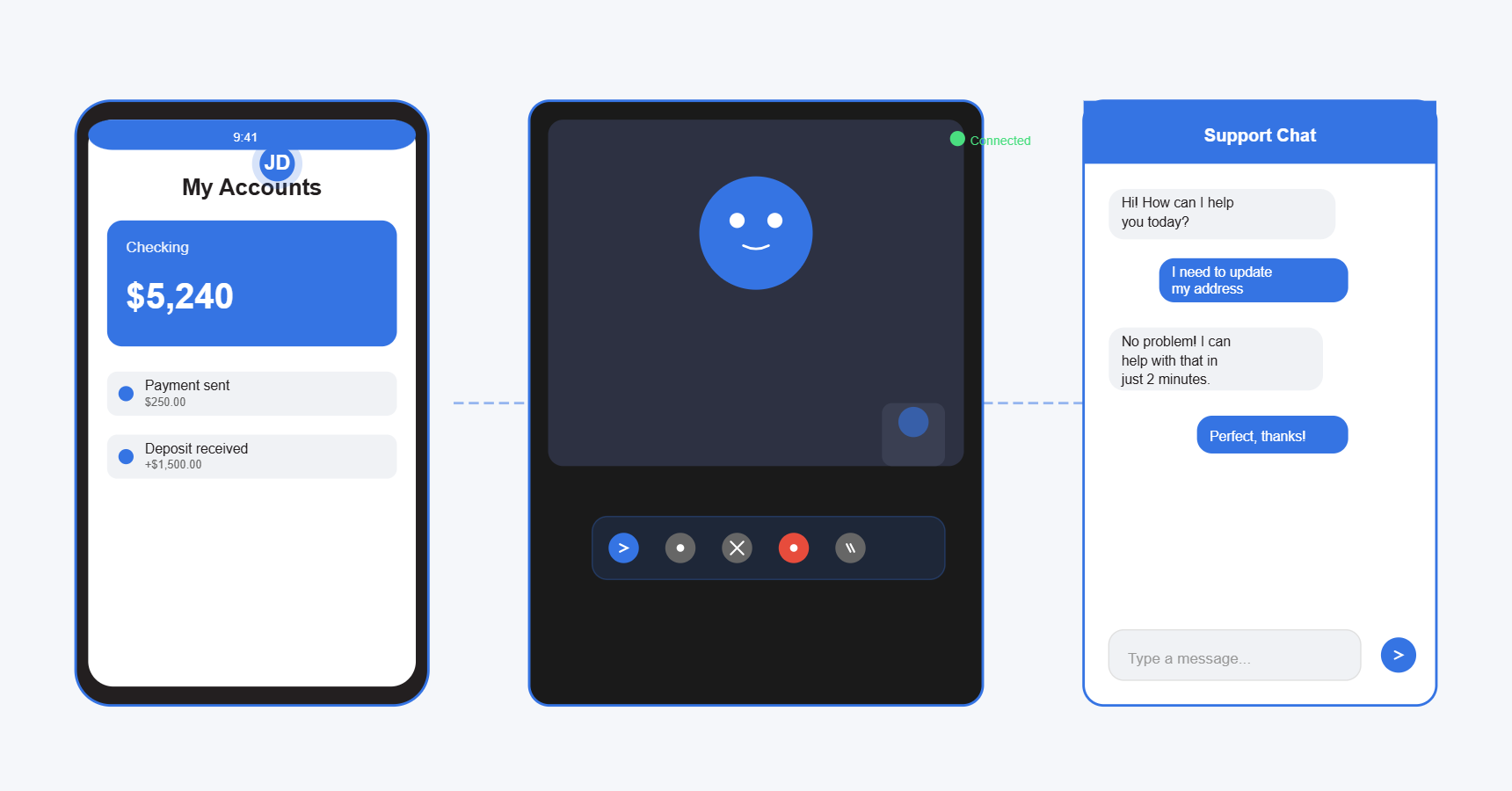
For example, a customer might start a service request in a chatbot, continue it on a phone call, and finish it by email — all while the bank retains a single, coherent interaction history.
Video and voice banking extend reach where branches can't
In markets like India and Southeast Asia, where physical bank branches are still limited in reach, video and voice banking through UC&C platforms has become an essential way to serve customers remotely. Video calls for support, onboarding, and financial advisory are a lifeline in these regions, delivering personalized interaction without an in-person visit.
UC&C is reshaping daily operations, not just customer-facing channels
The customer-facing win is only half the story — the internal one matters just as much.
Enhancing customer experience is a priority for banks and financial institutions across India, but the same platforms are just as consequential behind the scenes.
Hybrid work is standard practice, not a pandemic response
Hybrid work is now standard across Indian banking, even in a sector that was traditionally reliant on physical offices. UC platforms let bank employees collaborate whether they're at home or in the office — video conferencing, instant messaging, and document sharing keep teams connected in real time, which is essential for business continuity in a hybrid environment.
Cross-departmental collaboration at scale
Large banks typically have teams spread across different regions of India. UC platforms let employees collaborate across departments and locations, cutting the dependency on email chains and physical meetings.
Security and compliance are non-negotiable
The BFSI sector in India is heavily regulated, with strict requirements around data protection and security — for example, the Reserve Bank of India (RBI)'s cybersecurity guidelines. UC platforms support secure communication through encryption, helping protect sensitive data shared during customer interactions, and can be configured to meet India-specific data localization requirements so customer data stays within the country.
Audit trails support compliance as well as security
Unified communication platforms keep detailed logs of customer interactions across voice, video, and messaging. These logs support audit trails for regulatory reviews and legal or internal investigations, backing up compliance with the RBI's data privacy and security directives.
Real-time collaboration resolves complex issues faster
When a complex issue arises — a fraud flag, a credit dispute, a service outage — bank employees need to collaborate in real time. With UC solutions, staff from fraud detection, credit, and customer support can join a single call or chat instantly, instead of routing the issue through email and callbacks.
Round-the-clock support runs on AI plus UC integration
Many Indian banks now integrate AI-driven chatbots and virtual assistants with UC platforms to provide round-the-clock support and handle routine queries. If a query goes beyond the bot's capability, it can hand off to a human agent without losing the interaction history. AI layered onto UC platforms also gives banks insight to anticipate customer behavior, optimize contact center operations, and automate routine communications such as appointment reminders, loan status updates, and payment notifications.
Why monitoring is what turns UC&C investment into reliable customer experience
Deploying UC&C isn't the finish line. Watching it perform is.
UC&C platforms have to meet high standards of reliability, quality, and security to support banking operations across India and APAC. Monitoring is what makes those standards achievable — through real-time insight, proactive problem resolution, and control over the UC&C environment.
- Reliability and uptime:
UC&C monitoring tools like IR Collaborate continuously track the availability of voice, video, and messaging services, and send real-time alerts the moment something degrades. In a sector where downtime translates directly into lost business, keeping communication platforms operational isn't optional. - Proactive problem detection:
By continuously analyzing key performance indicators — network latency, jitter, packet loss, bandwidth usage — monitoring flags problems while they're still small, before they become disruptions customers can feel.
The impact shows up in the numbers: banks and financial institutions running IR Collaborate for financial services have cut UC&C support effort by 30–50% and reduced critical incidents by up to 40%, largely by catching problems before they reach the customer.
Digital transformation gets financial institutions to the starting line. What decides whether that investment pays off is whether the systems behind every call, chat, and video interaction hold up under real conditions — and whether problems get caught before the customer ever notices them. That's the line between a UC&C rollout and a UC&C advantage.
Ready to find out more?