















Datadog's infrastructure monitoring starts at $15 per host, per month. For most enterprise unified communications (UC) environments, that number has almost nothing to do with what shows up on the invoice.
A list price is what a platform advertises. Total cost of ownership is the sum of everything it actually meters.
Datadog doesn't bill on one dimension — it bills on host count, APM instrumentation, log ingestion, log indexing, span retention, and custom metrics, each priced and capped separately.
For a single server running one application, that's manageable. For a multi-vendor UC and contact center environment generating continuous call, session, and quality telemetry across thousands of endpoints, every one of those dimensions scales independently — and most of them scale faster than host count does.
What Datadog actually bills you for
The headline rate is one line item out of at least five.
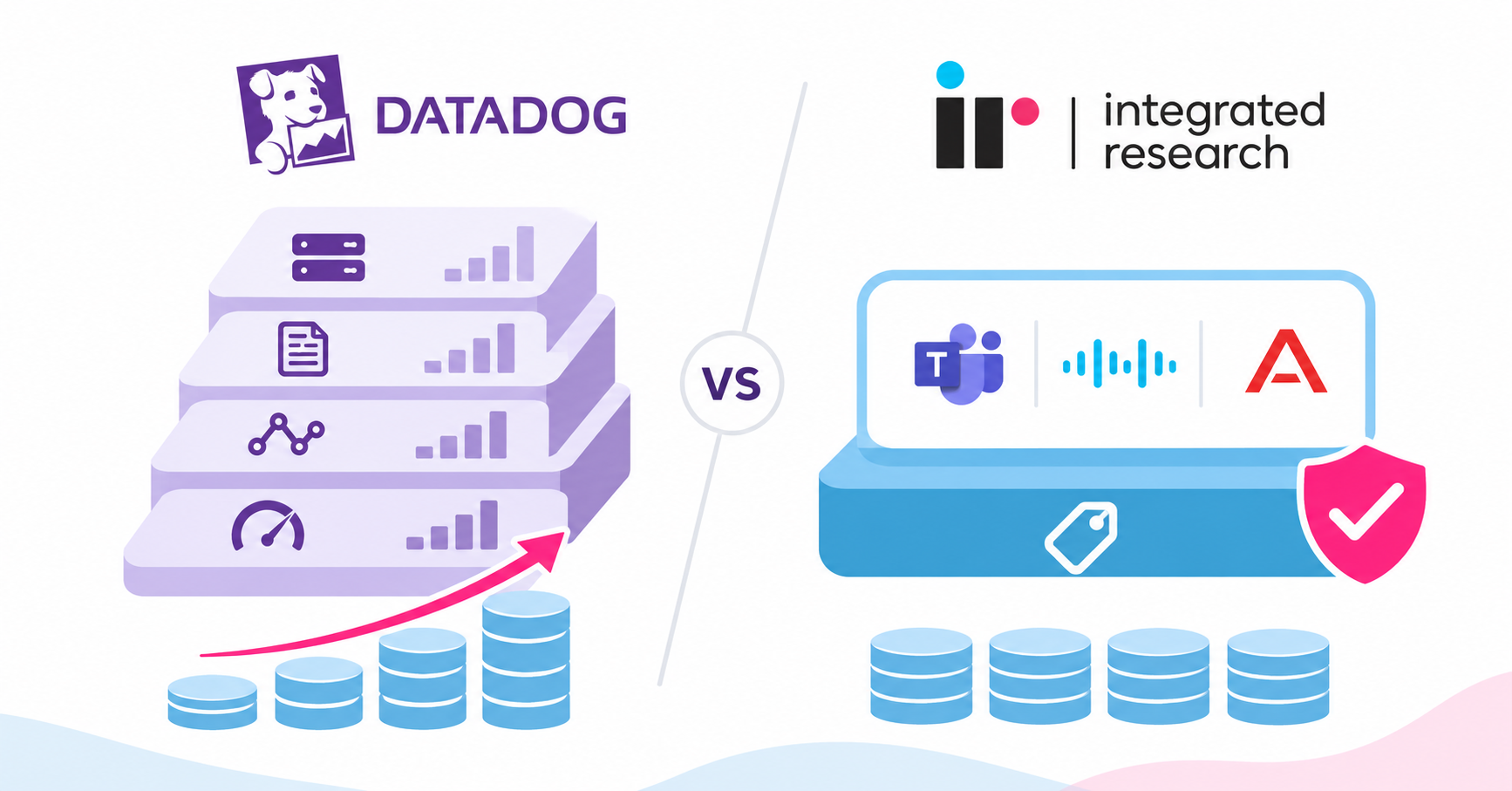
Based on Datadog's current published pricing, a production deployment is priced across at least five independent lines:
Infrastructure Monitoring runs $15–$23 per host per month (Pro and Enterprise tiers, billed annually; on-demand rates run higher). APM adds $31–$40 per host per month on top of that, and includes a fixed 150 GB of ingested trace data per host — additional ingestion is billed at $0.10 per GB.
Indexed spans, needed for live trace search, are billed per million spans per month, from $1.27 at 7-day retention up to $2.50 at 30-day retention. Log management is billed twice: $0.10 per GB ingested, whether or not that data is ever indexed, plus $1.70 per million log events indexed at 15-day retention. Custom metrics beyond each host's allotment are billed per 100,000 events.
Each of these has its own on-demand premium over the annual-committed rate — typically 15–50% higher — and Datadog's own pricing terms note that usage above a committed volume is billed at a further markup on top of that. None of this is hidden; it's published. It's also not one number.
Why enterprise UC environments feel this more than most
The telemetry volume, not the host count, is what drives the bill.
A UC and contact center environment doesn't generate telemetry the way a single application does. Every call, session, and quality metric across every monitored endpoint produces its own stream of logs and spans — and in a multi-vendor environment spanning platforms like Microsoft Teams, Cisco, and Avaya, that telemetry comes from more sources at once, not fewer.
That matters because three of Datadog's billing dimensions — log ingestion, log indexing, and span retention — scale with event volume, not with host count. A UC environment can hold its host count flat while its monitored call and session volume climbs, and the bill climbs with it. The $15 headline rate describes the smallest part of what a communications-heavy environment actually consumes.
The forecasting problem: how the bill actually gets calculated
A single spike can set your price for the whole month.
Datadog's infrastructure monitoring uses high-water mark billing: the month is priced on the peak of the lower 99% of hourly host counts, not an average. A short-lived spike — a seasonal contact center surge, a migration, a load test — can set the billed rate for the entire month, even after host count drops back down.
This is where a consumption model becomes a budgeting problem rather than just a cost. Finance can model a flat per-seat or per-platform license. It's much harder to model a bill built from five metered dimensions, each capable of spiking independently, with its own overage premium once a committed volume is exceeded.
A different way to calculate TCO
Predictability is a cost variable too — it just isn't on the pricing page.
The table below sets out where each model's cost comes from, so the comparison is about structure, not a single advertised rate.
| Cost dimension | Datadog's metered model | Consolidated platform model |
|---|---|---|
| Monitored hosts | Billed per host, per tier (Pro/Enterprise) | Covered under a single platform license |
| Application/call tracing | Separate APM charge per host, plus per-GB span ingestion | Included as part of the platform's core observability |
| Logs and events | Billed separately for ingestion and indexing | Included; no per-GB or per-million-event line item |
| Custom metrics | Capped per host, then billed per 100,000 | No per-metric billing dimension |
| Usage spikes | Billed at the high-water mark, plus overage premium | Scoped at the licensing stage, not re-priced monthly |
The table above isn't a claim that any platform is cheaper in every scenario — that depends on scale, usage patterns, and the commercial terms negotiated. The point is structural: a platform priced on one license dimension is forecastable in a way that a platform priced on five independently-scaling dimensions is not. For a budget owner, predictability is often worth more than the lowest advertised unit rate.
How IR Collaborate can help
One license, not five metered dimensions to track.
IR Collaborate, powered by the Prognosis platform, gives enterprise IT and UC teams a single, multi-vendor observability layer across platforms including Microsoft Teams, Cisco, Avaya, and Oracle — without asking a team to track ingestion volume, indexed-span counts, or per-metric overages as separate line items. The platform is licensed, not metered dimension by dimension, which is what makes it possible to forecast cost against headcount or endpoint growth instead of against telemetry volume.
For teams building the internal business case, IR's UC and contact center observability calculator is a useful starting point for estimating the operational cost of blind spots in a multi-vendor environment before comparing vendor quotes line by line.

The real comparison isn't the sticker price
Ask which bill is still predictable in eighteen months.
Datadog's per-host rate is real, and it's a reasonable starting point for a single-application deployment. It stops being the right comparison the moment an environment generates its cost from telemetry volume rather than host count — which is exactly what enterprise UC and contact center environments do. The question worth asking in a vendor evaluation isn't "what does the cheapest tier cost," but "which of these billing dimensions will still be predictable in eighteen months." That's the version of this decision that actually protects the budget and keeps control where it belongs.
Frequently asked questions
Straight answers to the questions this comparison raises most.