
















Quick AnswerNetwork security tools fall into two categories that get treated as one: tools that watch for attacks, and tools that prove your network can withstand real-world load, traffic, and failure conditions before an attack, an outage, or a busy Monday morning finds the weak point for you. If you are evaluating network security solutions and only looking at the first category, you are evaluating half the problem. |
Key takeaways: network security
- Network security search results are dominated by threat-detection tools, but resilience under real load is a separate and equally important discipline.
- Network resilience testing answers a different question than security monitoring: not is something attacking us, but will this hold up.
- The right evaluation criteria include multi-vendor coverage, real traffic simulation, breaking-point visibility, and deployment flexibility.
- Choosing the right tool depends on whether your environment is UC&C-heavy, general IT infrastructure, or both.
- IR Collaborate gives teams testing and monitoring depth across multi-vendor communications environments before performance problems reach users.
What network security actually means for network teams
Search for network security and you will land almost entirely on threat detection: SOC tooling, intrusion detection, and SIEM platforms that watch for attackers already on the network. That is a real and necessary discipline. It is also only half of what secure means for a network team that has to answer for uptime, not just intrusions.
The other half is resilience: whether the network, and the applications and calls running on it, actually hold up under the load, traffic patterns, and failure conditions they will face in production. A network can be free of active threats and still fail your users the moment call volume spikes, a carrier link degrades, or a rollout adds more concurrent sessions than anyone tested for.
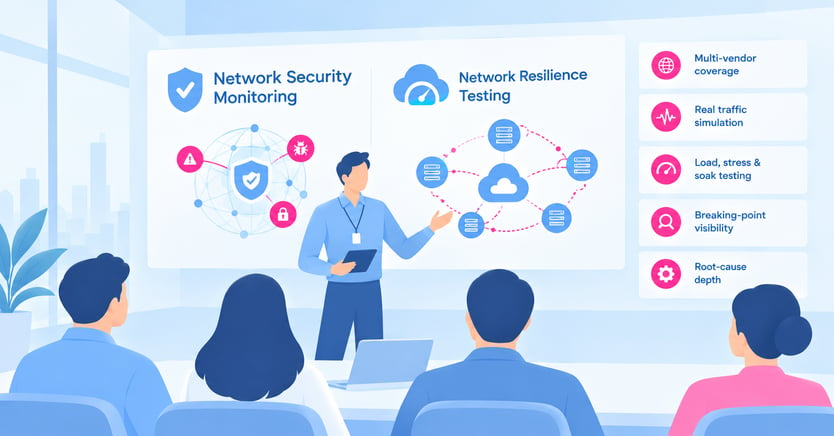
Network security monitoring answers one question: is something attacking us? Network resilience testing answers a different one: will this hold up?
| Network security monitoring | Network resilience testing | |
|---|---|---|
| Core question | Is something attacking us? | Will this hold up under real conditions? |
| What it watches | Traffic for intrusions, anomalies, and unauthorized access | Network and application behavior under load, stress, and failure scenarios |
| When it runs | Continuously, in production | Proactively, before and during change |
| Typical owner | Security operations or SOC | Network engineering, IT operations, and UC&C teams |
| What it misses | Whether the network can handle peak call volume or a carrier outage | Whether there is an active intrusion underway |
Neither replaces the other. A network can be well defended and still buckle under its own traffic; it can be perfectly provisioned and still be compromised. Evaluating network security tools without separating these two jobs is the fastest way to buy the wrong thing: a SIEM when what you needed was a way to prove your network survives its own busiest day.
Why resilience testing is the harder half to evaluate
Threat detection has a mature, well-understood evaluation path. Resilience is less settled, and more often skipped, because it does not announce itself as a gap until it becomes a production incident.
Three things make resilience harder to evaluate and easier to under-invest in. First, it requires realistic simulation, not generic synthetic traffic. A tool that fires basic HTTP requests tells you nothing about how a contact center handles thousands of concurrent voice calls or how an SBC behaves at SIP trunk capacity. Second, it spans multiple traffic dimensions. Latency, jitter, and packet loss each degrade differently, and a single aggregate network health score hides the dimension about to fail. Third, it has to work across vendors. A tool that only sees one platform or one carrier's SBCs has a blind spot exactly where multi-vendor handoffs tend to break.
The result is common: teams with solid security monitoring and no equivalent discipline for resilience until a rollout, a peak event, or a carrier issue exposes the gap in front of customers.
What evaluation criteria matter most
- Multi-vendor coverage: tests and reports across your actual mix of UC&C platforms, SBCs, gateways, and carriers, not just the vendor that built the tool.
- Real traffic simulation: simulated voice, video, and web sessions at scale for UC&C and contact center environments, not just synthetic web requests.
- Load, stress, and soak testing: each answers a different part of the resilience question, so you need all three.
- Breaking-point visibility: where and how the environment failed, not just whether the test passed or failed.
- Root-cause depth: enough detail to trace a surfaced problem to a specific component.
- Deployment flexibility: cloud, on-premises, and hybrid environments all testable without switching tools.
These criteria matter because a resilience program is only useful when your team can translate test results into action. A pass or fail signal is too blunt. Your team needs to know which threshold broke first, what dependency was involved, and what change must be made before the next production event.
How to choose the right tool for your environment
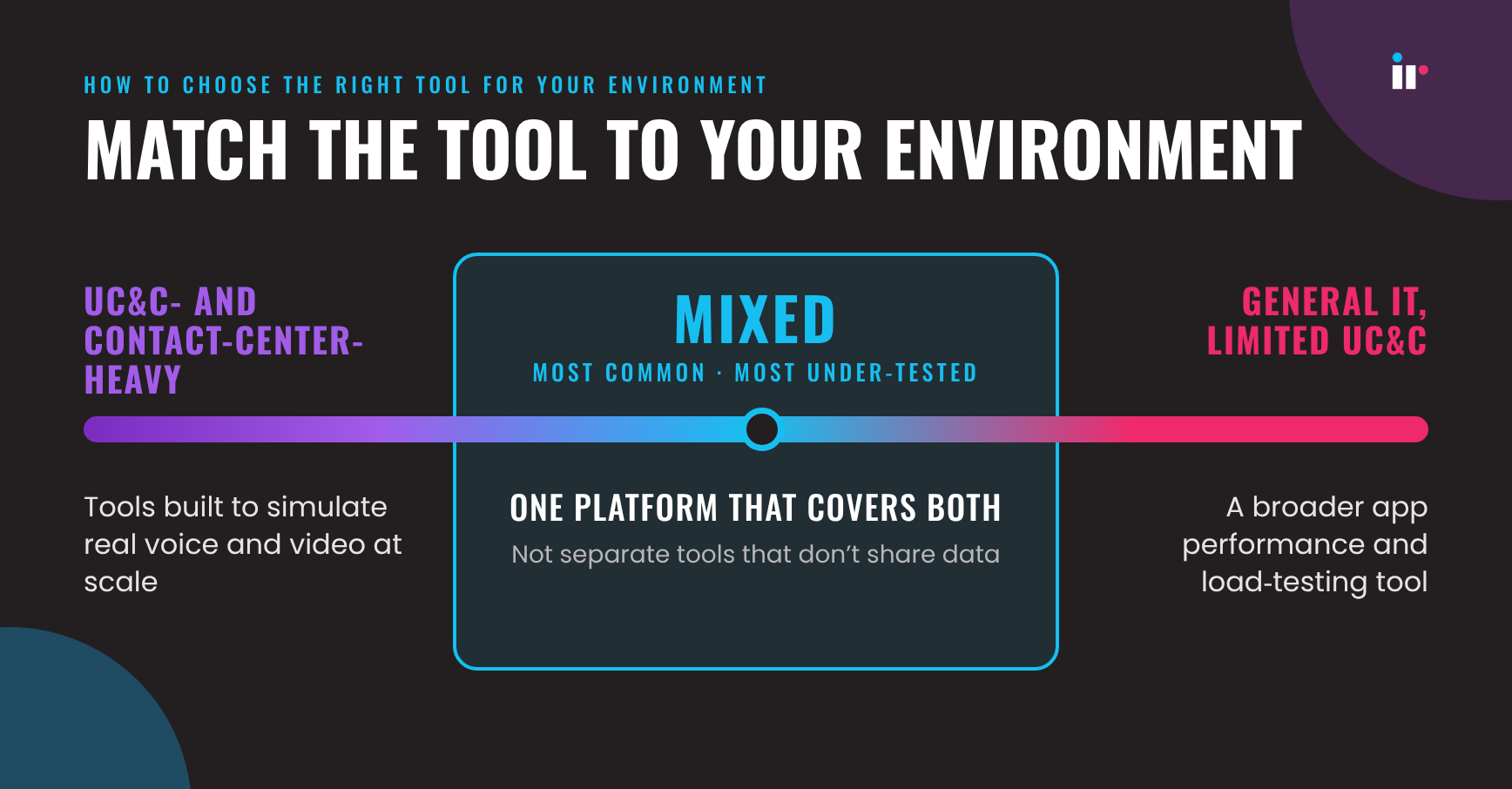
If your environment is UC&C- and contact-center-heavy, prioritize tools built to simulate real voice and video interactions at scale. Generic web and application load testing tools will miss call-quality and SBC-specific failure modes entirely. If your environment is general IT infrastructure with limited UC&C exposure, a broader application performance and load-testing tool may cover the need without UC&C-specific simulation.
Most enterprise networks are a mix of both, which is the more common and more commonly under-tested case: UC&C traffic running across shared infrastructure with everything else. In that case, look for a single platform that covers both, rather than stitching together a UC&C-specific tool and a general infrastructure tool that do not share data.
 The closest tracked analog to this combined need is the broader infrastructure monitoring category, which Grand View Research valued at approximately USD 4.29 billion in 2024 and projected to reach USD 10.08 billion by 2030. That growth reflects a larger shift: enterprises consolidating visibility and testing across previously siloed infrastructure and communications environments instead of running separate tools for each.
How IR Collaborate can help
IR Collaborate, powered by Prognosis, gives teams observability across unified communications, collaboration, and contact center ecosystems through IR Collaborate. In this use case, the value is not just monitoring ongoing performance. It is also helping teams understand where resilience breaks down before customers feel it.
Product Marketing sign-off is still needed on this framing before publish. Based on the supporting IR materials referenced in the package, the draft positions IQ Services around load, stress, and soak testing across multi-vendor UC&C and network environments. That includes simulating real voice, video, and web interactions at scale rather than relying on generic synthetic traffic. In practice, that means testing an IVR against thousands of concurrent callers or testing a contact center against peak-day call volume before the event arrives.
Collaborate also pairs that testing discipline with ongoing multi-vendor monitoring, so root-cause analysis for anything testing surfaces stays in one platform rather than a second tool. If you want to compare the underlying testing disciplines first, read Load Testing vs. Stress Testing, or explore adjacent monitoring depth in Network Performance Monitor and Network Diagnostics.
FAQs about network security evaluation
In conclusion: evaluate both sides of network security
The network security conversation has been dominated by one question for long enough: is something attacking us. That leaves the other question, will this hold up, unevaluated until an outage answers it instead of a test.
Both are part of what secure actually means for a network team that answers for uptime as much as intrusions. Evaluate for both, and choose tools built to answer the question you are actually asking.
Read the related guide or see testing in action
Start with Load Testing vs. Stress Testing or request a demo to see IR Collaborate's IQ Services testing in action.