
















The biggest threat to customer experience today is not a poorly trained agent, or a badly designed service flow. It's technical friction.
This friction is defined by network, platform, and device issues — but the real problem is that these issues can remain invisible. By the time anyone with the authority to fix something knows about it, it has usually already caused significant damage.
In this article, we make the case that closing that visibility gap is the next real competitive battleground in customer-facing service delivery, and what you can do about it.
Download a PDF copy of: The Hidden Cost of Invisible Problems
The Scenario: What Went Wrong?
There are countless negative scenarios that your distributed workforce can identify with, and most of them are created by blind spots. End users feel them, customers experience them, and everyone in the organization is affected by them.
A customer is a few minutes into explaining a billing problem. The agent is finally in a position to solve it, when the audio breaks up and communication is interrupted. The agent asks the customer to repeat themselves, and the call drops out altogether. The result is a bad customer experience that has nothing to do with billing. The customer is left annoyed and confused. The agent is left frustrated and helpless.
Was it the agent's headset? Home Wi-Fi? An issue with the contact centre platform? Nobody on the call, or watching a dashboard, knows — because as far as the dashboard is concerned, the platform is green. There was no indication of a dropped call, average handling time barely moved, and by every metric IT is currently tracking, nothing went wrong.
This scenario is not rare. As contact centre and UC&C environments have become distributed by default, the issues associated with home-based agents, hybrid knowledge workers, and offshore or outsourced capacity spread across time zones and ISPs have moved outside the boundary of what most organizations can see.
The Shift: CX is Now the Differentiator, Not the Afterthought
For much of the last two decades, customer experience was not deemed as important as price, product, and distribution. Service was almost an afterthought — brought out to keep customers from leaving once the more "serious" parts of the business had already won or lost them.
That hierarchy has completely inverted. In almost every category and industry, product and pricing have converged to the point where they're barely a source of differentiation at all.
From cloud infrastructure and telecoms to insurance, banking, and SaaS, it costs customers little to switch allegiance. With alternatives only one search away, the interaction itself becomes the all-important differentiator.
This puts enormous pressure on contact centres and UC environments to perform flawlessly — at exactly the same time those environments have become the most complex they've ever been.
The Revenue Case: Improving CX can Drive Potential Billions in Revenue
Forrester runs an annual analysis quantifying exactly how much revenue a single point of improvement on its Customer Experience Index is worth, industry by industry.
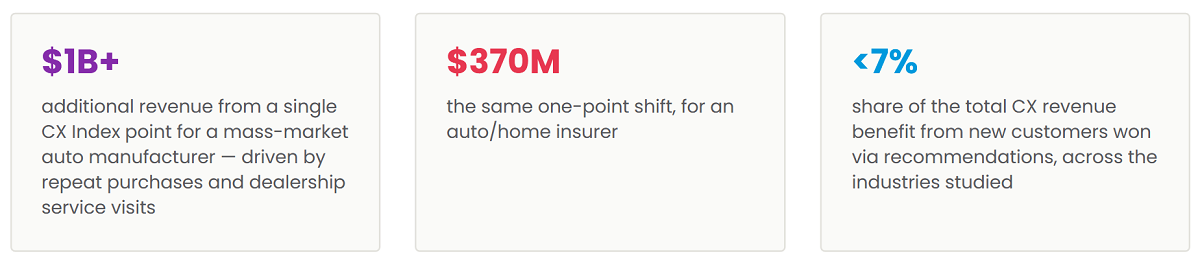 In many industries — including several in financial services — the growth benefit of improving CX doesn't scale evenly. It scales much larger when moving customers from "good" to "excellent" than when moving them from "poor" to "good."
In other words, the biggest revenue opportunity often isn't damage control for customers already having a visibly bad time. It's the mass of mediocre interactions — calls that didn't go wrong exactly, but didn't go well either — sitting in the "not-yet-excellent" band.
Degraded audio, a laggy platform, dropped calls, or a stumbling agent workflow can all quietly and invisibly keep a company parked indefinitely in that category, without anyone being aware of it.
CX is no longer a soft metric. It's a revenue line with a number attached.
In summary: the biggest point of focus for service organizations is not agent training or service design, but the invisible technical layer sitting underneath.
The Distributed Workforce: Is Hybrid Working Compromising CX?
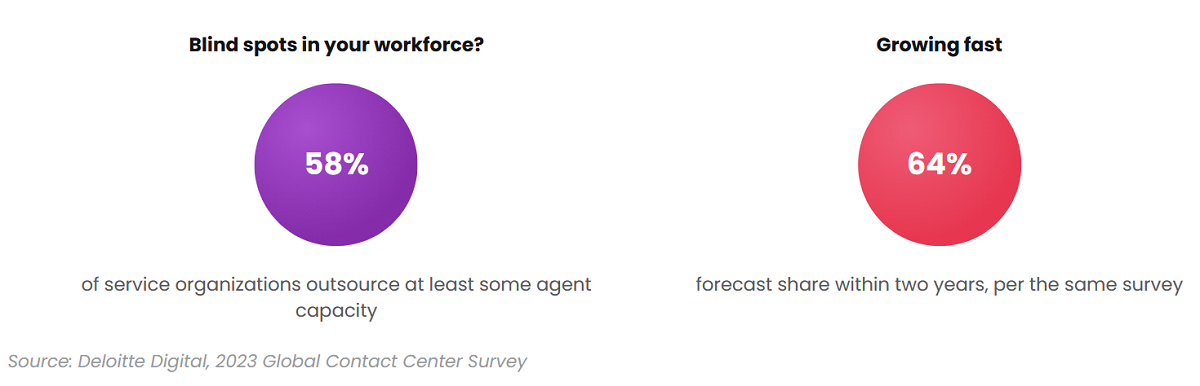 Every customer service agent working from a spare room is operating on a residential ISP connection that your organization's IT team has never touched, over a home router it never configured. Often, agents are using hardware that's old, outdated, or incompatible — and devices that aren't properly secured or updated become easy targets for cyberattacks.
Every outsourced or offshore team introduces another layer of infrastructure and local conditions that sits between your platform and your customers — harder to manage, harder to control, and all of it shows up in the customer's experience of the call.
CX leaders who are still measuring their competitive position purely on agent quality and process design are only seeing half the picture. It's the technical layer running underneath that they really need to be watching.
This isn't a criticism of team leaders or those running these organizations — it's a natural consequence of how legacy monitoring tools and org charts have historically been built. CX and network/IT operations have traditionally had separate reporting lines, differing KPIs, and separate budgets. But now, with the direct intersection of the technical layer and CX outcomes, the question becomes: is the connection good enough to deliver a great interaction — and is it resourced accordingly?
The Numbers: The Cost of Getting It Wrong
It's important to be precise about what "getting it wrong" actually costs, because the numbers are larger — and less abstract — than most leaders assume.
The time cost
According to HappySignals' Global IT Experience Benchmark 2026, employees lose an average of three hours and eighteen minutes of productive time for every IT incident they experience.
Inside a contact centre or a UC-heavy sales team, that's a multi-hour drag on the productivity of not just one person, but an entire team. That number climbs sharply for distributed teams: incidents handled by outsourced first-line support take 45% longer to resolve than those handled by in-house teams, according to the same benchmark.
Distance from IT doesn't just mean a slower physical response — it means a slower diagnostic one. An issue that might take minutes to triage on a monitored, on-site machine can take hours when the first step is simply establishing whether the problem is local, in transit, or on the platform side.
The productivity cost
The same friction is quietly taxing meetings too, not just contact centre traffic. Research from Jabra's "Billion Dollar Brain Drain" report found that three in four hybrid meetings experience some kind of technical issue — audio dropouts, video freezing, connection instability, or participants unable to join cleanly (52% for fully virtual meetings).
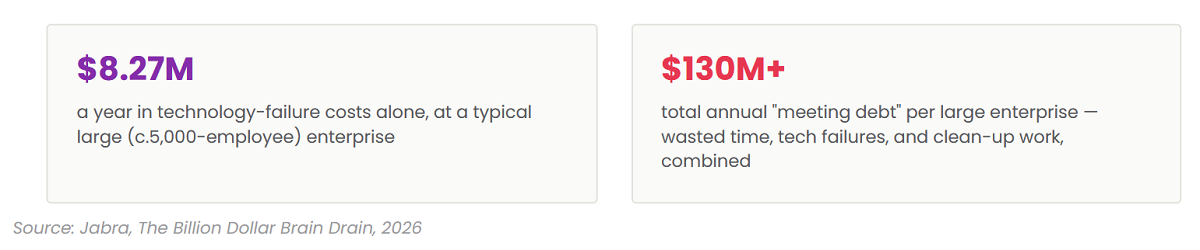 This is not a contact-centre-specific problem. It's a distributed-work problem that happens to hit contact centres hardest, because contact centres are where the customer is listening in real time.
|
|
The customer relationship cost
None of this yet accounts for the cost that's hardest to put a number on but easiest to feel: how a degraded interaction affects the customer relationship itself.
A dropped or glitchy call doesn't just cost the minutes it takes to reconnect — it changes what the customer believes about the company they're dealing with. It reads as a lack of competence, even when the actual fault sits three network hops away in someone's home broadband.
Customers don't care about root cause. They care about the experience they're having, and an interaction broken by "sorry, can you repeat that, I think my connection dropped" lands as unprofessional regardless of where the fault actually originated.
The cost to employee morale
Nothing erodes morale faster than being blamed — implicitly or explicitly — for problems you have no ability to diagnose or fix. An agent who spends part of every shift anxious about whether the next incident will be logged against their performance, with no way to prove it wasn't their fault, is an agent who is quietly disengaging.
In an industry already fighting high attrition, adding an invisible, under-addressed source of daily frustration is an agent retention risk.
The Root Cause: Why the Problem Has Become Invisible
Traditional IT and network monitoring was built for a centralized ecosystem — its own data centre, its own corporate network, and platform infrastructure owned and controlled by the organization itself.
Once an agent's chair, headset, and internet connection are physically outside the building, it becomes far harder to manage and control. Monitoring essentially stops at the edge of what the organization controls —usually the UC platform itself. Everything past that point — the agent's home Wi-Fi signal strength, their ISP's latency and packet loss, whether their headset driver is outdated, or whether their laptop's CPU is being throttled by background applications — sits in a genuine blind spot.
Platform monitoring tells you Teams, Genesys, or your CCaaS platform is up. It tells you nothing about whether any individual agent can actually reach it cleanly, or whether their own hardware and network conditions are quietly degrading the call before it ever touches your platform.
In a centralized environment, a problem tends to surface fast because IT is physically or logically close to it. In a distributed environment, the only way most organizations currently learn about a problem is when:
-
the affected employee reports it after the fact,
-
a post-call survey flags a poor rating,
-
or a pattern eventually becomes visible in aggregate complaint data weeks later.
All three detection methods share the same fatal flaw: they're retrospective. They tell you a customer already had a bad experience. They do nothing to catch the problem before it reaches that customer.
That retrospective gap creates a second, subtler problem for the people actually living through it. When a remote agent or hybrid knowledge worker asks "is it me, or is the platform down?" in most organizations today, there is no fast, confident answer. Lacking that information, they either burn time trying to self-diagnose using guesswork, or push through a degraded call hoping it resolves itself — unaware that the customer on the other
end is already forming a judgment. Either way, the uncertainty itself is a productivity and quality cost that sits on top of the incident itself.
For many organizations, it's tempting to treat this as a transitional problem — something that resolves itself once hybrid work settles into a permanent equilibrium. In reality, the data points the other way: outsourced and distributed agent capacity is forecast to keep growing, not shrink back toward the centralized model the old monitoring approach was built for. This isn't a temporary gap that time will close. It's a structural mismatch between where the workforce now sits and where an organization's visibility currently reaches — and it will keep widening unless something closes it deliberately.
The Solution Shape: What "Good" Looks Like - Proactive, Endpoint-Level Visibility
If the core problem is that visibility stops at the platform while the workforce sits well beyond it, the fix has to extend visibility all the way out to wherever the employee actually is — on whatever network and device they're actually using.
That sounds obvious stated plainly. It's a genuine departure from how most organizations currently approach monitoring, which tends to be built in silos: a network team watching network tools, a UC or platform team watching platform status pages, a device management team watching endpoint inventory. These three separate views prevent an answer to the actual question everyone is asking in the moment: what, specifically, is wrong with this call, right now?
Closing that gap properly means a few things have to be true simultaneously, not sequentially:
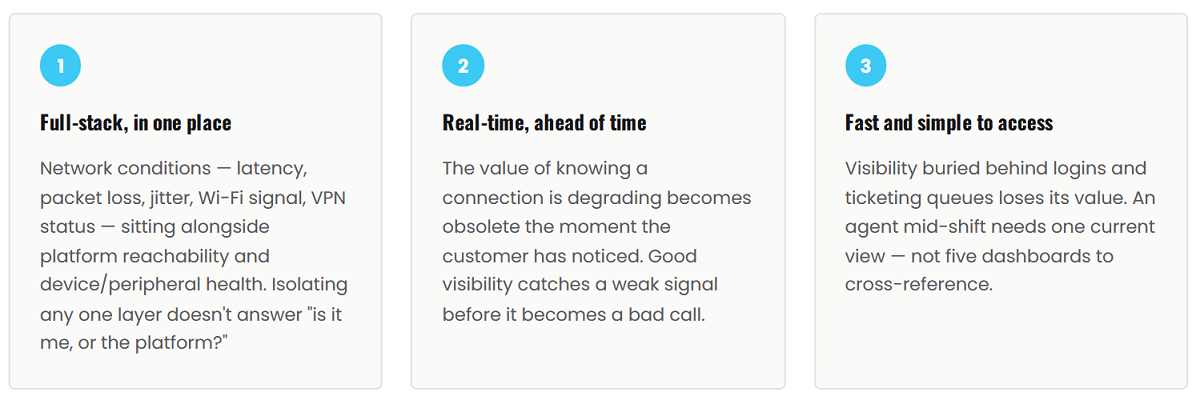 Getting those three things right pays off in different ways for each part of the organization: The individual worker gets the ability to self-serve a fix before the next call, rather than guessing through it.
IT and ops teams skip the slow, manual process of ruling things out one dashboard at a time, going straight to root cause — turning an hours-long chase into a minutes-long diagnosis.
The business gets to protect the metrics that are mission-critical now but were never part of a traditional IT ecosystem: customer satisfaction, agent retention, and the reputation that's built or eroded one interaction at a time.
Closing the Gap with Clarion (powered by Iris)
Make Every Worker Visible, Supported and Ready to Perform
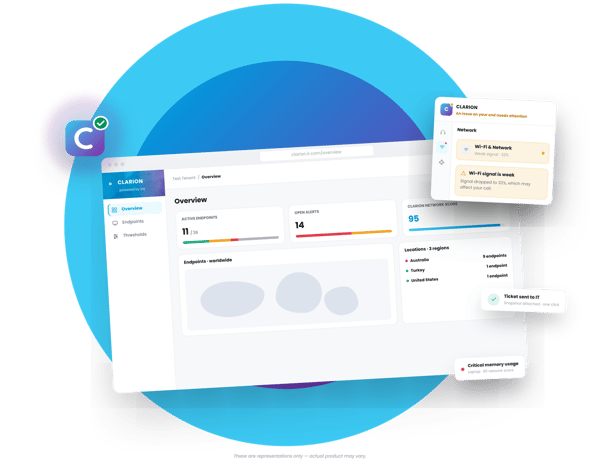 In a distributed workforce, IT and end users usually learn about a problem only after it's already impacted the call. Clarion, powered by Iris, gives every worker and every IT team the real-time intelligence to catch it first.
Clarion pairs an on-device widget with a centralized cloud dashboard, so agents, UC users, and IT admins each see exactly what they need, the moment it matters — closing the visibility gap, accelerating resolution, and protecting the experience your customers actually feel.

Frequently Asked Questions
Download a PDF copy of: The Hidden Cost of Invisible Problems