






.png?width=141&height=141&name=Transact%20(1).png)






.svg)

.svg)
.svg)
.svg)


%201.svg)














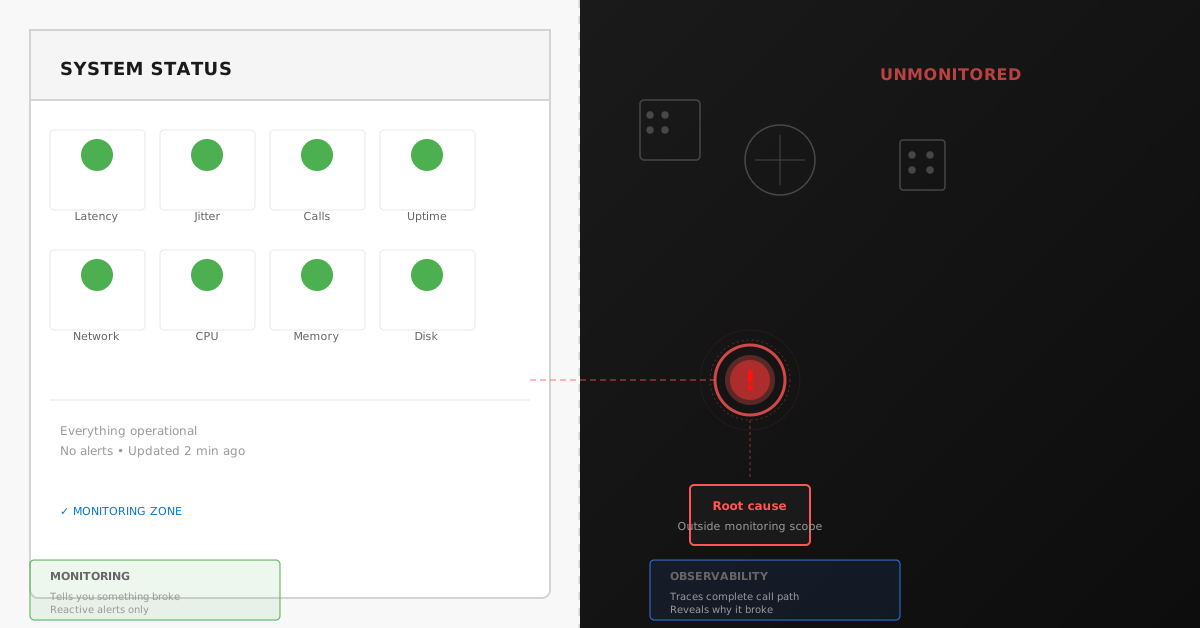

The difference between monitoring and observability isn't semantic. In a high-pressure environment, it becomes the difference between knowing something broke, and understanding why before it takes down everything else.
Most IT leaders in the region have monitoring in place for their UC and contact centre infrastructure.
SLA dashboards, alert thresholds, uptime checks — all standard elements of a robust monitoring system.
But what if there's an unexpected call-quality incident during a surge event, causing 400 calls to degrade simultaneously? A monitoring system alone won't have the capability to trace the fault from the endpoint through the carrier to a misconfigured Session Border Controller.
That gap between discovering something is wrong, and pinpointing exactly what happened, how, and where, is the crucial difference between monitoring and observability. And in a high-stakes communications environment, this gap becomes enormous.
The core distinction
Monitoring answers one question: is everything working as expected?
It tracks metrics against predefined thresholds. Known alerts fire, such as jitter above threshold, or packet loss exceeding 2%. These are reactive systems built for known failure modes.
Observability answers a completely different question: why is this happening?
Observability is the ability to understand the internal state of a complex system from its external outputs — including failures triggered by a combination of factors that no monitoring threshold was ever configured to catch.
|
MONITORING |
OBSERVABILITY |
|
• Tracks known metrics • Predefined thresholds • Reactive alerting • Siloed data (latency, jitter, packet loss) • Tells you that something broke |
• Correlated telemetry across systems • AI-assisted root cause analysis • Proactive synthetic testing • End-to-end session tracing • Tells you why and where |
What observability adds that monitoring cannot
Observability platforms for UC and contact centres address five capabilities that basic monitoring tools simply do not offer at the required depth.
-
End-to-end session visibility: Traces a call's complete path across SBCs, carriers, UCaaS and CCaaS platforms, bots, IVR, and individual agents — quality metrics, errors, and user impact unified in a single view, not siloed by system, but stitched into a coherent session narrative.
-
Unified telemetry: Correlates metrics, logs, traces, events, and UC analytics so operators understand not just that KPIs dropped, but why a specific customer journey degraded on a specific carrier through a specific SBC at a certain time.
-
AI-assisted root cause analysis: Reduces alert noise through automated correlation across millions of events, pinpointing faulty routes, misconfigured SBCs, failing regions, or carrier issues in minutes rather than hours.
-
Proactive testing and assurance: Uses synthetic transactions to detect degradation before real customers are impacted — particularly critical in an environment where the next surge event could arrive with no warning.
-
Business and technical context views: Maps technical issues to SLAs, customer journeys, and queues for prioritisation, presenting contextual datasets to line-of-business and senior management teams in forms that drive action, not just visibility.
"Monitoring tells you the bridge has collapsed. Observability tells you which bolt failed, when it first showed stress, and what you should have done six weeks ago."
The regional crisis context that changes everything
In normal operating conditions, the gap between monitoring and observability is a performance question.
But during periods of regional disruption, it becomes existential. Network attack correlation, linking network telemetry to UC performance in real time, is mission critical. It can mean the difference between a team that reroutes traffic within minutes and prevents a potential collapse, and one that spends hours chasing symptoms while call quality disintegrates.
For organisations operating across the Middle East right now, the question is not whether observability tools are worth the investment. The question is whether you can afford to find out the hard way what happens without them.
Download the complete report:
The High Stakes of Not Investing in Observability Tools During the Middle East Conflict
Mapping the observability gap across four critical sectors, with detailed analysis of failure modes, solution capabilities, and strategic recommendations for regional enterprises.

.png?width=767&height=450&name=ivr-voice-testing-at-scale-tile%20(1).png)