






.png?width=141&height=141&name=Transact%20(1).png)






.svg)

.svg)
.svg)
.svg)


%201.svg)















In a crowded vendor landscape, the wrong choice does not just waste budget — it leaves your communications infrastructure unprotected precisely when resilience matters most.
In the Middle East, national initiatives like the UAE's massive AI investment funds and Saudi Vision 2030 are pushing businesses to move AI models out of the pilot stage and into live production.
Observability is the frontline initiative for this transition, and enterprises are relying on it to track inference times, API response inconsistencies, and model behaviours.
As a result, the Middle East UC and Contact Centre Observability vendor landscape is crowded. Providers are making bold claims, with marketing promising real-time visibility, AI-assisted root cause analysis, and seamless hybrid support.
But in a high-stakes operational environment, the gap between a vendor who performs under pressure and one who does not can have consequences far beyond a missed SLA.
A structured, thorough vendor evaluation process is not optional. Here is the framework that enterprises should be applying.
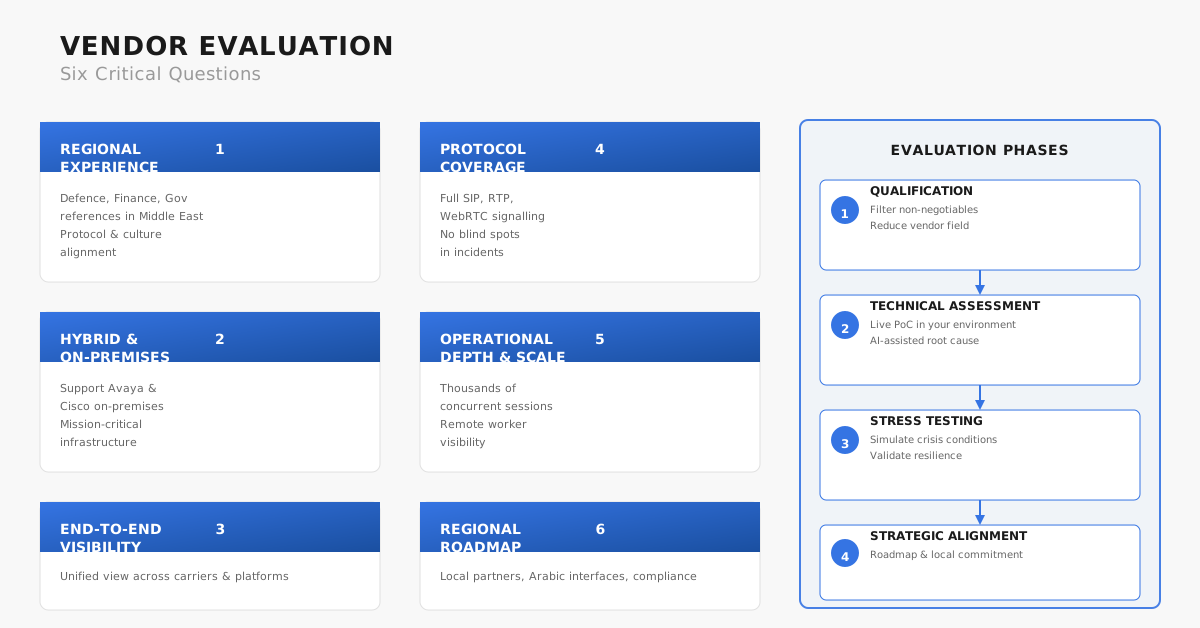
The evaluation checklist
-
Regional implementation experience: Demand reference customers in Defence, Financial Services, Government, and Telecom across the Middle East. Understanding regional business protocol and culture is as important as technical capability.
-
Hybrid and on-premises capability: The vast majority of large enterprises in the region still run Avaya and Cisco Enterprise Communications on-premises. Any vendor that cannot support hybrid or fully on-premises deployments is disqualified for mission-critical sectors.
-
Real-time end-to-end visibility: MOS scores, jitter, packet loss, and codec negotiation must be visible across UC, contact centres, carriers, and remote users simultaneously. Eliminating the need for multiple monitoring tools is a core requirement, not a bonus.
-
Protocol coverage: Require full coverage of SIP, RTP, and WebRTC signalling and media tracing. Partial protocol support creates blind spots that become critical during complex multi-platform incidents.
-
Operational depth and scale: Years of incident data translate to better AI models and faster root cause analysis. The platform must handle thousands of concurrent sessions and provide visibility into remote workers — the post-pandemic reality across the Gulf.
-
Regional roadmap and partner networks: Look for investment in Middle East-specific features: Arabic language interfaces, support for regional telecom platforms, and compliance with evolving local regulations. Established local partners enable faster implementation and in-country procurement navigation.
How the evaluation should unfold
Vendor selection for enterprise observability tools is not a single decision — it is a structured process that should follow a clear sequence.
|
PHASE 1 — QUALIFICATION |
Eliminate vendors who cannot demonstrate hybrid/on-premises capability, regional references, or full protocol coverage. This step should reduce the field significantly. |
|
PHASE 2 — TECHNICAL ASSESSMENT |
Require a live PoC that tests end-to-end visibility across your existing Cisco, Avaya, and Microsoft Teams infrastructure simultaneously. Assess AI-assisted root cause against a real historical incident. |
|
PHASE 3 — STRESS AND RESILIENCE TESTING |
Test survivability procedures: pre-validate failover with continuous monitoring active. Simulate surge scenarios. Confirm the platform holds under load conditions representative of a genuine crisis-period event. |
|
PHASE 4 — STRATEGIC ALIGNMENT |
Assess the vendor's Middle East investment trajectory. Validate local partner networks. Confirm that compliance with current and emerging regional regulations is on the product roadmap, not the backlog. |
The cost of getting it wrong
Choosing the wrong vendor can have far-reaching consequences. Your observability solution should:
-
Scale under pressure
-
Provide proper protocol support
-
Have a meaningful regional presence
Failing to consider these elements — especially in sectors like defence, government, and healthcare — becomes a risk to operational continuity in the moments when continuity is non-negotiable.
"In a high-pressure environment, vendor selection is not a procurement exercise. It is a risk management decision."
The right observability vendor becomes a strategic partner that helps your organisation understand not only that your communications infrastructure is functioning, but why — and how to keep it that way under conditions it was never designed to face.
Enterprises that invest in a thorough evaluation process, and in comprehensive UC and contact centre observability tools, are far more likely to maintain operational continuity when it matters most.
Download the full analysis:
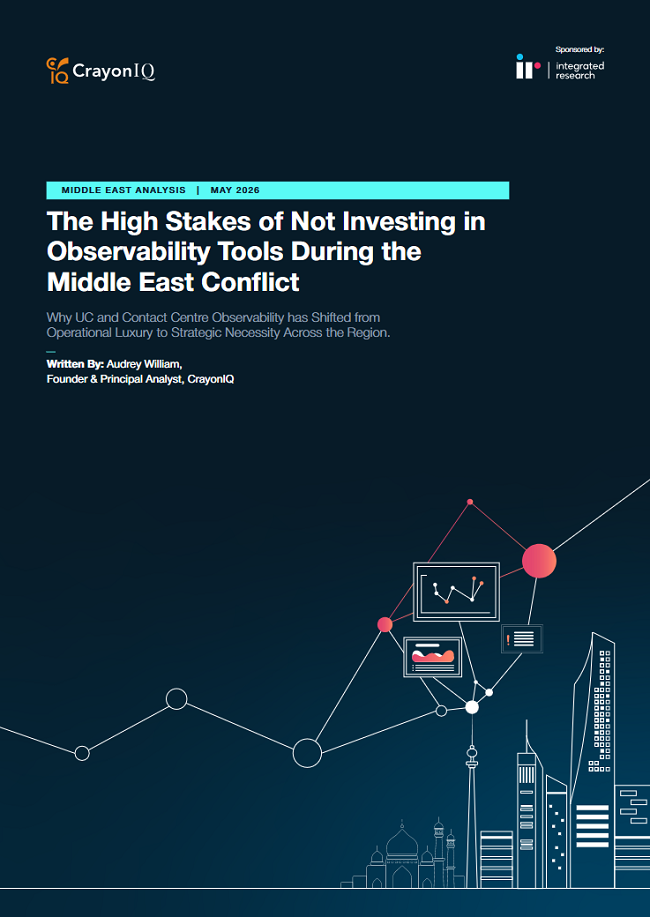
The High Stakes of Not Investing in Observability Tools During the Middle East Conflict
Including in-depth vendor evaluation criteria, sector-by-sector risk profiles, and strategic recommendations for enterprises operating across the region during active high-pressure operational conditions.

.png?width=767&height=450&name=ivr-voice-testing-at-scale-tile%20(1).png)