






.png?width=141&height=141&name=Transact%20(1).png)






.svg)

.svg)
.svg)
.svg)


%201.svg)















Why large enterprises and government agencies across the Middle East can no longer treat UC observability as an operational nice-to-have. Read on to find out what happens when they do.
Imagine a government emergency contact centre during a regional crisis. Citizens are calling for evacuation routes, hospital coordinates, and shelter information.
Agents and resources are stretched, call volumes have spiked by 400%, overtaxing IVR systems and losing calls. Management is struggling for answers, and behind every moment, the crisis threatens to escalate. Fixing this fast is crucial — lives depend on it.
This is far from a hypothetical. Across the Middle East today, enterprises, government departments, and critical service providers operate under extraordinary communications pressure.
Vulnerable systems are subject to escalating cyberattacks. Infrastructure is being tested. Legacy networks are crumbling under the pressure of supporting remote workforces.
And in this environment, the organisations without real-time visibility into their communication systems are the most at risk.
"When communication systems fail during a crisis, disrupting day-to-day operations and business continuity, individuals face significant challenges in urgently reaching government departments, airlines, and financial services organisations. This underscores the critical need to prioritise observability tools. Without observability, organisations are forced to operate reactively and without clear insight — essentially, in the dark. Problems are often more complex by the time they are detected, making resolution slower, more costly, and leaving no clear record of what actually happened.
— Audrey William, Founder & Principal Analyst at CrayonIQ
The sectors most exposed
Not every sector faces equal risk, but in times of crisis — whether ongoing or unexpected — the consequences of failure are highest where communications underpin life-critical decisions.
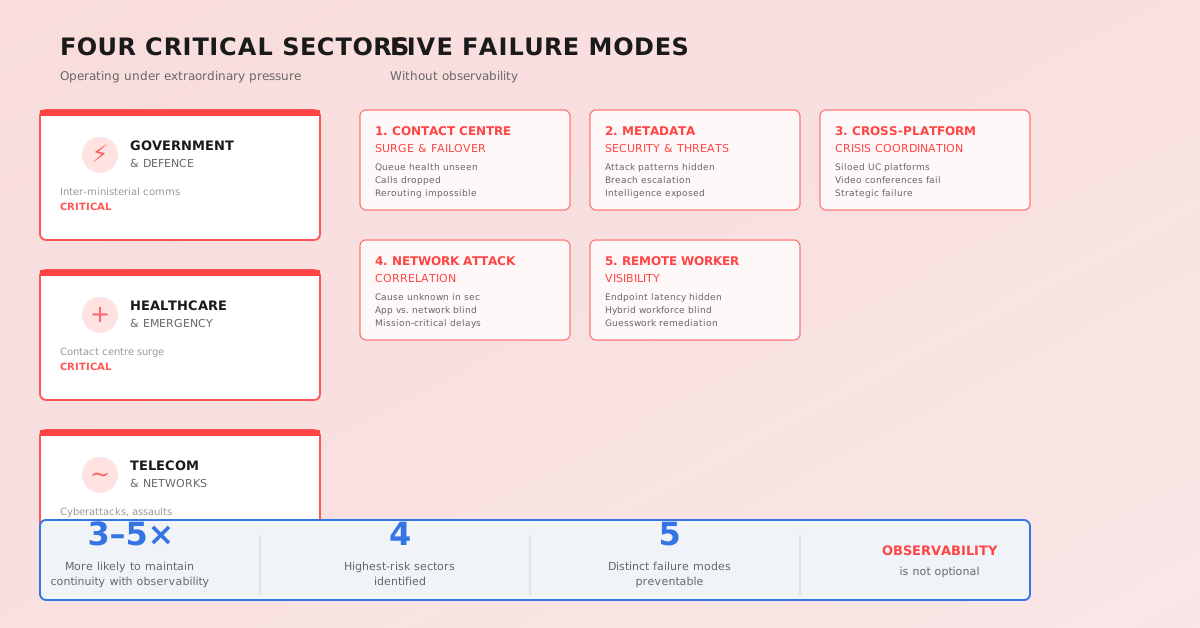
Four sectors stand out as especially vulnerable during periods of regional instability.
|
Sector |
Primary risk |
Consequence of failure |
Risk level |
|
Government & Defence |
Inter-ministerial comms disruption, IVR failure |
Evacuation orders delayed, public panic |
Critical |
|
Healthcare & Emergency |
Contact centre surge, coordination failures |
Medical resource misallocation, preventable harm |
Critical |
|
Telecom & Networks |
Cyberattacks, infrastructure assaults |
Cascading UC failures across dependent sectors |
Critical |
|
Financial Services |
Session metadata exposure, fraud spikes |
Regulatory breach, customer confidence collapse |
High |
Five failure modes: Why observability is non-negotiable
The challenges facing large enterprises during a regional crisis are not abstract. Each represents a scenario where the absence of real-time visibility can turn a manageable incident into a life-threatening crisis.
IT teams don't necessarily need more visibility — they need understanding. They need tools that show cause and effect, revealing not only what is happening but why it matters.
Contact centre surge and failover
Without observability into queue health, IVR capacity, and agent availability, organisations don't have the ability to dynamically reroute demand when call volumes spike. Survivability testing and pre-validated failover procedures become impossible without the right tooling.
Metadata security and threat detection
Attackers don't need to intercept content to extract intelligence. Behavioural analytics embedded in observability platforms can detect suspicious access patterns and abnormal session routing before a breach escalates.
Cross-platform crisis coordination
Most government ministries and organisations run IT infrastructures made up of different UC platforms from different vendors. Government crisis response requires real-time coordination across these platforms. Dropped video conferences and failed secure voice calls between officials during an active event are no longer an inconvenience — they're a strategic failure.
Network attack correlation
When calls drop and video freezes, timing is mission critical. Teams need to know within seconds whether the cause is a network-level attack or an application failure. Observability tools that link network telemetry with UC performance make that determination possible in near real-time.
Remote worker visibility
The post-pandemic Gulf runs on hybrid and remote workforce models. Without endpoint-level visibility into latency, jitter, and packet loss for individual agents working from home, targeted remediation becomes guesswork that can affect the entire agent pool.
|
3–5× more likely to maintain continuity during a crisis with observability |
4 critical sectors identified as highest-risk during regional instability |
5 distinct failure modes preventable with UC observability tooling |
The bottom line
Organisations that have invested in comprehensive UC and Contact Centre Observability tools are between three and five times more likely to maintain operational continuity during crisis-induced network disruptions, cyber incidents, and staff surges.
In sectors like defence, banking, and government, communication failure is simply not an option.
Observability is no longer a line item to be deferred. It is the first and last line of operational defence.
Download the full CrayonIQ analysis:
The High Stakes of Not Investing in Observability Tools During the Middle East Conflict
Understand the complete risk landscape, sector-by-sector breakdowns, and what your organisation should be prioritising right now.


.png?width=767&height=450&name=ivr-voice-testing-at-scale-tile%20(1).png)