

















Valentina Dunoski, Product Director at Integrated Research (IR), is tackling a familiar workplace problem. When a call breaks up, is it the internet, the device or the platform?
 Illustrated portrait of Valentina Dunoski, IR’s Product Director, against a blue and purple collage background.
When Valentina Dunoski spoke to colleagues after Clarion’s October launch, she began with a story about Wiz. The cloud-security company had walked away from acquisition discussions reported at about US$23 billion in 2024; Google later agreed to buy it for US$32 billion and completed the acquisition in March 2026. Dunoski’s point was not the valuation. It was conviction. “I feel that it starts with belief,” she told the town hall, before turning the room back to IR’s newest product.
Clarion monitors the technology supporting calls and meetings, including network performance, connections to calling platforms, audio-device health and computer performance. In interactive mode, employees see a real-time status summary in plain language. Fleet View, its dashboard for IT teams, brings together performance data from employees’ computers.
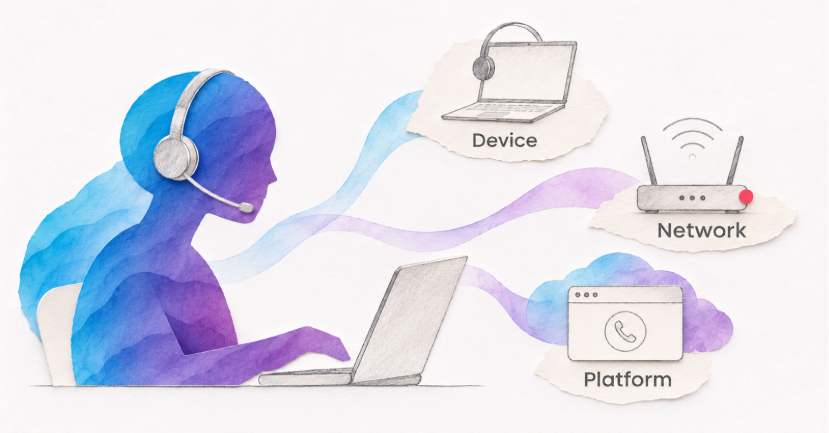 Conceptual illustration of the device, network and platform conditions Clarion monitors to support calls and meetings.
Start with the problem
Dunoski grew up in Sydney’s south-west and once considered becoming an actress. Her parents, who had come to Australia from the former Yugoslavia, saw education as a way for their daughter to have opportunities they had missed.
She studied business at the University of Technology Sydney and took her first product management role at Optus. She went on to lead product work across banking, insurance and energy. At Caltex Australia, now Ampol, she helped explore ways for motorists to pay at the pump.
In an email to colleagues ahead of Clarion’s launch, Dunoski said the aim was to help customers “cut through complexity and act with confidence”.
An internal demonstration in August showed how Clarion’s application monitored connection and device health in real time. Employees could report a problem to IT through a pre-filled email with the relevant technical data attached.
IR launched Clarion on 15 October 2026 to help close the gap between what employees experience during calls and meetings and what IT can see.
A clearer view
For contact-centre staff and other employees, tracing a call problem can be difficult when the IT team is in another city or on a different network. A cloud service may appear healthy to IT while an employee struggles with weak Wi-Fi, an overloaded computer or a headset issue. By the time a support request reaches IT, conditions may have changed.
Fleet View helps IT teams see whether a problem appears isolated or widespread. IR says Clarion observes the technology supporting employees rather than the employees themselves.
“Prognosis built IR’s reputation. We see Clarion as our next phase of growth,” Dunoski said. Clarion’s name evokes a trumpet’s clear call and what she described ahead of launch as “a clear signal or call to action”.
To explore Clarion for your workforce, request a demo.
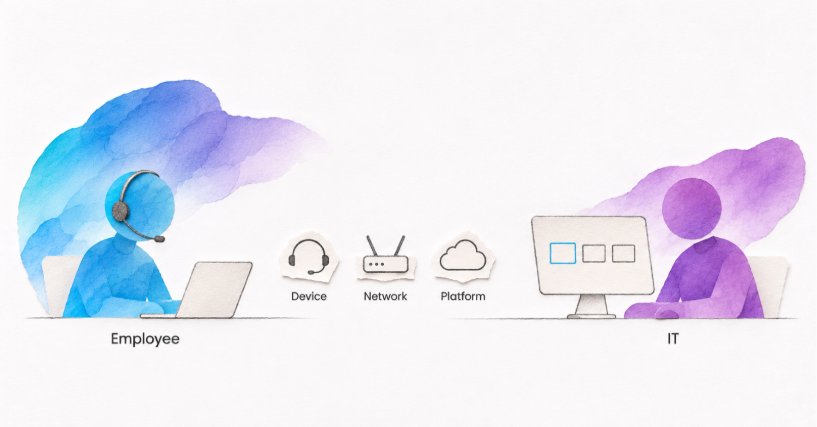 Conceptual illustration of the device, network and platform conditions Clarion observes.
Related reading