
















If you ask most contact center leaders what drives customer experience, they will most likely give you operational answers such as scripts, training schedules, or service design.
If you ask what drives agent attrition, the answers pivot entirely toward human elements like wages, rigid scheduling, and emotional burnout.
For years, organizations have treated these two issues as completely separate line items. Customer experience (CX) belongs to operations and marketing, while attrition belongs to HR. But there is a glaring, under-prioritized link connecting them. A human being who is genuinely trying to do a good job, but using internal tools and processes that are constantly working against them.
When we fail to fix the invisible, day-to-day friction holding agents back, we aren’t just mismanaging an HR metric, we’re actively dismantling our customer strategy.
Investigating the under-prioritized link
The link between employee sentiment and customer happiness isn't just a theory, it’s mathematically verifiable.
In 2019, Glassdoor's Economic Research team published a landmark large-scale study linking employee satisfaction ratings directly to customer satisfaction.
They used a panel of 293 employers across 13 industries over a decade to analyze the direct impact of workplace culture on the consumer. While the study established our foundational understanding of this relationship, its core finding remains incredibly relevant.
They found that each 1-star improvement in an employer’s Glassdoor company rating (out of 5), is associated with a statistically significant 1.3 point increase in customer satisfaction (out of 100).
Cruicially, the effect is more than twice as large in ‘high customer contact’ sectors where customers routinely interact with employees, like retail, food services, tourism, financial services, and health care. In these environments, each 1-star improvement in employee satisfaction predicts a 3.2 point increase in customer satisfaction.
Regardless of industry, the takeaway is clear. The internal Glassdoor reviews given by customer-facing sales, and customer service roles serve as a direct leading indicator of your external customer success. In other words, you can’t deliver a seamless external experience through a fractured internal culture.
What the link looks like today
If Glassdoor proved the correlation, modern workplace data shows just how strained that link has become. The front line is sending an urgent distress signal.
Verint's State of Agent Experience 2026 report, based on a survey of 1,000 contact center agents fielded in late 2025, found that 31% of agents say they're likely to leave their current role within the next six months. Astoundingly, that's almost a third of a workforce with one foot already out the door.
When HR and operational leaders investigate why this is happening, the default assumption is often that ‘agents are just overworked’ or need better wellness benefits.
But the root cause is far more specific and systemic. The same report found that in 45% of calls, agents spend an average of three minutes searching for answers, or information they should already have at their fingertips.
This becomes time that isn't spent solving the customer's actual problem. For three minutes of a live interaction, an agent is not listening with empathy, problem-solving, or building rapport. They are frantically navigating multiple disconnected systems, clicking through outdated knowledge bases, and feeling the customer’s palpable frustration build.
This is not a training gap, but a systemic friction point. It’s an invisible, unmeasured category of workplace distress that erodes morale. When multiplied across every shift, every agent, and every day, it turns the contact center into a pressure cooker. End users will feel it, customers will experience it, and everyone in the organization will be affected by it.
The anatomy of "The invisible stuff"
For an audience focused on culture, talent, and organizational health, it is essential to understand that this friction breaks down into three distinct areas of human impact:
The cognitive load
We ask agents to display deep emotional intelligence while simultaneously expecting them to act like human system integrators. Forcing a distributed or hybrid agent to toggle between five to seven mismatched applications just to resolve a single billing query creates acute mental fatigue.
The growth ceiling
When internal tools are slow and fractured, performance metrics inevitably suffer. Agents are frequently penalized for higher Average Handle Times (AHT) or lower First Contact Resolution (FCR) rates, even when the delays are entirely caused by infrastructure blind spots. This creates a toxic psychological environment where employees feel set up to fail.
The culture shift of AI
As organizations rapidly roll out automation, agents report that their roles are actually becoming more complex. While simple questions are diverted to self-service, human agents are left exclusively handling the most complicated, high-emotion escalations. If we don’t simultaneously fix their internal tools, we are giving them a harder workload with fewer resources.
The "Is It Me or the Platform?" isolation
The rise of remote and distributed workforces has introduced a highly stressful technical blind spot. When a system stutters, resulting in dropped calls, garbled audio, jitter, latency, or sudden bandwidth drops, a hybrid agent is often left completely in the dark. Sitting alone at home, they face a stressful dilemma: "Is it my domestic Wi-Fi, or is the corporate platform failing?" Without immediate clarity, they bear the brunt of the customer’s frustration while feeling isolated and unsupported by tech support. This lack of transparency turns minor tech glitches into major drivers of job dissatisfaction.
|
Your platform dashboard says everything’s green. Your customer just heard the call drop. Our new guide shows why remote and hybrid teams have a visibility gap, what it costs, and how closing it protects customer experience. |
The Human-Centric Business Case for AX First
To fix customer experience, leadership must look equally through the customer-facing window and the agent-facing one. True CX automation and transformation must begin with Agent Experience (AX).
When organizations invest heavily in optimizing internal knowledge access, streamlining the desktop, and offering intelligent tech observability, the business returns are immediate:
The attrition dividend
Reducing that 31% flight risk even by half saves hundreds of thousands of dollars in recruitment, background checks, and onboarding costs. More importantly, it keeps institutional knowledge within your walls.
The empathy premium
When an agent doesn't have to spend several minutes fighting a clunky database or worrying about line jitter, that capacity is redirected back into the human interaction. They have the mental clarity to listen, show genuine empathy, and turn a frustrated customer into a brand advocate.
The reputation cycle
A workplace culture that actively eliminates friction creates a positive feedback loop. Satisfied agents stay longer, speak highly of their employers, and naturally elevate your corporate reputation on platforms like Glassdoor.
Clarion – powered by Iris
This is exactly what Integrated Research has built into Clarion, the new intelligence layer that makes every worker visible, supported, and able to do their best work.
Clarion is our newest, most innovative offering. A lightweight, endpoint-level intelligence layer designed to sit alongside existing monitoring platforms, so that you can capture and observe the metrics that matter.
Individual workers and IT teams get shared, real-time answers to the questions that currently have none.
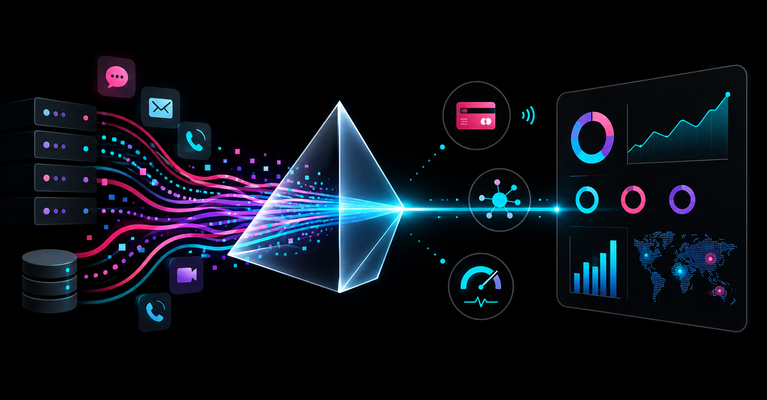
With a fleet-wide dashboard you can aggregate telemetry from every endpoint into one cloud-based view, give everyone real-time visibility across a distributed workforce.
Clarion has been built to answer the question, ‘is it me or the platform?’
In the world of global enterprise, IT complexity is not just a challenge, it’s a material risk. For over thirty-five years, IR has been the invisible support behind the world’s most critical operations, turning insights into a performance advantage.
Clarion was built to close the visibility gap, so that your team is always visible, constantly supported and able to do their best work. Your customers benefit from faster resolution and increased satisfaction, which means significant cost savings for your organization.