


.png?width=141&height=141&name=Transact%20(1).png)






.svg)

.svg)
.svg)
.svg)


%201.svg)















As AI agents take over more of the customer conversation in APAC and the Middle East, the old rules of monitoring are breaking down — and a new analyst report reveals which vendors are actually ready for what comes next.
For years, the question enterprise IT and CX teams asked about their Unified Communications (UC) and Contact Centre (CC) systems was simple: is it up or is it down? Today, that approach is a dangerous relic.
Until now, managing an IT failure was a reactive process, driven by a dashboard flashing light or an alert, that a technician would be called on to fix. In our world of hyper-connected remote teams and cloud-first contact centres, waiting for a red light to blink means you have already lost money, customers, and reputation. In Asia-Pacific (APAC) and the Middle East, with ongoing conflict and the extreme stress on communications infrastructure, the stakes for getting it wrong have never been higher.
"When communication systems fail during a crisis, business continuity and access to critical services—ranging from government agencies and airlines to financial institutions— are jeopardized. This highlights the critical importance of observability. Without clear visibility, organizations must respond reactively to issues, making incidents more difficult, time-consuming, and expensive to resolve."
— Audrey William, Founder & Principal Analyst at CrayonIQ
The Problem With "Up or Down" Thinking
Across the region, contact centres are generally utilizing a mix of Microsoft Teams, Zoom, Cisco, Genesys, NICE, and Avaya, often layered with specialised AI tools bolted on top.
When a live agent handles a call, the process is somewhat predictable. A script, a workflow, a known path. But when an AI agent or AI-powered tool takes the call instead, the process becomes dynamic, adaptive, and much harder to predict.
Traditional monitoring was built for the predictable world. It tells you a server is down. It cannot tell you why a customer's experience is degrading, whether an AI agent gave the right answer, or where in a tangled, multi-vendor stack the actual root cause is hiding. These are the "unknown unknowns", that no longer respond to the oversimplified question ‘Is it up or is it down?’
From Status Checks to Root Cause: A Different Way of Seeing
Traditional Monitoring takes a UC/CC system with limited visibility, runs a status check, and returns a binary answer: up or down. It is reactive by nature, firing alerts only after failure, and it simply cannot see unknown unknowns coming.
Observability treats the same system as a source of rich external signals. Logs, metrics, and traces are correlated to reveal the internal state of the system. The output isn't a status light; it's a root cause, often surfaced before users even notice something is wrong.
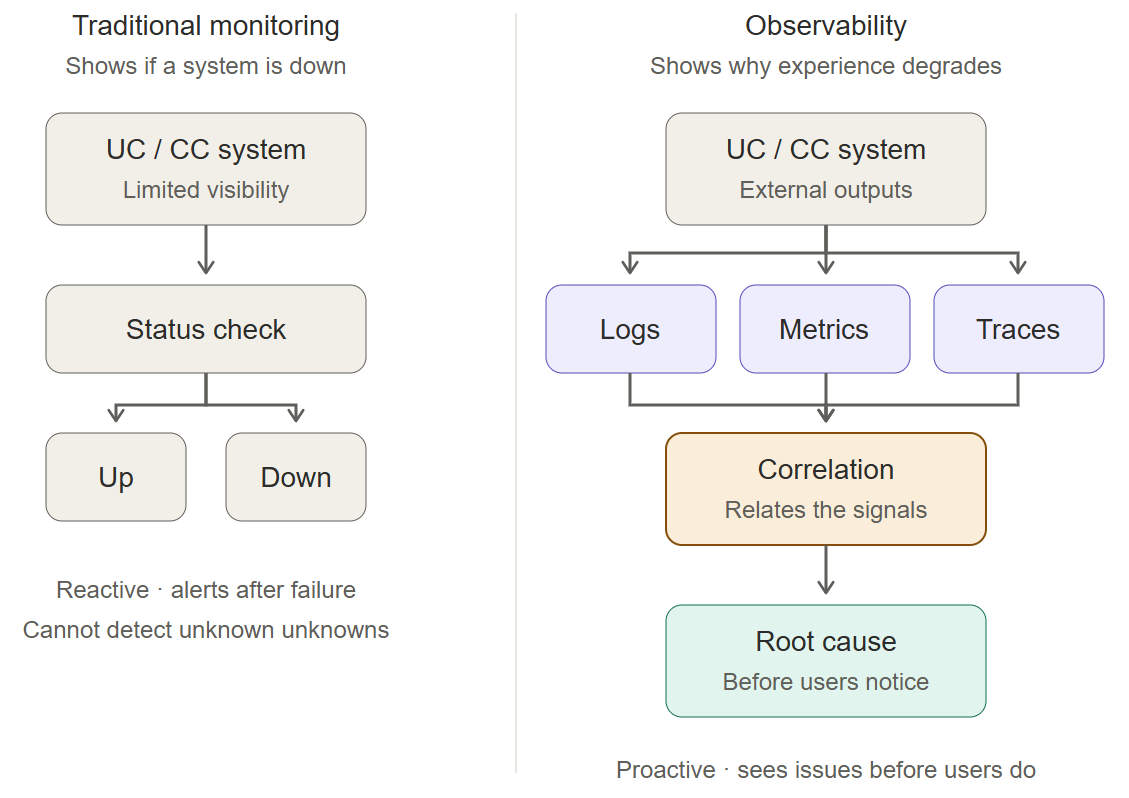
The difference isn't about collecting more data. It's about understanding the relationships between the data an enterprise already has. That correlation capability is what separates genuine observability from advanced-sounding data collection.
Why This Matters More in APAC and the Middle East Specifically
Ongoing conflicts, rapidly shifting alliances, and persistent cyber threat actors have placed extraordinary stress on the communications infrastructure supporting critical sectors in these regions.
In this environment, UC (Unified Communications) and Contact Centre Observability tools have shifted from operational luxuries to strategic necessities. Three regional realities make this shift urgent rather than optional:
A genuinely multi-vendor landscape.
Very few large enterprises in the APAC and Middle East region run a single-vendor stack. Most combine UC platforms like Teams and Zoom with CC platforms like Cisco, Genesys, NICE, or Avaya, plus specialised AI point solutions. Observability functions as the "single pane of glass" that correlates signals across all of it. This is something no individual vendor's native tools can do alone.
Tightening data sovereignty rules.
New data residency laws across APAC and the Middle East mean organisations must be able to prove, in real time, where customer data is being processed. Observability turns that proof from a manual, periodic checklist into a continuous, automated process, and this represents a meaningful advantage for compliance and audit teams alike.
Regulated industries with zero tolerance for downtime.
Government, financial services, defence, and telecommunications organisations across the region are under growing pressure to demonstrate operational resilience. For these sectors, the ability to ask "which servers are down right now?" or "what's the root cause of this outage?" and get an immediate, accurate answer is becoming mission critical.
What Good Observability Actually Looks Like
The enterprises pulling ahead share a few common traits:
-
Full-stack visibility from the endpoint and local network through to Session Border Controllers n-premises, hybrid, and cloud environments
-
The ability to interpret AI agent reasoning paths, not just whether the bot is "on"
-
Generative AI assistants that let non-technical stakeholders generate performance insights without needing a specialised engineer on standby.
Vendor Spotlight: Why Analysts Point to IR
One name keeps surfacing when analysts assess who is actually solving this problem at enterprise scale: IR (Integrated Research).
Through its Prognosis and Iris platforms, IR has built its position by specialising precisely where general-purpose monitoring tools struggle — deep domain visibility into call quality, user experience, endpoints, network paths, and service dependencies across UC and CC environments.
A few reasons IR keeps coming up in enterprise shortlists across the region:
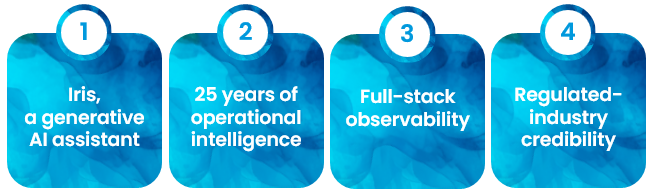 IR also partners closely with the CX and CC vendors that enterprises already run, including Genesys, Cisco, and Avaya. IR is actively extending its observability capabilities into NiCE and other emerging CC environments through 2026 and 2027.
Find out more about why UC observability is critical in APAC and the Middle East
What the Full Buyer's Guide Covers
This blog only scratches the surface. The full CrayonIQ report goes considerably deeper — and was built specifically to cut through vendor marketing spin with a region-first lens (rather than the North America–centric benchmarks most global research relies on). Inside, you'll find:
-
The current state of cloud adoption across APAC — why on-premises and hybrid architectures still dominate outside ANZ, and what that means for your buying criteria.
-
The four ways enterprises actually buy a contact centre solution today — direct from a CC vendor, through a CRM/Experience Management vendor, via a CPaaS provider, or from a hyperscaler — and which path fits which type of organisation.
-
A full vendor evaluation framework, scoring AI Vision and Capability alongside Strategic Impact on CX, covering criteria like AI agents delivering functional outcomes, third-party AI integrations, compliance and security, and completeness of vision.
-
A quadrant analysis mapping leading vendors — including Verint, AWS, NiCE, Cisco, Genesys, Google, Microsoft, Avaya, Mitel, and mid-market challengers like Zoom, Dialpad, and Talkdesk — against AI vision and enterprise CX impact.
-
Vendor-by-vendor assessments and 12-month outlooks, detailing where each player is strong, where they're exposed, and what to watch for as the market moves further into agentic AI.
-
The IR Vendor Highlight in full, including where IR sits relative to the broader CX and AI vendor landscape and where its observability roadmap is headed next.
Where This Leaves Decision-Makers
If your organisation is running a multi-vendor UC or CC environment anywhere in APAC or the Middle East, the question isn't whether your systems are up. It's will you know why they were degrading before your customers did — and whether you could prove it to a regulator if asked.
-
Covered in detail in the full CrayonIQ analyst report.
-
The vendors best positioned to answer that question
-
The compliance pressures driving the shift
-
What enterprise buyers should expect over the next 12 months
Free Research Report
Download the free CrayonIQ Buyer’s Guide report
Including the full Buyer's Guide vendor assessments, quadrant analysis, and the "IR Leads with Observability Solutions for Major Enterprises across Asia-Pacific and the Middle East" Vendor Highlight — for the complete analyst breakdown and a 12-month outlook on where the market is heading.