






.png?width=141&height=141&name=Transact%20(1).png)






.svg)

.svg)
.svg)
.svg)


%201.svg)















I recently sat down with LANcom’s CTO, Steve Lu, to co-present an exclusive webinar, hosted by LANcom, IR’s trusted partner in Taiwan.
LANcom Networks Group is a Taipei-based technology and ICT solutions provider with over 30 years of experience, specializing in enterprise-grade collaboration, voice, video, messaging, and network infrastructure solutions.
The webinar shared insights into key unified communications and contact center (UC & CC) market trends and introduced IR’s newly launched AI-powered Prognosis assistant, Iris, designed to help enterprises move from reactive monitoring to proactive observability.
UC & CC systems are highly critical aspects of core business infrastructures. In this article, we’ll share some highlights and takeaways from the webinar, focussing on how observability enhances enterprise resilience:
Hybrid working
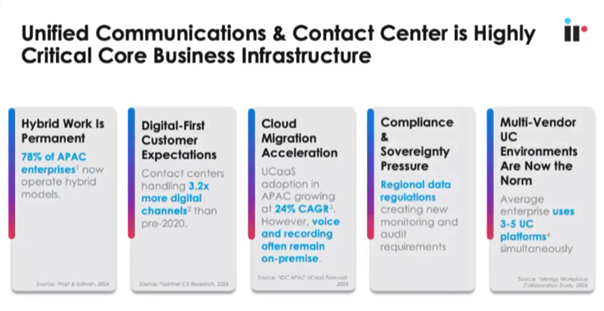
Remote and hybrid working in the APAC region is emerging as a preferred path for hiring, growth and stability. Hybrid working has reached around 78% in the region, and continues to grow, significantly increasing the level of complexity throughout IT infrastructures.
Distributed systems, increased digital channels and the explosion of data calls for more control, and this can no longer be achieved through traditional monitoring solutions or strategies.
AI and digital-first customer expectations
The integration of AI brings with it even more complexity, as enterprise organizations globally, struggle to keep up with the evolving customer expectations.
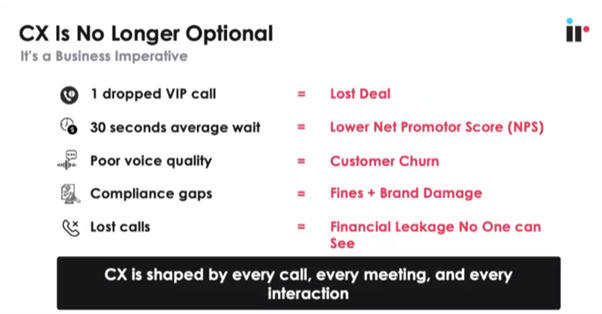
In 2026, customers will no longer accept generic service. AI-powered hyper-personalization has become the baseline, and they now expect organizations to know their history and their preferences, and to provide service without fault across every channel.
Cloud migration acceleration
Cloud migration increases the need for observability because it transitions IT environments from static, predictable on-premises infrastructure to highly distributed, dynamic, and complex cloud-native architectures.
Cloud environments are often multi-cloud or hybrid, involving dozens or hundreds of independent, interconnected services.
-
Difficulty in Mapping: Understanding dependencies between services becomes difficult, making it hard to identify the root cause of a failure.
-
Dynamic Nature: Containers and virtual machines may disappear or appear instantly, making it impossible for static, pre-configured dashboards to track them.
-
"Unknown Unknowns": Cloud-native environments face novel, unpredictable issues that traditional monitoring cannot detect, necessitating deeper, proactive observability.
Automated compliance & sovereignty pressure
Observability acts as the ‘control plane’ for digital operations, easing compliance and sovereignty pressures by transforming static regulatory requirements into real-time, auditable, and actionable insights.
Rather than just monitoring if a system is up, modern observability (using logs, metrics, and traces) allows organizations to prove where data resides, who accesses it, and how it is used, which is critical for complying with regulations like GDPR, DORA, and CCPA.
By transforming compliance from a periodic, manual checkbox exercise into a continuous, automated, and observable process, organizations can confidently manage sovereignty requirements without sacrificing operational efficiency or innovation.
“As IT environments have become bigger, more distributed with more tools, compliance actually now has to cover a larger variety of systems. And, what's making it all that little bit harder is most enterprise organizations are multi vendor.”
- Michael Tomkins, CTO, IR
Multi-vendor UC environments
AI observability addresses the complexity of multi-vendor environments by providing a unified layer of intelligence that aggregates, normalizes, and analyzes data across disparate systems such as Cisco, Microsoft, Azure etc.
Vendor-specific tools create operational silos and inconsistent data formats, AI-driven observability breaks down these barriers, acting as a single source of truth to reduce troubleshooting time and optimize performance.
Additionally, AI observability provides:
-
Data correlation by breaking down silos
-
Vendor-neutral optimization and cost control
-
Simplified management and security through natural language interfaces
By adopting AI-driven, unified observability, organizations can transform their multi-vendor complexity into a competitive advantage, achieving faster resolution times and increased operational efficiency.

Why observability has become essential
Observability has become mission-critical for enterprise organizations because modern digital architectures, specifically cloud-native, microservices, and hybrid-cloud environments, are too complex for traditional, static monitoring tools to manage.
Today’s leading enterprises have had to restructure their existing IT eco-systems to overcome the complexity of hybrid environments.
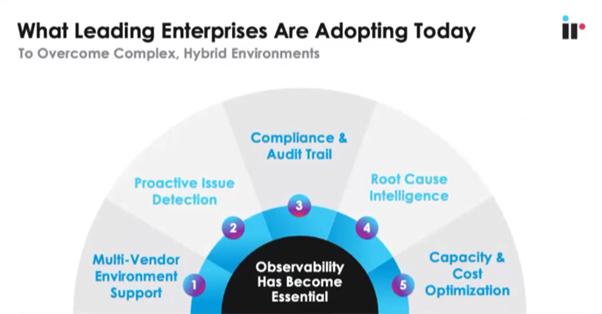
Observability is critical to:
-
Manage extreme system complexity
-
Reduce costly downtime and improve MTTR
-
Boost developer and IT Productivity
-
Create optimal impact on business outcomes
-
Drive innovation and AI-adoption
-
Optimize costs and increase efficiency
How Taiwan is fortifying its UC environment
The Taiwan Unified Communication (UC) market is projected to grow at a CAGR of 10.7% from 2025 to 2032, driven by technological advancements and the need for more secure, reliable communication.
By focusing on digital resilience, AI integration, and 5G expansion, hybrid work is growing through:
-
Integrating AI & cloud-based UC solutions
-
Upgrading and expanding network infrastructures
-
Strengthening digital resilience by exploring alternative connectivity
-
Enhancing cybersecurity and partnerships
-
Promoting industry-wide collaboration
As application reliability becomes critical to business in Taiwan, the focus is shifting from traditional, reactive monitoring to proactive, AI-driven observability.
Iris: The backbone of operational intelligence
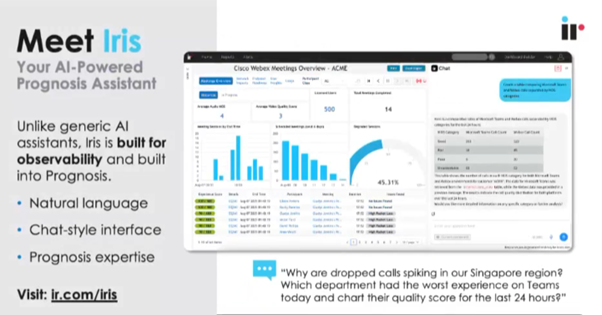
Iris is embedded in Prognosis as a true, real-time intelligence layer. It’s the only conversational AI built for multi-vendor UC&C observability – so you can ask, analyze, and act, all in one place.
Iris’s natural language interface and intelligence layer built right into our Collaborate solution suite.
It brings the depth of Prognosis data to everyone on your team, from IT to executives, through a simple chat-style experience. It can turn plain-language questions into live, actionable answers about your communications environment.
"What Iris allows you to do is actually just talk to the machine in natural language. For example, ‘Can you tell me the worst ten calls of the morning?’ And it will tell you, these are the worst ten calls in the morning based on A B C. It allows people of a lower skill level to just ask questions and get that result very quickly.”
- Michael Tomkins, CTO, IR
Why IT teams need the democratization of data
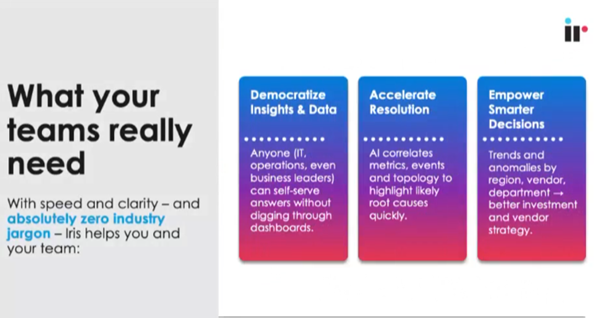
IT teams today urgently need to democratize insights and data to remain effective, and shift from being bottlenecked "gatekeepers" to strategic "enablers."
With the rapid pace of AI adoption, organizations are facing increasing pressure to move faster. The traditional, centralized model, where IT handles all data requests is a major liability that slows down decision-making and innovation.
Data democratization through AI-powered observability can:
-
Eliminate bottlenecks: Centralized data teams are often overwhelmed, leading to long queues for reports. Democratization allows business users to access and analyze data independently, reducing the "submit a ticket" bottleneck.
-
Accelerate AI/ML initiatives: AI models require constant, real-time data flow. Providing democratized access allows data scientists and IT to collaborate on AI projects more efficiently, rather than spending time on data preparation.
-
Shift IT's role: IT teams can move away from manual, repetitive data reporting and focus on high-value, strategic work like governance, infrastructure optimization, and security.
-
Improve agility & decisions: When operational, marketing, and product teams can access real-time insights, they can react to market changes faster rather than waiting for stale, batch-processed reports.
Key takeaways
-
Observability is critical: Traditional monitoring is no longer fit for purpose. End to end UC observability is absolutely essential for performance, visibility, control, and compliance.
-
From reactive to proactive operations: AI-powered systems correlate millions of events, allowing for automated, real-time identification of root causes for issues before they cause significant downtime.
-
The elimination of data silos: Vendor-specific tools create operational silos and inconsistent data formats, AI-driven observability breaks down these barriers, acting as a single source of truth to reduce troubleshooting time and optimize performance.
-
Regulatory and data compliance: Observability acts as the ‘control plane’ for digital operations, easing compliance and sovereignty pressures by transforming static regulatory requirements into real-time, auditable, and actionable insights.
-
Cloud migration: Cloud migration increases the need for observability because it transitions IT environments from static, predictable on-premises infrastructure to highly distributed, dynamic, and complex cloud-native architectures.
Find out more about how IR can help you uncover the next generation of observability.


.png?width=767&height=450&name=ivr-voice-testing-at-scale-tile%20(1).png)